Centralisation versus Décentralisation du Compute — Architectures Systémiques de l’IA
Topologie du Compute, Contrainte Énergétique et Fragmentation de la Puissance de l’IA
Navigation Systémique
Le système se déploie à travers trois niveaux :
Contrainte → Architecture → Souveraineté
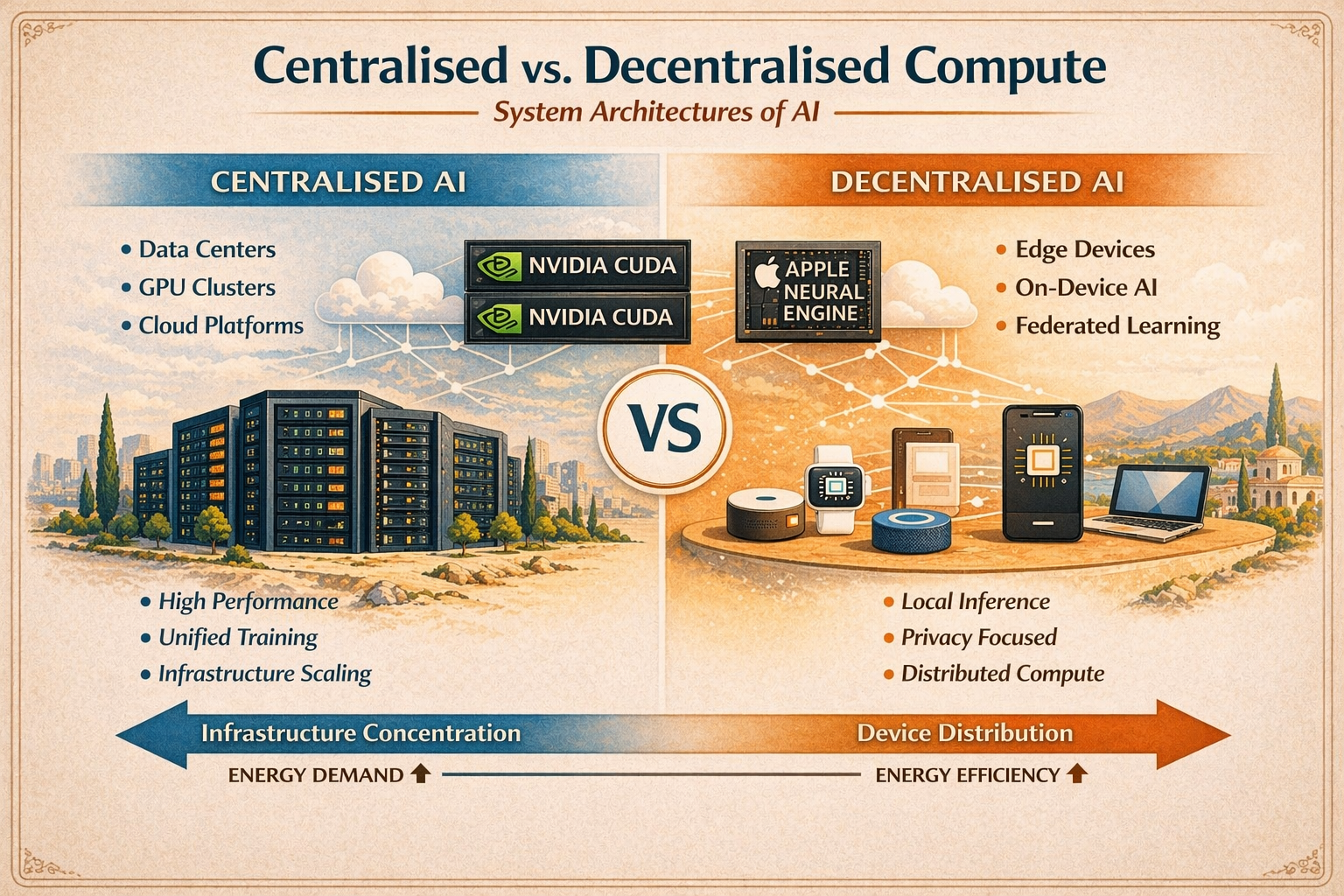
Centralised vs Decentralised Compute
Point Central — L’IA se Divise en Deux Architectures Systémiques
L’intelligence artificielle ne se développe plus à travers un modèle infrastructurel unique.
La couche de calcul diverge désormais vers deux architectures distinctes :
les systèmes de calcul centralisés
et
les systèmes de calcul décentralisés
Cette divergence n’est pas simplement technologique.
Elle est énergétique, infrastructurelle, géopolitique et systémique.
L’économie émergente de l’IA n’évolue donc pas vers une structure universelle du compute, mais vers un système stratifié et de plus en plus fragmenté, dans lequel différentes architectures optimisent différentes formes d’échelle, de résilience, d’allocation énergétique et de souveraineté.
Dans des conditions de capital abondant et d’énergie non contrainte, la centralisation apparaissait structurellement supérieure, car la concentration maximisait l’intensité computationnelle, l’échelle des modèles et l’efficacité de l’entraînement.
Sous contrainte énergétique, cependant, la logique de la mise à l’échelle se transforme.
À mesure que l’électricité, les infrastructures, le refroidissement, la stabilité des réseaux et les limites physiques de déploiement deviennent des contraintes structurelles, la distribution elle-même acquiert une valeur stratégique.
Le résultat est l’émergence d’un ordre computationnel dual.
Le Modèle de Compute Centralisé
L’Infrastructure comme Noyau de la Puissance de l’IA
La première architecture est le modèle d’infrastructure hyperscale.
Ce système concentre le compute dans d’immenses clusters d’infrastructures énergivores :
centres de données hyperscale
clusters GPU
infrastructures cloud
installations d’entraînement de l’IA
systèmes réseau intégrés
systèmes énergétiques à haute densité
Cette architecture est principalement portée par :
NVIDIA
les hyperscalers
les plateformes cloud
les laboratoires d’IA à grande échelle
Sa logique de mise à l’échelle est directe :
Concentrer le compute
→ maximiser les capacités des modèles
→ étendre l’échelle par l’expansion des infrastructures
Ce modèle domine :
l’entraînement des modèles frontier
les simulations à grande échelle
les systèmes fondamentaux d’IA
l’orchestration centralisée
les tâches computationnelles à forte intensité
Le modèle centralisé considère donc l’infrastructure elle-même comme la source première de la puissance de l’IA.
Le Modèle de Compute Décentralisé
La Distribution comme Architecture de Mise à l’Échelle
La seconde architecture distribue l’intelligence à travers les appareils au lieu de la concentrer dans des infrastructures hyperscale.
Ce modèle repose sur :
les appareils edge
l’inférence locale
l’IA embarquée
l’intégration au niveau du système d’exploitation
les réseaux de traitement distribués
les écosystèmes d’appareils
Au lieu de se développer par concentration infrastructurelle, les systèmes décentralisés se développent par prolifération.
Leur logique est fondamentalement différente :
Distribuer le compute
→ intégrer localement l’intelligence
→ étendre l’échelle par la distribution en réseau
Ce modèle est le plus visiblement associé à :
Apple
les écosystèmes d’edge AI
les systèmes de compute mobile
les architectures distribuées d’appareils
L’importance de cette architecture ne réside pas dans le fait qu’elle remplace les systèmes hyperscale.
Ce n’est pas le cas.
Son importance réside dans le fait qu’elle résout des problèmes différents sous des contraintes différentes.
Contrainte Énergétique — La Ligne de Division Structurelle
L’IA est Devenue Physique
La divergence entre ces architectures n’apparaît clairement que lorsque l’IA est comprise comme un système physique plutôt que comme un système purement numérique.
La mise à l’échelle de l’IA est désormais contrainte par :
la disponibilité de l’électricité
la stabilité des réseaux
les systèmes de refroidissement
les infrastructures de transmission
les chaînes d’approvisionnement en semi-conducteurs
la capacité physique de déploiement
C’est la logique fondamentale du :
Dans ce cadre, le compute n’est plus principalement limité par les capacités logicielles.
Il est limité par la capacité à soutenir une mise à l’échelle physique sous pression énergétique et infrastructurelle.
Les Systèmes Centralisés Sous Contrainte
Les systèmes d’IA centralisés nécessitent :
une demande électrique concentrée
un refroidissement à grande échelle
un accès ininterrompu aux réseaux
une forte densité infrastructurelle
des dépenses massives en capital
À mesure que l’IA se développe, ces systèmes rencontrent de plus en plus :
des goulets d’étranglement des réseaux
une volatilité des prix de l’énergie
des retards infrastructurels
des contraintes de transmission
des résistances politiques face aux expansions énergivores
La contrainte devient donc :
non pas de savoir si le compute peut croître,
mais si l’infrastructure concentrée peut croître suffisamment vite et à un coût soutenable
Cela transforme la géographie énergétique en déterminant stratégique de la puissance de l’IA.
Les Systèmes Décentralisés Sous Contrainte
Les systèmes décentralisés fonctionnent différemment.
Au lieu de concentrer la consommation énergétique dans des nœuds uniques d’infrastructure, ils distribuent le compute à travers des appareils déjà déployés.
Cela crée plusieurs avantages structurels :
une demande marginale d’infrastructure plus faible
une utilisation énergétique distribuée
une dépendance réduite aux réseaux de transmission
des capacités locales de traitement
une résilience par redondance
La logique de mise à l’échelle se déplace donc :
de la concentration infrastructurelle
vers :
la distribution infrastructurelle
Sous contrainte énergétique, cela devient de plus en plus stratégique.
La distribution ne maximise pas l’intensité computationnelle brute.
Mais elle améliore la résilience systémique.
Géographie du Compute et Souveraineté
L’Infrastructure de l’IA est Géographique
La couche de calcul devient de plus en plus inégale géographiquement.
Les systèmes centralisés d’IA se concentrent autour des régions capables de soutenir :
une production massive d’électricité
des réseaux stables
une disponibilité hydrique
des écosystèmes de semi-conducteurs
le financement d’infrastructures hyperscale
Cela favorise de plus en plus :
les États-Unis
certains États du Golfe
la Chine
des corridors limités d’Europe du Nord
L’infrastructure de l’IA suit donc la géographie énergétique.
Cela crée une asymétrie croissante entre les régions capables de soutenir une concentration du compute et celles qui en sont structurellement exclues.
La Position Structurelle de l’Europe
L’Europe fait face à une position particulièrement difficile dans cette transition.
Le continent conserve :
des capacités industrielles avancées
des capacités scientifiques
une influence réglementaire
une échelle de consommation
Mais il manque :
de domination hyperscale
d’abondance énergétique
d’infrastructures computationnelles intégrées
d’échelle cloud souveraine
de concentration dans les semi-conducteurs
Cela crée une vulnérabilité structurelle dans la course au compute centralisé.
L’Europe ne peut donc pas s’appuyer exclusivement sur l’imitation hyperscale.
Son avantage comparatif pourrait plutôt émerger à travers des architectures hybrides et distribuées.
La Méditerranée et l’Infrastructure Distribuée
La Distribution comme Opportunité Stratégique
La Méditerranée introduit une logique infrastructurelle différente dans la transition computationnelle.
Au lieu de concurrencer directement la concentration hyperscale, la région possède des avantages associés aux systèmes distribués :
géographie des câbles sous-marins
positionnement maritime
potentiel d’énergies renouvelables
production solaire distribuée
expansion des interconnexions
architectures de réseaux insulaires
déploiement d’infrastructures edge
connectivité logistique
Dans un paradigme computationnel décentralisé, ces caractéristiques deviennent stratégiquement significatives.
Cela est particulièrement pertinent pour :
la Grèce
l’Europe du Sud
les systèmes énergétiques distribués
la coordination du compute edge
le déploiement localisé de l’IA
les réseaux infrastructurels résilients
La question stratégique se déplace donc de :
« Qui possède les plus grands clusters hyperscale ? »
vers :
« Quels systèmes peuvent distribuer l’intelligence le plus efficacement sous contrainte physique ? »
Divergence Fonctionnelle — Pas de Logique Winner-Takes-All
Des Systèmes Différents pour des Fonctions Différentes
Les modèles centralisés et décentralisés ne sont pas mutuellement exclusifs.
Ils ne sont pas non plus des substituts directs.
Ils optimisent différentes couches de la stack de l’IA.
Les systèmes centralisés dominent :
l’entraînement des modèles frontier
l’agrégation massive du compute
les charges computationnelles à forte intensité
le développement des modèles fondamentaux
Les systèmes décentralisés dominent :
l’inférence edge
le traitement local
l’intelligence embarquée
la coordination autonome
la résilience distribuée
le déploiement en temps réel
Cela crée :
une divergence fonctionnelle plutôt qu’un remplacement total
Le système futur ne deviendra donc probablement ni totalement centralisé ni totalement distribué.
Il évolue vers une hybridation stratifiée.
Souveraineté Hybride des Infrastructures
L’Architecture Émergente de l’IA
La trajectoire de long terme pointe vers un système computationnel hybride :
entraînement centralisé
inférence décentralisée
coordination edge distribuée
intégration cloud-edge
intelligence locale opérant sur des fondations hyperscale
Cela crée une nouvelle architecture de souveraineté dans laquelle le contrôle n’émerge plus d’une seule couche infrastructurelle.
La puissance dépend de plus en plus de l’intégration :
des systèmes énergétiques
des infrastructures computationnelles
des systèmes d’exploitation
des écosystèmes de semi-conducteurs
de l’orchestration cloud
du déploiement edge
des écosystèmes de plateformes
des réseaux physiques
C’est la logique de :
Conclusion — La Topologie du Compute dans un Monde Sous Contrainte Énergétique
La transition de l’IA n’est plus simplement une révolution logicielle.
Elle constitue une réorganisation des infrastructures physiques, de l’allocation énergétique et de la puissance systémique.
La division fondamentale ne se situe pas simplement entre entreprises.
Elle oppose deux logiques différentes de mise à l’échelle :
la concentration
versus
la distribution
Les systèmes centralisés maximisent l’intensité computationnelle.
Les systèmes décentralisés maximisent la dispersion systémique et la résilience.
Dans des conditions d’abondance, la concentration domine.
Dans des conditions de contrainte, la distribution devient de plus en plus stratégique.
L’ordre futur de l’IA ne sera donc pas défini par une architecture unique.
Il sera défini par l’interaction entre :
la concentration hyperscale,
l’intelligence distribuée,
la géographie énergétique,
et les capacités infrastructurelles souveraines.