Global LNG Routes
Maritime Energy Flows and Europe’s Structural Exposure
Keynote
Liquefied Natural Gas (LNG) has become a central component of the global energy system. Unlike pipeline gas, LNG is maritime, flexible, and globally traded. This flexibility creates a structural implication: energy security becomes dependent on maritime routes. In an energy-bound system, LNG flows transform geography, logistics, and geopolitics into monetary and industrial outcomes.
System Position
This map sits within GLOBAL → Energy Geopolitics → Energy Flows. It complements Global Energy Flows and Trade Dependencies, Chokepoints Under Compression, and Peripheral Nodes in an Energy-Bound System.
I. Structure of LNG Flows
Global LNG flows connect three core zones. Exporters: United States, Qatar, Australia, Russia (partial). Maritime routes: Atlantic Basin, Pacific Basin, Middle East → Europe corridor. Importers: Europe and East Asia (Japan, Korea, China). LNG transforms gas into a globally mobile energy commodity.
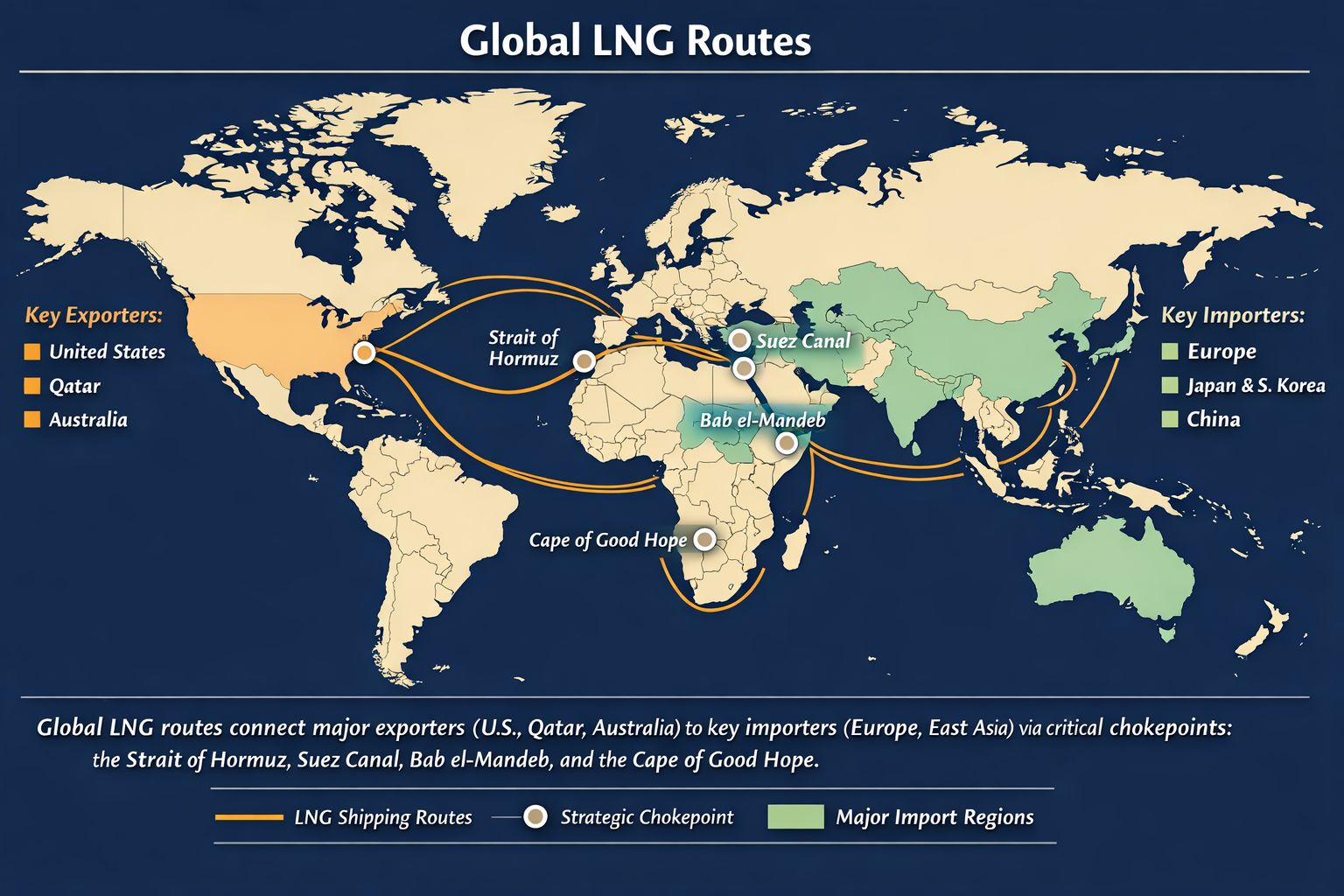
Global LNG routes connect energy surplus regions (U.S., Qatar, Australia) to major import systems (Europe, East Asia) through a small number of critical maritime chokepoints (Hormuz, Bab el-Mandeb, Suez). In an energy-bound system, these routes are not just logistical pathways but monetary transmission channels, linking geopolitical disruption to industrial costs, capital allocation, and currency dynamics.
II. Critical Maritime Routes
LNG flows depend on a limited number of corridors: Strait of Hormuz (Gulf to global markets), Bab el-Mandeb (Red Sea to Indian Ocean), Suez Canal (Asia/Middle East to Europe), and the Cape of Good Hope (alternative route). These routes form a continuous energy corridor from the Gulf to Europe.
III. Europe’s LNG Dependence
Following pipeline disruptions, Europe increased LNG imports, expanded regasification capacity, and shifted to maritime supply chains. This marks a structural shift: pipeline system → regional dependency; LNG system → global dependency. Europe becomes exposed to global price competition, maritime disruption, and geopolitical risk.
IV. Transmission Mechanism
LNG flows translate directly into economic conditions: LNG prices → import costs → electricity pricing → industrial competitiveness → capital allocation → monetary pressure. LNG routes therefore function as monetary transmission pathways.
V. Nodes Along LNG Routes
LNG concentrates at export terminals, regasification facilities, and port infrastructure. These form infrastructure nodes within global energy flows, connecting maritime energy to continental systems. Examples include US Gulf Coast terminals, Qatar export hubs, and European regasification nodes (Spain, Greece, Netherlands).
VI. System Vulnerability
Because LNG depends on maritime routes, disruptions propagate rapidly, rerouting increases costs, and volatility rises. Chokepoint disruption leads to longer routes, higher transport costs, and tighter supply, amplifying system-wide price instability.
VII. Link to Peripheral Nodes
LNG routes illustrate a broader principle: flows create corridors; corridors create nodes. Southern European entry points, including Greece, sit directly on these LNG transmission pathways. See Mediterranean Energy System and Greece as a System Node.
VIII. Strategic Implication
In an energy-bound system, maritime infrastructure becomes critical, energy security becomes logistical, and pricing becomes global. Power shifts toward exporters with surplus, nodes controlling entry and redistribution, and systems with resilient infrastructure.
Doctrinal Link
Energy Geopolitics and the Global Energy Paradigm Shift; Chokepoints Under Compression; Peripheral Nodes in an Energy-Bound System.
System Insight
LNG globalises gas. Globalisation increases flexibility; flexibility increases exposure. Maritime energy flows therefore become the transmission layer between geopolitics and monetary systems.
Conceptual Summary
Global LNG flows → maritime chokepoints → European entry nodes → cost transmission → industrial and monetary outcomes. LNG routes are not just logistics; they are the architecture of energy dependence in a global system.