Operating Systems and System Control
The Hidden Interface Between Compute and Sovereignty
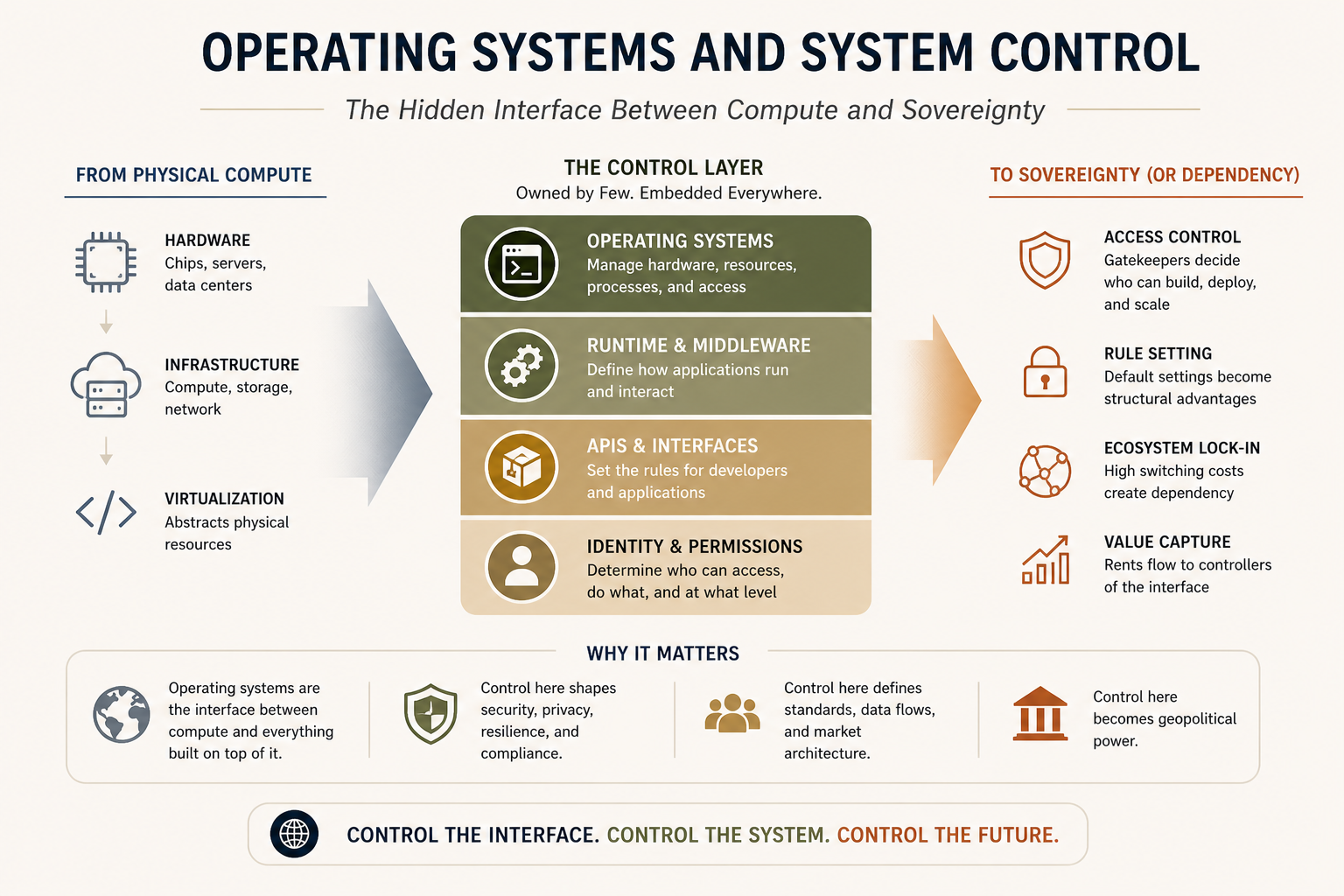
System Navigation
The stack propagates through hidden control layers:
Compute → Operating Systems → Standards → Platforms → Capital → Sovereignty
Operating Systems and System Control
Keynote
Operating systems are often treated as a technical layer.
They are more than that.
They are a control interface.
An operating system mediates between:
hardware and software
infrastructure and application
capability and coordination
access and restriction
This gives operating systems structural importance far beyond engineering.
In an energy-bound system, control does not begin only at the platform layer.
It begins lower.
It begins where compute is organised, where software environments are governed, and where technical dependency is normalised.
Operating systems are not neutral infrastructure.
They define how compute is used, who can build on it, and under whose rules digital capability scales.
Core Thesis
The operating system is the hidden governance layer of digital power.
It determines:
what applications can run
how hardware is accessed
how developers build
how ecosystems form
and how control can be enforced or decentralised
This is why operating systems matter strategically.
They are the interface through which raw compute becomes usable power.
Without control over the operating system layer, control over higher layers becomes conditional.
A system may possess:
chips
data centres
network access
or applications
Yet still remain structurally dependent if the software layer governing interaction, permissions, compatibility, and standards is controlled elsewhere.
System Position — Between Compute and Platforms
Within the system stack, the operating system sits between physical compute and platform power:
Energy → Industry → Compute → Operating Systems → Platforms → Standards → Capital → Sovereignty
This layer performs three functions simultaneously:
1. It translates hardware into usable capability
Compute without an operating environment is inert.
2. It structures software ecosystems
Developers do not build directly on silicon.
They build on controlled environments.
3. It governs access and dependency
Permissions, interfaces, updates, security models, app distribution, and interoperability all pass through this layer.
For this reason, operating systems are not simply technical tools.
They are coordination architectures.
Why the OS Layer Matters
The strategic significance of operating systems comes from their ability to shape:
ecosystem lock-in
developer dependence
security boundaries
hardware optimisation
update control
and standards adoption
This means the operating system layer helps determine whether a digital system is:
open or closed
interoperable or captive
resilient or externally dependent
sovereign or subordinate
The power of the OS layer is often invisible precisely because it is infrastructural.
Users see devices.
Firms see applications.
States see platforms.
But the operating system defines the rules of interaction underneath them all.
The Three Strategic Models
The contemporary system can be understood through three broad operating-system models.
1. Integrated Closed Control
This model is defined by vertical integration.
Hardware, operating system, application environment, distribution, and payments are tightly aligned within one governed ecosystem.
The strongest example is the Apple model.
Its power comes not from software alone, but from the alignment of:
silicon
device design
operating system
developer environment
app distribution
services
and user identity
This creates:
high performance
security coherence
ecosystem discipline
and durable user lock-in
But it also concentrates control.
In this model, the operating system becomes a strategic instrument for:
governing access
selecting participants
shaping margins
and extending control from hardware into services
The closed operating system is not merely a product.
It is an enforcement layer for ecosystem power.
2. Open-Core Infrastructure Control
This model appears more decentralised.
It is based on open software foundations, shared technical contributions, and broad adoption across infrastructure layers.
The clearest example is Linux.
Linux matters not because it dominates consumer imagination, but because it underpins much of global digital infrastructure:
servers
cloud environments
embedded systems
networking equipment
supercomputing
and large portions of AI compute infrastructure
Its strategic importance lies in a paradox:
Open systems can still underpin concentrated power.
Linux allows broad participation.
But the infrastructure built on top of it may still be dominated by hyperscalers, major cloud providers, semiconductor firms, or national systems with scale advantages.
This means open-source infrastructure does not automatically produce sovereignty.
It reduces some forms of dependency while leaving others intact.
Still, Linux demonstrates a crucial principle:
the OS layer can support distributed innovation
while also serving as the substrate for large-scale concentration
This makes it central to any serious discussion of digital sovereignty.
3. Controlled Adaptation and Forked Sovereignty
A third model uses open or semi-open operating-system foundations but adapts them into controlled national or corporate ecosystems.
This approach seeks partial autonomy without full technological independence.
It often involves:
forking open software
rebuilding interfaces
localising standards
restricting external dependencies
and aligning the software layer with national industrial goals
This model is especially relevant where states or regional blocs seek to reduce vulnerability to foreign platform power without reproducing the entire stack from scratch.
Its promise is strategic adaptation.
Its constraint is fragmentation.
Forked sovereignty can create room for autonomy, but it may also produce:
compatibility losses
weaker developer adoption
higher maintenance burdens
and reduced ecosystem scale
So the question is not whether forked systems are possible.
They are.
The question is whether they can sustain:
enough industrial depth
enough developer gravity
enough standards influence
and enough capital support
to remain viable over time.
Operating Systems as a Layer of Digital Sovereignty
Digital sovereignty is often discussed at the level of:
data
chips
cloud
AI
or regulation
But the operating system sits underneath all of them.
Without influence at this layer, sovereignty remains incomplete.
Why?
Because the OS governs the practical terms under which digital capacity is exercised.
This includes:
how workloads run
how software is secured
how applications are distributed
how hardware is optimised
and how systems interoperate
A country or region that controls neither platforms nor operating systems risks dependency at both ends of the digital hierarchy:
dependent below on foreign compute standards
dependent above on foreign ecosystem governance
This creates a structural squeeze.
Europe and the OS Problem
Europe’s digital weakness is often framed in terms of missing platforms or insufficient scale.
But the problem runs deeper.
Europe has limited native control over the core operating-system environments that mediate modern digital activity.
This matters because the continent is highly exposed to:
foreign cloud layers
foreign mobile ecosystems
foreign developer environments
and external software standards
As a result, Europe often participates in the digital economy through systems whose core coordination logic is governed elsewhere.
That weakens:
strategic autonomy
industrial leverage
developer retention
and the capacity to compound digital value internally
Europe can regulate.
It can fund.
It can sometimes build niche capability.
But without stronger positioning at the infrastructural software layer, much of its digital activity remains rule-taking rather than rule-setting.
The Linux Question
Linux complicates simplistic narratives of dependency.
It shows that open infrastructure can become globally foundational without being fully monopolised in the consumer sense.
But it also reveals the difference between use and control.
A region may use Linux widely.
That does not mean it shapes:
the key distributions
enterprise support layers
cloud orchestration environments
AI deployment stacks
or the industrial systems built above them
So Linux is strategically important for two reasons:
First
It proves that foundational digital layers do not have to be fully closed.
Second
It shows that openness alone does not dissolve asymmetry.
Power still accumulates where:
infrastructure is scaled
developer ecosystems concentrate
capital supports deployment
and complementary industries are strongest
Linux therefore belongs at the centre of stack analysis not as a symbolic alternative, but as a real example of how infrastructural openness and system concentration can coexist.
From Operating Systems to Platform Power
The OS layer does not replace platform analysis.
It explains it.
Platforms scale upward from operating environments that already structure:
permissions
interfaces
development pathways
optimisation
and user access
This is why platform power is rarely only about applications.
It is about owning the interface through which applications are made usable, discoverable, and governable.
Where operating systems are tightly integrated with hardware and services, platform power deepens.
Where operating systems are open but ecosystem layers concentrate, platform power still emerges—just through different mechanisms.
Either way, the OS layer is a strategic precursor.
Platforms are the visible surface.
Operating systems are the underlying control grammar.
Strategic Implications
The operating-system layer should be treated as part of system power analysis because it determines whether higher-level digital activity compounds locally or leaks outward.
This has implications for:
industrial policy
digital sovereignty
cloud dependence
platform regulation
and AI infrastructure strategy
A serious digital strategy must therefore ask:
Who governs the operating environments?
Who controls updates and permissions?
Who defines developer pathways?
Who captures ecosystem rents above the infrastructure layer?
Can domestic capability build on controlled foundations, or only within external rules?
These are not secondary questions.
They are system questions.
Control, Leverage, and Fracture
Because operating systems sit at a key interface layer, they are also a site of leverage and fracture.
Control at this layer can produce disproportionate effects by shaping:
exclusion
compatibility
optimisation
distribution
and ecosystem continuity
Likewise, weakness at this layer can propagate upward into:
weak platforms
fragile sovereignty
capital leakage
and strategic dependence
This makes the OS layer central to stack analysis.
It is one of the places where:
technical architecture becomes geopolitical architecture
Conclusion
Operating systems are not merely software environments.
They are hidden systems of control.
They shape how compute becomes usable, how ecosystems form, and how digital power is governed.
In an energy-bound system, this matters because digital sovereignty does not depend only on owning infrastructure or regulating platforms.
It depends on controlling the interfaces through which infrastructure, software, and power are connected.
The operating system is one of those interfaces.
And for that reason, it belongs not at the margins of strategic analysis, but near its centre.