Mediterranean Energy System
Energy Geography and Europe’s Monetary Exposure
Europe’s energy system is physically downstream from several maritime chokepoints linking the Persian Gulf and Eastern Mediterranean to the European market. Instability along these corridors therefore transmits directly into European energy prices, industrial costs, and ultimately monetary conditions.
This geography explains why disruptions in the Middle East propagate rapidly into European financial systems.
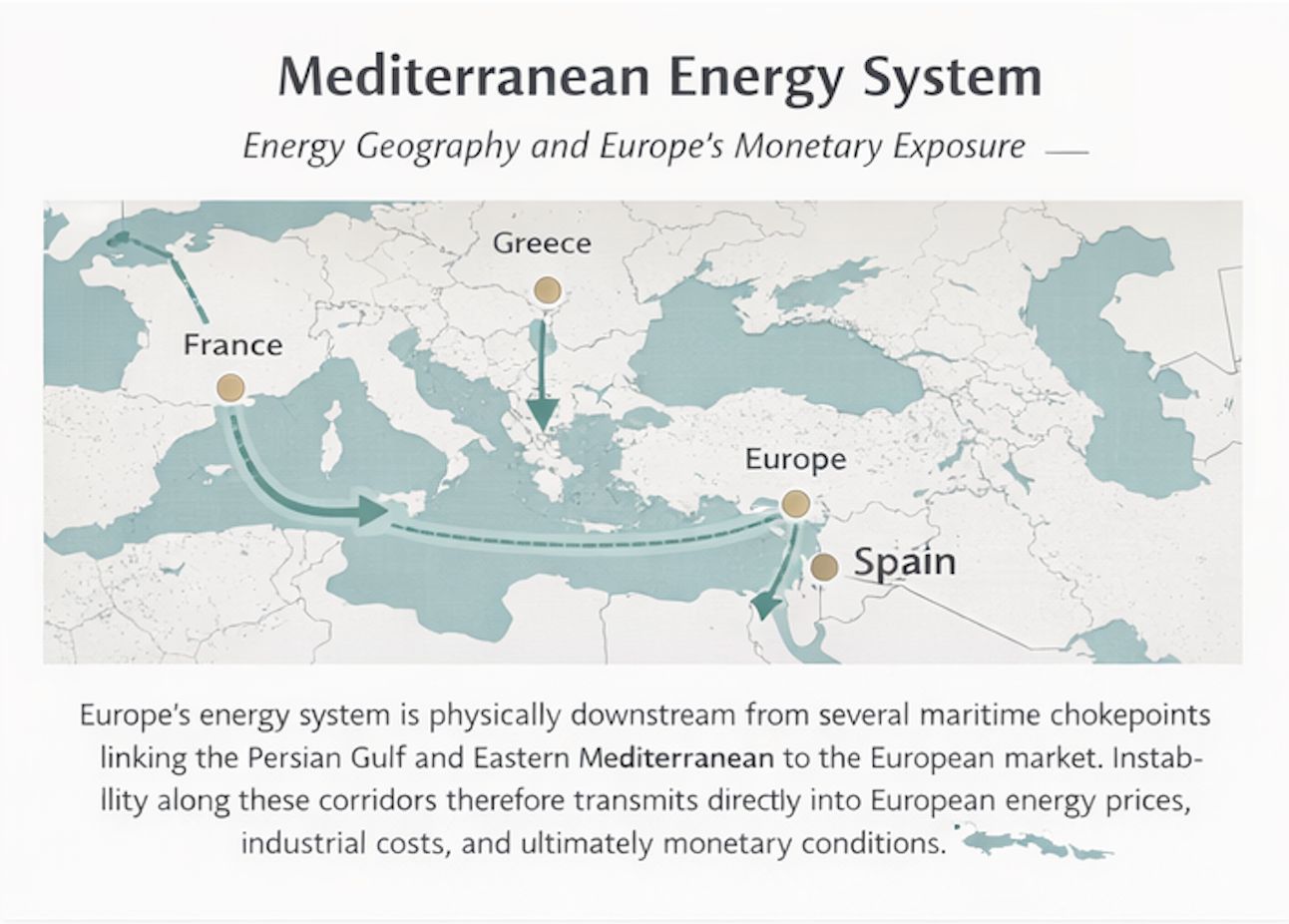
Global Energy Corridor
A significant portion of the energy supplying Europe travels through a continuous maritime corridor connecting the Persian Gulf to the Mediterranean basin.
Persian Gulf
↓
Strait of Hormuz
↓
Bab el-Mandeb
↓
Red Sea
↓
Suez Canal
↓
Eastern Mediterranean
↓
European energy network
This chain of maritime passages forms the physical backbone of Europe’s external energy supply.
Energy Sources
Major energy supply regions feeding this corridor include:
Persian Gulf
North Africa
Eastern Mediterranean gas fields
These production zones supply oil and LNG that travel through the maritime routes connecting the Middle East to European markets.
Strategic Chokepoints
Several narrow maritime passages concentrate this energy traffic:
Strait of Hormuz
Bab el-Mandeb
Suez Canal
Instability at any of these locations can disrupt shipping flows, increase insurance and freight costs, and introduce persistent price volatility into European energy markets.
European Entry Nodes
Energy entering the Mediterranean basin reaches Europe through several gateway states:
Greece
Italy
Spain
France
These countries function as distribution nodes connecting maritime energy routes with continental energy networks.
Structural Implication
Because Europe sits downstream from these corridors, external energy shocks propagate rapidly through the European economy. Shipping disruptions, risk premiums, and supply uncertainty translate into higher input costs for industry, tighter capital conditions, and increased pressure on monetary systems.
Energy geography therefore shapes Europe’s economic and financial exposure to global instability.
Cross-references
Mediterranean Energy–Compute Transition - system transformation
Mediterranean Energy–Compute Corridors - infrastructure layer