Energy Systems — Cross-Panel Index
Energy as the Operating System of Power

Keynote
Energy is not one domain among others.
It is the structuring variable of the system.
In an energy-bound world, energy determines:
cost structures
industrial competitiveness
compute scalability
monetary stability
geopolitical leverage
This page functions as the thematic entry point into the energy dimension of the site.
It connects the GLOBAL, TECHWAR, and EU SOVEREIGNTY panels through a single organising principle:
Energy defines the boundaries within which systems operate—and the hierarchy through which power is exercised.
Energy System Map — Full Stack

→ This map synthesises architecture, transmission, and system layers into a single operational view of power.
System Map — Energy-Bound Architecture of Power

→ This architecture underpins all panels: GLOBAL, TECHWAR, and EU SOVEREIGNTY
System Transmission Map — Energy, Capital, and Power
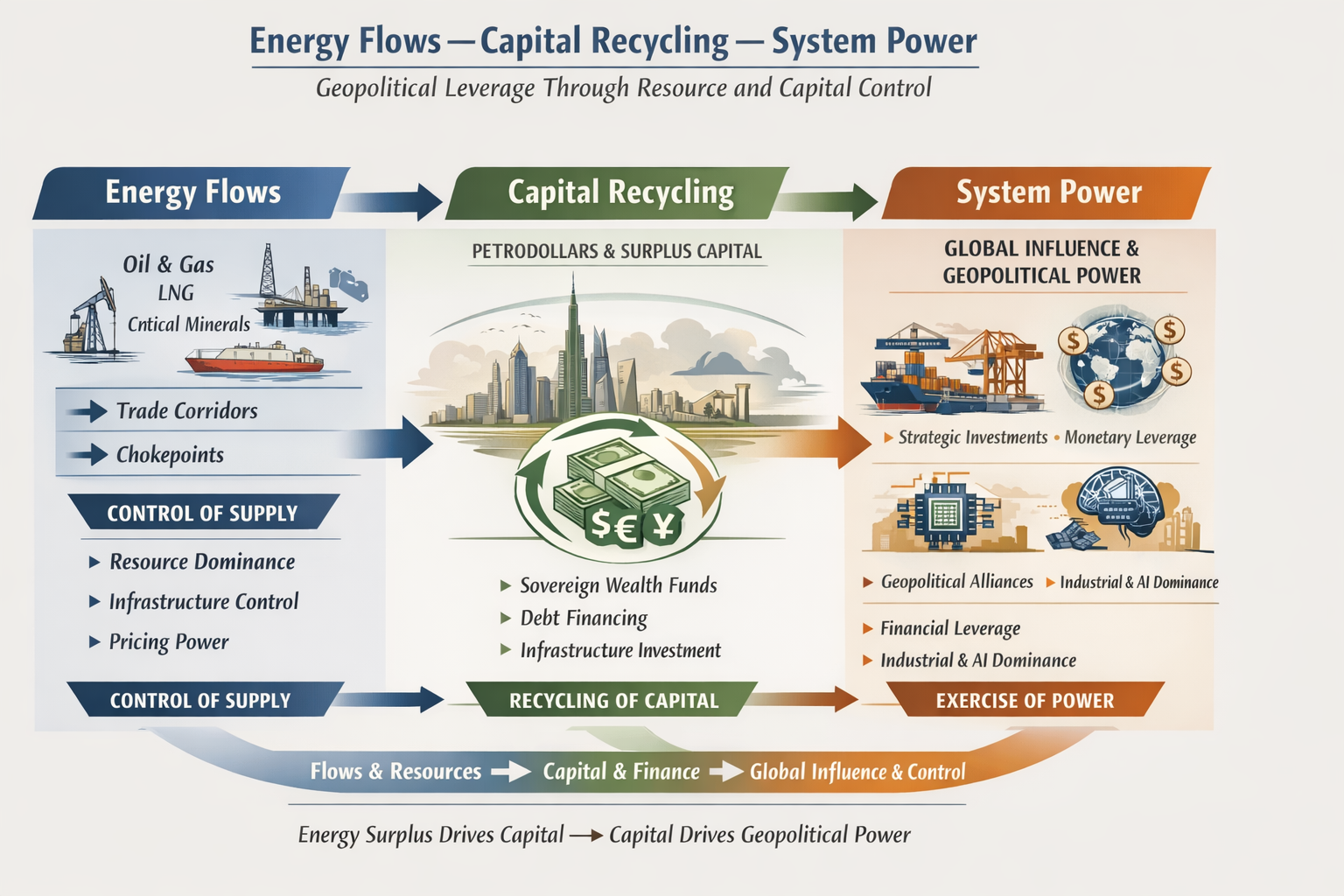
Energy surplus
→ capital accumulation
→ capital recycling (sovereign funds, financial markets,
infrastructure)
→ geopolitical leverage
→ This loop explains how energy advantage is converted into financial, technological, and geopolitical power
System Layers — Decomposition of Power
→ The system can be analysed across interacting layers:
Energy systems (generation, grids, cost structure)
Industrial systems (manufacturing depth, electrification, deployment scale)
Compute systems (AI infrastructure, semiconductor efficiency, data centres)
Capital systems (financial markets, sovereign allocation, investment capacity)
Governance systems (state capacity, regulation, security alignment)
I. Foundational Doctrine (GLOBAL)
Core System Logic
System Foundations Expansion (NEW — important addition)
II. System Dynamics (GLOBAL → TECHWAR)
→ How energy interacts with industry, compute, and system competition
AI–Energy–Cost Chasm
→ divergence in cost structures across systemsElectrostate Deployment and Industrial Scale
→ electrification + industrial capacity as structural advantageAI, Energy Constraint, and Compute Infrastructure
→ compute as an energy-limited systemSystem Stack Architecture (Applied)
→ interaction between layers in practice
III. System Competition (TECHWAR)
→ Where energy becomes technological and industrial power
IV. System Constraint (EU SOVEREIGNTY)
→ How energy structure constrains sovereignty, industry, and capital
V. Investor & Capital Allocation Layer
→ Translating system structure into capital allocation logic
VI. System Extensions (Optional / Emerging)
→ Expanding the system beyond core OECD architectures
Closing Frame
Energy is not simply a sector.
It is the operating system of power.
Industrial capacity, compute infrastructure, capital allocation, and geopolitical influence all emerge from—and are constrained by—the structure of energy systems.
Energy sets the cost base.
Cost shapes industry.
Industry determines capital.
Capital underpins power.