FOUNDATIONS
Why AI Has Become Physical
Keynote
Technological competition is no longer primarily a contest of software, innovation, or intellectual property.
It is increasingly a contest of physical systems.
Artificial intelligence, semiconductors, cloud infrastructure, industrial automation, logistics networks, and digital platforms all depend upon energy systems, industrial capacity, compute infrastructure, and capital formation.
As a result, technology can no longer be analysed independently of the physical systems that sustain it.
The central argument of this section is simple:
AI has become physical.
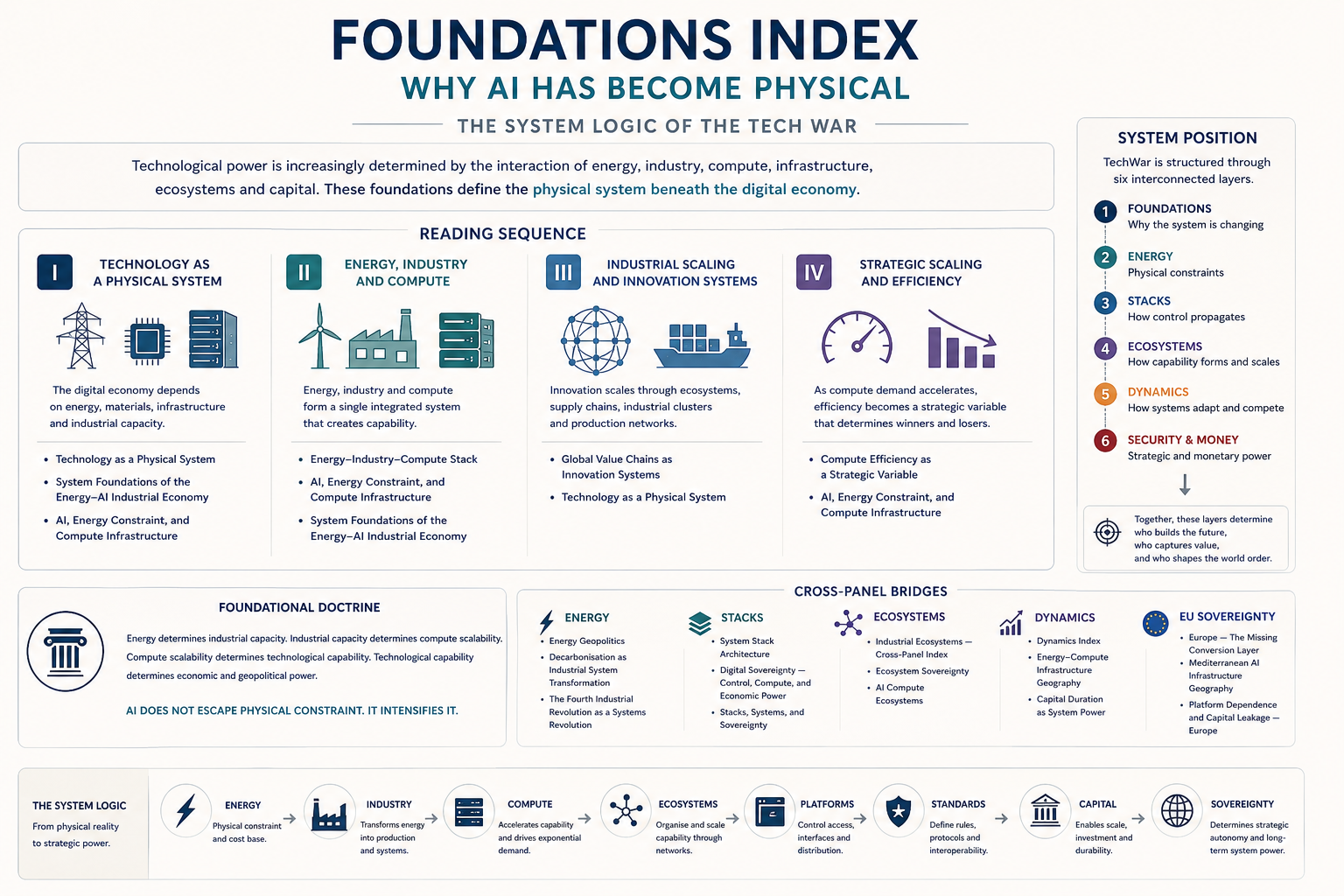
The emerging technological order is increasingly structured by the interaction of energy, industry, compute, infrastructure, ecosystems, and capital.
These foundations establish the system logic upon which the rest of the TechWar panel is built.
They are not downstream outcomes.
They are the conditions that determine what outcomes become possible.
System Position
The TechWar panel can be understood through six interconnected layers:
FOUNDATIONS
Why the system is changing.
STACKS
How control propagates.
ECOSYSTEMS
How capability forms and scales.
DYNAMICS
How systems adapt and compete.
SECURITY
How strategic competition manifests.
MONEY
How technological power translates into monetary power.
This section sits at the base of that architecture.
It explains the structural transition driving the entire system.
Reading Sequence
I. Technology as a Physical System
The digital economy increasingly depends upon physical infrastructure.
Energy systems, semiconductors, industrial capacity, logistics networks, and compute infrastructure define the limits of technological power.
II. Energy, Industry, and Compute
The foundational architecture through which capability is created.
These analyses explain how energy systems, industrial production, and compute infrastructure increasingly function as a single integrated system.
III. Industrial Scaling and Innovation Systems
Innovation does not scale through isolated firms.
It scales through ecosystems, supply chains, industrial clusters, and production networks.
IV. Strategic Scaling and Efficiency
As compute demand accelerates, efficiency becomes a strategic variable rather than a technical optimisation problem.
The systems that convert energy into compute most effectively gain disproportionate advantages.
Related Foundational Reading
Global Paradigm Shift
System Architecture
Constraint and Scale
Cross-Panel Bridges
ENERGY
The physical foundations of technological competition.
STACKS
How technological control propagates.
ECOSYSTEMS
How capability forms and scales.
DYNAMICS
How systems adapt under pressure.
EU SOVEREIGNTY
Applied outcomes of the AI-energy transition.
Foundational Doctrine
The analyses in this section share a common assumption:
Technological power is increasingly determined by the interaction of energy systems, industrial capacity, compute infrastructure, ecosystems, and capital formation.
Artificial intelligence does not escape physical constraint.
It intensifies it.
The systems that can align energy, infrastructure, industry, compute, ecosystems, and capital most effectively will increasingly determine the future distribution of technological, economic, and geopolitical power.
Position in the Project
This section explains why the system is changing.
GLOBAL explains the paradigm shift.
FOUNDATIONS explain the physical architecture emerging from that shift.
STACKS explain how control propagates through that architecture.
ECOSYSTEMS explain how capability forms.
DYNAMICS explain how systems compete and adapt.
SECURITY and MONEY examine the strategic consequences.
Together they form a single analytical framework for understanding technological power in an energy-bound world.
Scope
This section focuses on:
AI as physical infrastructure
energy–industry–compute integration
industrial scaling systems
compute efficiency
infrastructure sovereignty
physical constraints
ecosystem formation
technological capability
strategic scale
Its purpose is to explain the foundational system logic that underpins the modern TechWar.