Mediterranean Guide to the System
Energy, Infrastructure, Compute, and Capital in an Energy-Bound Europe
Purpose
This guide provides a structured reading of the system from a Mediterranean perspective.
It connects energy systems, infrastructure, compute capacity, technological ecosystems, and capital allocation into a single analytical framework.
It is not a sitemap.
It is a system map operating under constraint and oriented toward conversion.
System Assertion
The Mediterranean is not a region within Europe.
It is the system interface through which Europe connects to energy, infrastructure, and emerging compute systems.
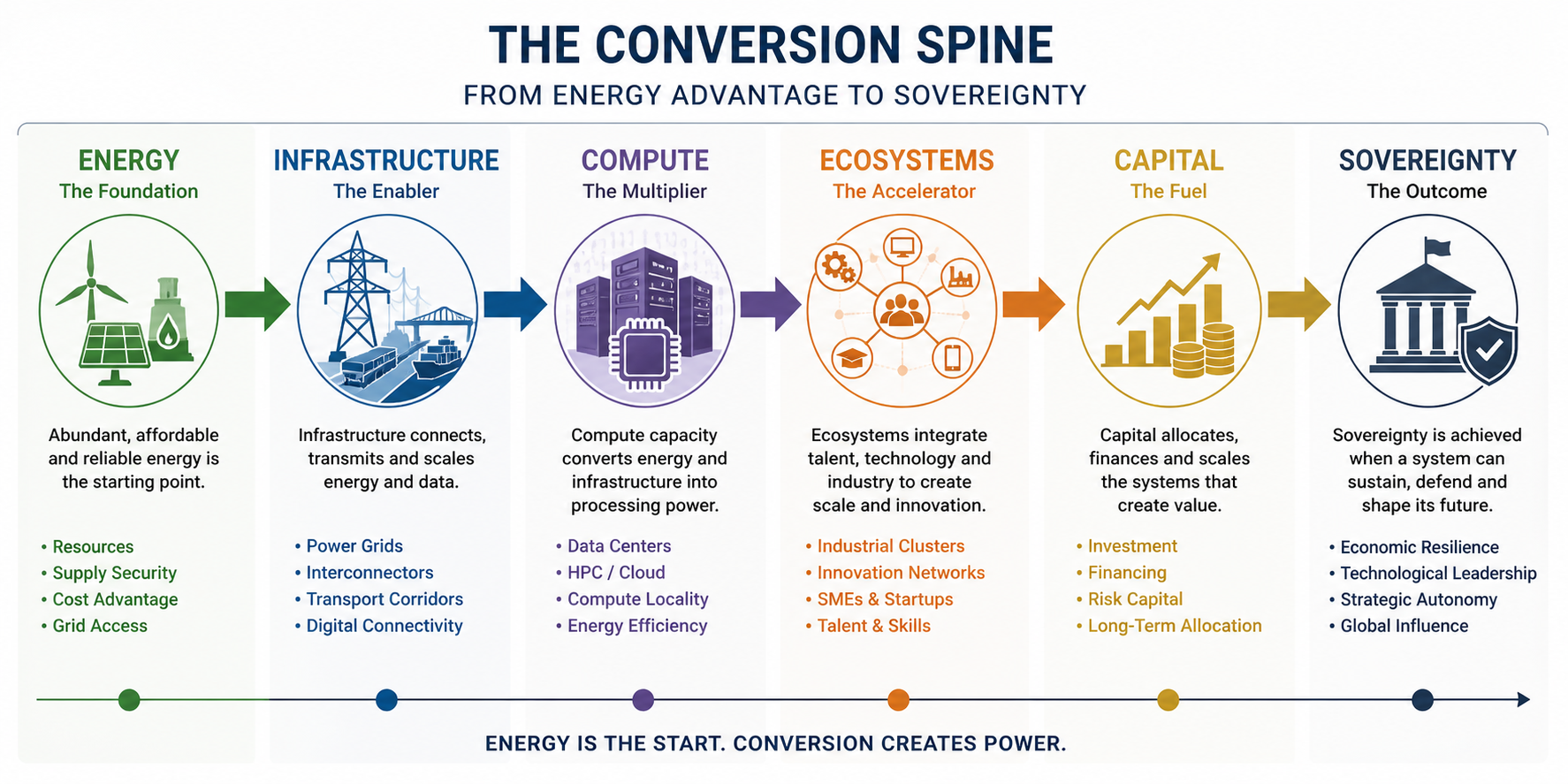
Energy → Infrastructure → Compute → Ecosystems → Capital → Sovereignty
Its strategic role is not defined by constraint alone.
It is defined by its capacity to convert energy advantage into technological capability, industrial capacity, and capital power.
Hybrid Infrastructure Sovereignty
The emerging European system is increasingly organised around hybrid infrastructure architectures combining:
- centralized energy systems,
- distributed renewable generation,
- compute infrastructure,
- industrial ecosystems,
- digital coordination,
- and regional transmission networks.
Within an Energy-Bound System, sovereignty increasingly depends upon the capacity to coordinate these layers into resilient infrastructure architectures capable of sustaining industrial, computational, and geopolitical continuity under conditions of constraint.
→ Hybrid Infrastructure Sovereignty
How This System Must Be Read
The Mediterranean system resolves through five interacting layers:
Constraint → Architecture → Evidence → Allocation → Conversion
Constraint (Diagnostics) — the structural limits of the system
Architecture (System Structure) — the organisation of energy, infrastructure, and compute
Evidence (Transmission) — how constraint and advantage propagate through the system
Allocation (Investor Layer) — how value is distributed, captured, or lost
Conversion (Technology, Ecosystems, and Coordination) — how energy advantage is transformed into compute capacity, industrial capability, and capital power
This is not a static condition.
It is a conversion problem operating under structural constraint and increasing time pressure.
Full System Navigation
For the full system structure across GLOBAL, TECHWAR, and EU SOVEREIGNTY:
→ Mediterranean System Navigation
System Transmission Map — Mediterranean Flows
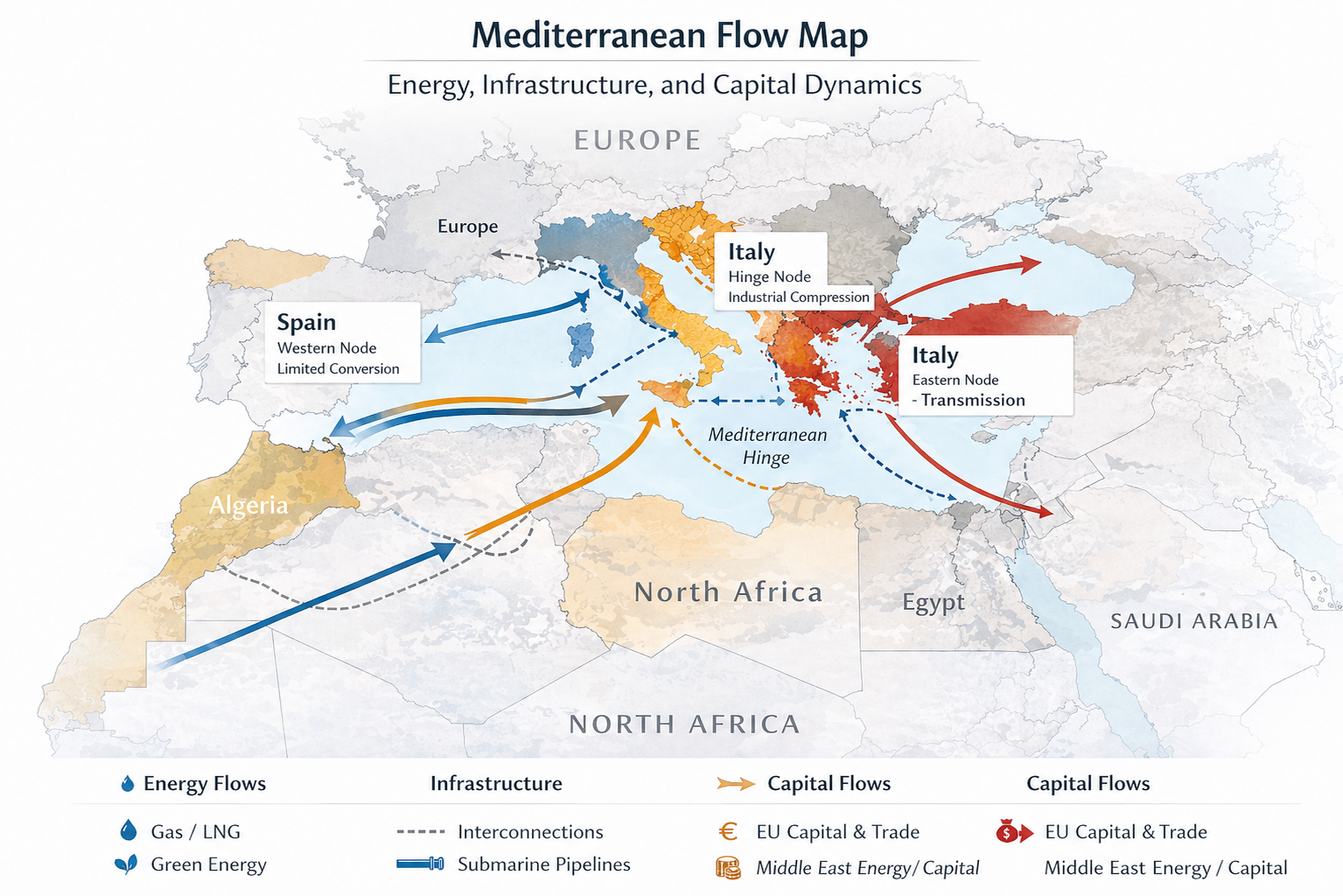
The Mediterranean system is defined by flows:
– energy enters from the south and east
– infrastructure channels movement across nodes
– compute concentrates where energy is stable, abundant, and structurally competitive
– capital circulates but does not consolidate→ The region connects systems but does not fully capture value.
System Architecture — Interface Without Consolidation
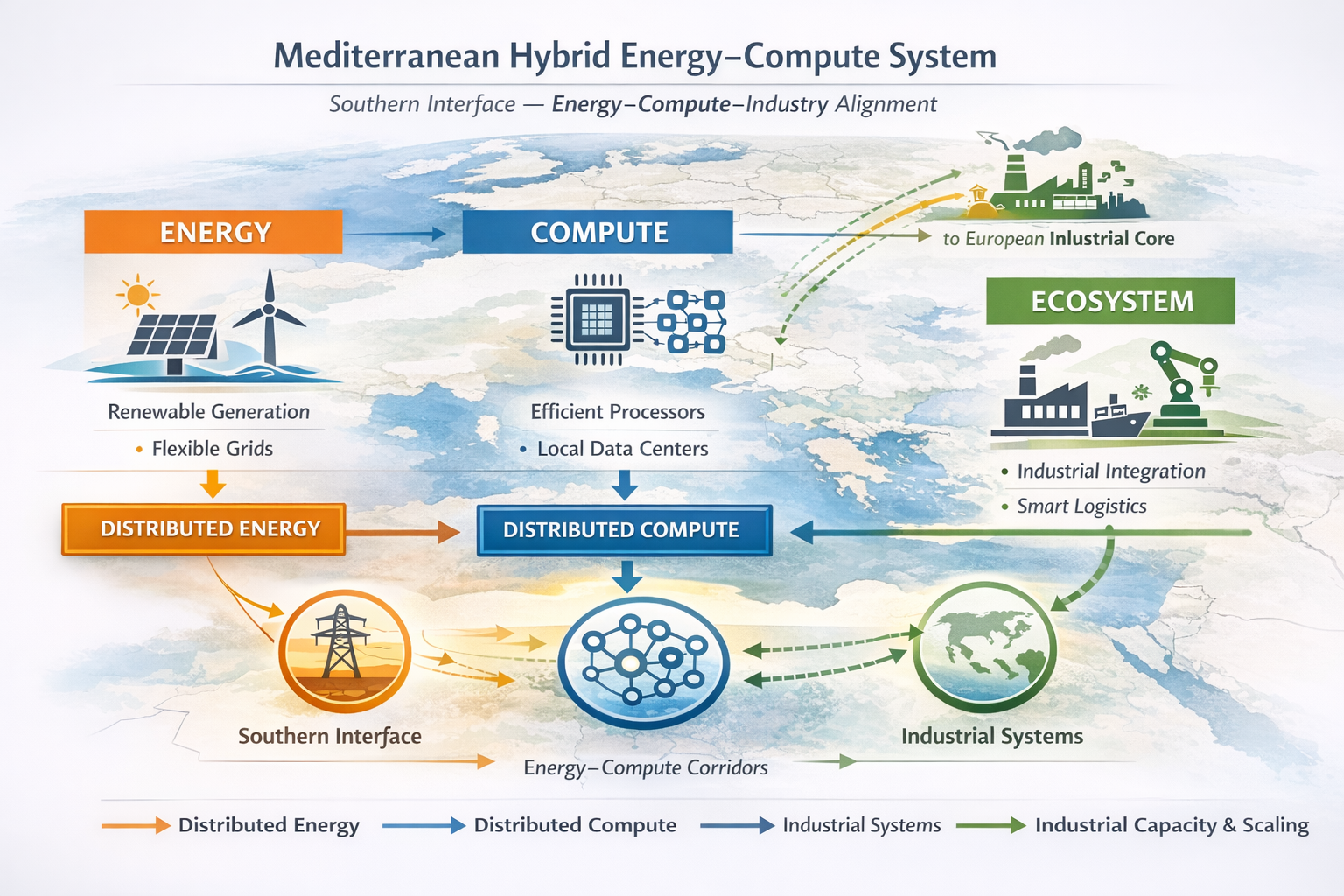
The Mediterranean is a convergence zone:
Energy systems, infrastructure corridors, logistics routes, and compute infrastructure intersect within this space.
The strategic question is not access alone.
It is whether access can be converted into system control.
Mediterranean Country Interface Layer
The Mediterranean system does not operate through uniform national structures.
Each country occupies a different position within the wider energy–infrastructure–compute system.
Some function primarily as:
energy gateways
industrial processors
logistics corridors
infrastructure nodes
maritime interfaces
compute transition zones
capital absorption layers
conversion platforms
The Mediterranean should therefore be read as a differentiated system architecture rather than a homogeneous regional bloc.
The following country pages examine how structural position, infrastructure density, industrial capacity, energy exposure, and capital allocation interact within the Mediterranean system.
National System Entry Layers
→ Italy — Industrial Sovereignty Under Constraint
→ Spain — Energy Advantage Without System Power
→ Greece — Energy, Capital, and Sovereignty Under Constraint
→ France — Nuclear Continuity and Hybrid Infrastructure Sovereignty
Mediterranean System Structure Layer
→ Mediterranean System Architecture — Western, Eastern, and Hinge Nodes
The geographic and infrastructural organisation of the Mediterranean interface.
→ Mediterranean System Role Matrix
Functional differentiation across energy, infrastructure, logistics, compute, and industrial layers.
→ Europe — The Missing Conversion Layer Why Europe does not yet fully convert Mediterranean energy, infrastructure, and industrial potential into consolidated system power.
Evidence and Allocation Layer
→ Mediterranean — Flow vs Capture
How energy, infrastructure, and capital move through the Mediterranean system—and why value capture remains incomplete.
→ Mediterranean — System Opportunity vs Structural Leakage
The divergence between strategic positioning and retained economic power.
→ Mediterranean Energy–Compute Investment Platform (MECIP)
A proposed infrastructure and capital coordination architecture for Mediterranean-scale system integration.
System Orientation
This guide introduces the Mediterranean as a system interface within an Energy-Bound System.
It does not attempt to provide exhaustive system coverage.
The system must be read across three interacting dimensions:
– Energy and infrastructure flows (GLOBAL / EU
SOVEREIGNTY)
– Compute, stacks, and ecosystems (TECHWAR)
– Capital allocation and system capture (EU SOVEREIGNTY
— Investor layer)
The Mediterranean does not lack energy.
It lacks alignment across system layers.
Energy enters.
Infrastructure connects.
Compute scales where systems align.
Industry processes.
Capital accumulates only where conversion is achieved.
When these layers are not aligned,
value flows but is not captured.
Final Principle
Energy defines system potential.
Conversion determines whether that potential becomes power.
Execution Path
For full system structure and cross-panel navigation:
→ Mediterranean System Navigation