Italy — Industrial Sovereignty Under Constraint
Energy, Industry, Infrastructure, Compute, and Capital in an Energy-Bound Europe
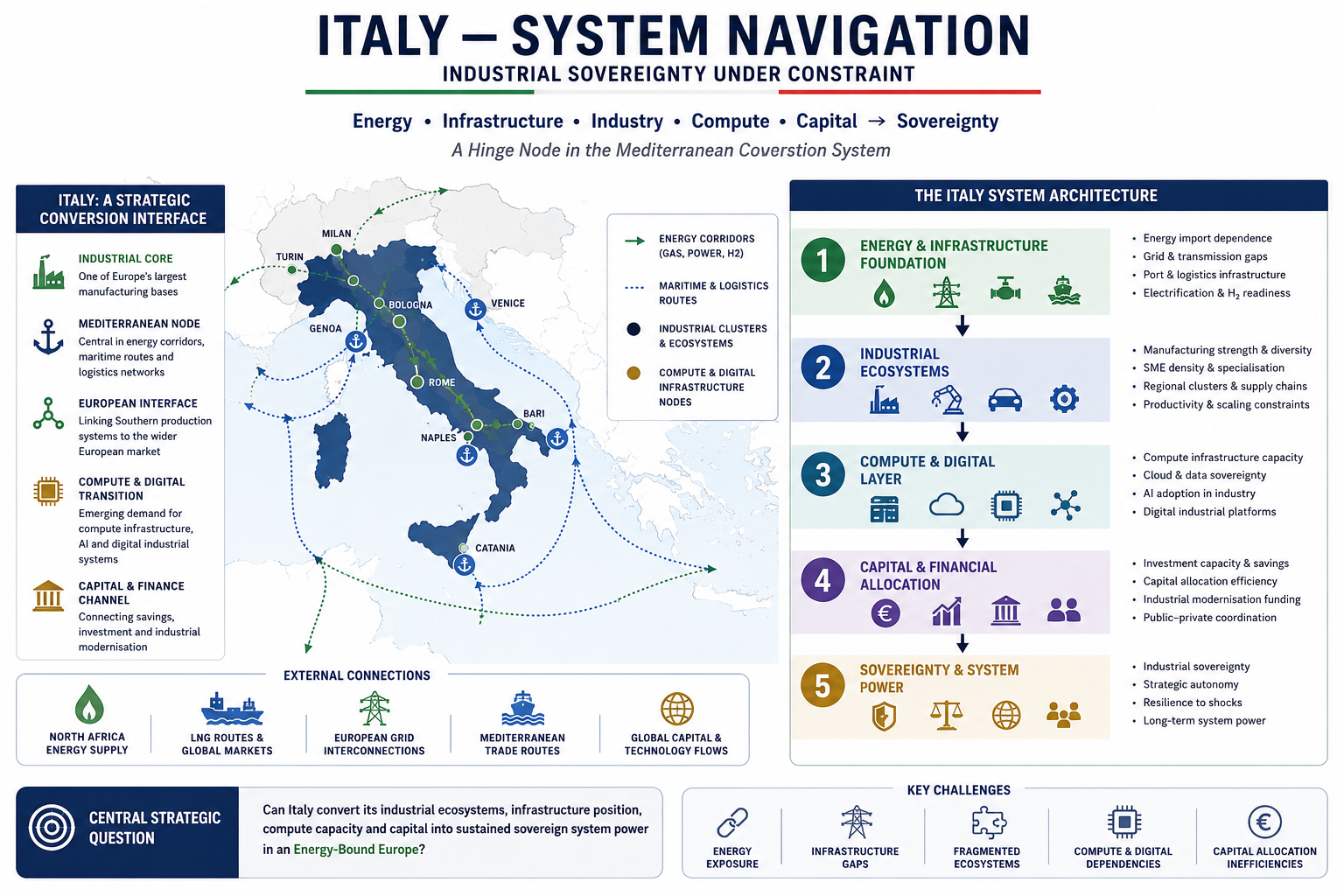
Purpose
This guide provides the operational reading layer for Italy within the wider Mediterranean and European system.
It connects:
energy systems
industrial ecosystems
infrastructure
compute capacity
digital systems
capital allocation
and sovereignty dynamics
into a single strategic framework.
Italy should not be understood as a peripheral or structurally irrelevant economy.
It should be understood as:
a major industrial and infrastructural system operating under growing energy, conversion, and technological constraint inside an Energy-Bound Europe.
System Position
Italy occupies a structurally distinct position within the European system.
It combines:
one of Europe’s largest manufacturing bases,
dense industrial ecosystems,
export-oriented production,
strategic logistics infrastructure,
regional industrial clustering,
high energy exposure,
fragmented productive coordination,
and incomplete infrastructure modernisation.
This makes Italy one of the clearest examples of how advanced industrial systems behave under conditions of structural energy constraint.
The Italian case therefore reveals a broader European problem:
industrial capacity alone is no longer sufficient.
Industrial resilience increasingly depends on the capacity to align:
energy → infrastructure → compute → ecosystems → capital → sovereignty
within an increasingly constrained global system.
Industrial competitiveness now depends not only on manufacturing capability, but also on the ability to support:
compute-intensive infrastructure,
AI-enabled industrial systems,
digital coordination layers,
logistics integration,
electrification,
and long-term infrastructure scaling.
This shifts industrial sovereignty beyond production alone.
Industrial sovereignty increasingly depends on control over the infrastructural, computational, and technological systems through which production itself is organised.
Italy Inside the Mediterranean System
Italy should not be understood solely through a national framework.
Italy operates simultaneously as:
a European industrial core,
a Mediterranean infrastructure node,
and a strategic conversion interface between energy systems, industrial capacity, infrastructure corridors, compute expansion, and capital flows.
Its strategic importance therefore lies not only in industrial scale, but in systemic position.
Italy sits at the intersection of:
Mediterranean energy corridors,
European manufacturing systems,
maritime infrastructure,
industrial logistics,
electrification requirements,
AI-driven industrial transition,
and emerging compute-infrastructure demand.
This makes Italy one of the key hinge systems within the wider Mediterranean architecture.
The central strategic question is therefore no longer whether Italy possesses industrial capacity.
The question is whether Italy can successfully convert:
infrastructure, energy access, industrial ecosystems, compute capacity, and capital allocation
into retained long-term system power under conditions of growing global constraint.
How the Italy System Should Be Read
The Italian system unfolds across five interacting layers:
Constraint → Infrastructure → Industry → Compute → Capital
These layers should not be understood separately.
They function as a single transmission architecture operating across:
energy systems,
industrial ecosystems,
logistics networks,
digital infrastructure,
technological scaling,
and sovereign capacity.
Core Diagnostic Layer
These articles define Italy’s systemic position within the wider Mediterranean and European structure.
→ Italy — Industrial Capacity Under Energy Constraint
Primary diagnostic of Italy as an advanced industrial system operating under structural energy and infrastructure constraint.
→ Europe — The Missing Conversion Layer
Explains why Europe does not yet fully convert Mediterranean energy, infrastructure, industrial capacity, and capital into retained strategic power.
→ Mediterranean — From Constraint to System Power
Defines the wider Mediterranean conversion framework within which Italy operates.
Industrial and Technological Structure Layer
These articles explain the structural composition of the Italian industrial system and its relationship to technological power.
→ Italy — Industrial Structure Deep Dive
Examines industrial density, fragmentation, regional asymmetry, productive resilience, infrastructure bottlenecks, and scaling limitations inside the Italian economy.
→ Energy–Industry–Compute Stack
Defines the structural relationship between energy systems, industrial capacity, compute infrastructure, AI scaling, and sovereignty.
→ Industrial Ecosystems and Technological Power
Explains why ecosystem density, industrial coordination, and technological integration increasingly determine sovereign and industrial capability.
Explains why compute infrastructure increasingly follows energy availability, infrastructure density, and system-scale coordination capacity.
Infrastructure and Evidence Layer
These articles validate how energy, infrastructure, and capital constraints propagate through the Italian system.
→ Italy — Energy–Industrial Transmission Under Constraint
Maps how energy-price transmission affects industrial competitiveness, manufacturing compression, and productive capacity.
→ Mediterranean — Flow vs Capture
Explains why infrastructure flows, energy corridors, and capital exposure do not automatically convert into retained strategic power.
→ Energy Shock Transmission Chain
Defines the transmission architecture linking energy shocks to industrial instability, monetary stress, capital pressure, and sovereign constraint.
Investment and Allocation Layer
These articles examine how infrastructure transition and capital allocation interact with industrial compression inside constrained systems.
→ Italy — Industrial Compression and Capital Allocation
Examines investment positioning within a constrained industrial environment undergoing infrastructure, electrification, and technological transition.
→ Mediterranean Energy–Compute Investment Platform (MECIP)
Defines a regional architecture for converting capital into energy systems, infrastructure integration, compute capacity, and productive coordination.
→ Mediterranean — System Opportunity vs Structural Leakage
Explains the difference between infrastructure exposure and retained conversion capacity within the Mediterranean system.
Strategic Conclusion
Italy represents one of the most important systemic test cases inside Europe.
It demonstrates:
how advanced industrial systems respond to energy constraint,
how infrastructure bottlenecks compress industrial scaling,
how fragmented capital allocation weakens long-term conversion,
how industrial ecosystems struggle under rising energy and compute demands,
and why sovereignty increasingly depends on integrated energy–infrastructure–compute architectures.
Italy therefore matters not only for Italy itself.
It matters because it reveals the structural pressures increasingly confronting industrial Europe as a whole.
Under conditions of accelerating AI expansion, infrastructure competition, energy transition, and geopolitical fragmentation, Italy becomes more than an industrial economy.
It becomes a strategic test case for whether Europe can successfully convert:
energy, infrastructure, industry, compute, ecosystems, and capital
into durable sovereign system capacity.