Global System Power — Comparative Architecture (G2 Framework)
Energy, Industry, Capital, and Control in an Energy-Bound World
>[!IMPORTANT]
> Key information users need to know to achieve their goal.
>
Framework → Diagnostics
This page first defines the structure of global system power,
then validates it through empirical energy, industrial, and cost
dynamics.
Keynote
The global system is not defined by symmetry.
It is structured by asymmetry across system architectures.
In an Energy-Bound System, power does not emerge
from isolated strengths.
It emerges from the ability to align and integrate:
energy systems
industrial capacity
capital allocation
technological infrastructure
and security architecture
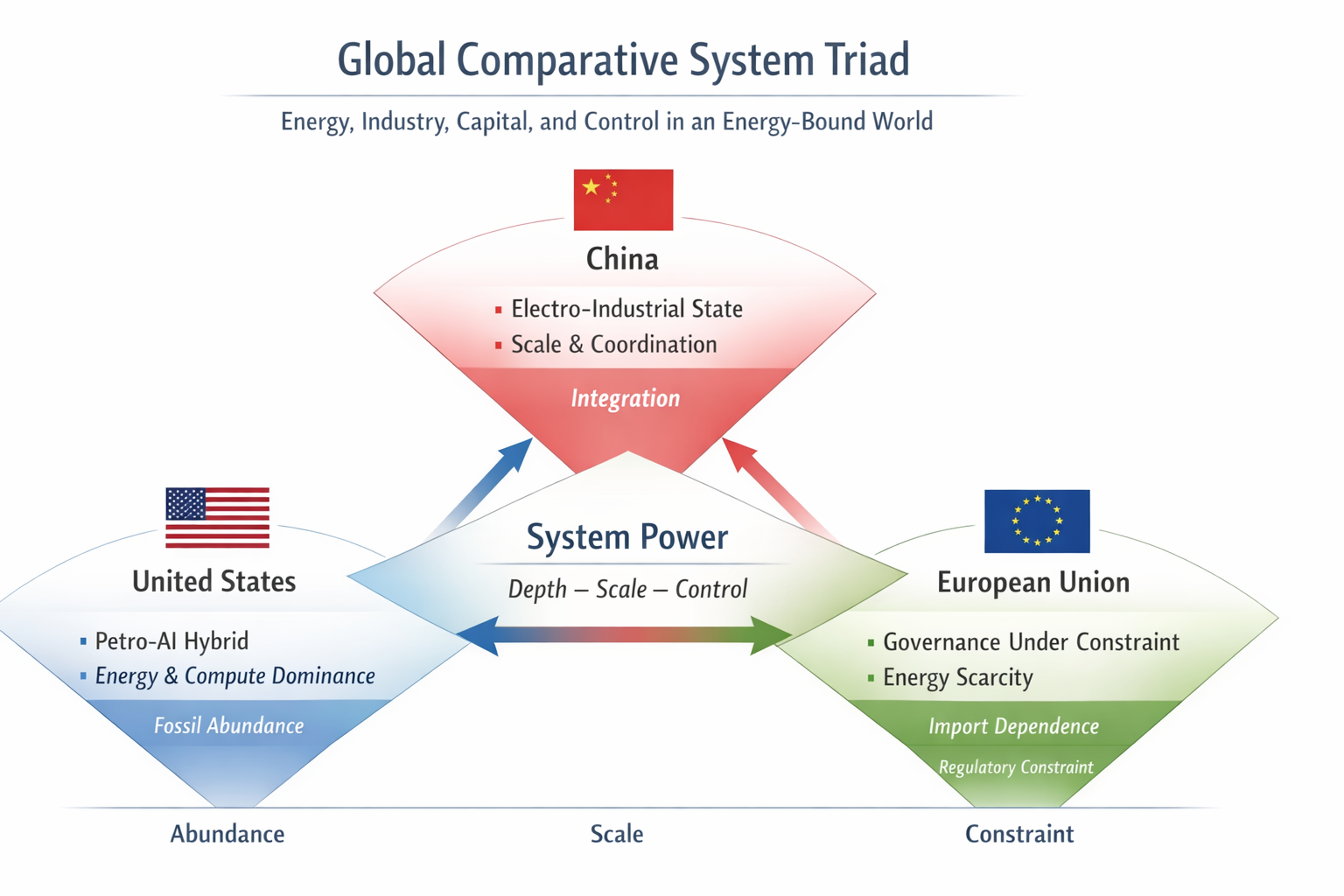
Three dominant configurations define the system:
United States — Integrated System Power
China — Industrial-Scale System Coordination
Europe — Constrained and Fragmented System
These are not variations of the same model.
They are distinct system architectures.
System Navigation
This synthesis connects:
→ Energy-Bound
System
→ The United
States: Energy Abundance and System Power
→ China Industrial
System
→ European Sovereignty
I. System Architectures — Comparative Core
How power is structured
🇺🇸 United States — Integrated System Power
Core driver:
→ Energy abundance + capital markets depth + technological
integration
System characteristics:
high domestic energy production
deep and liquid capital markets
global monetary dominance (USD)
leadership in compute and platforms
embedded security architecture
System logic:
Integration across system layers
Energy → Capital → Technology → Monetary Power → Global Influence
Outcome:
high resilience
strong shock absorption
continuous global projection
🇨🇳 China — Industrial System Coordination
Core driver:
→ Industrial scale + state coordination + infrastructure
depth
System characteristics:
large-scale industrial base
centralised coordination mechanisms
control over supply chains
rapid infrastructure deployment
growing technological capacity
System logic:
Scale + coordination
Industry → Infrastructure → Export Capacity → System Expansion
Constraint:
energy import dependence
financial system rigidity
external exposure
Outcome:
high production capacity
strong execution capability
constrained external flexibility
🇪🇺 Europe — Constrained System Fragmentation
Core driver:
→ Energy constraint + institutional fragmentation
System characteristics:
high energy costs
reliance on external energy inputs
fragmented capital markets
strong industrial legacy (under pressure)
regulatory complexity
System logic:
Constraint without full integration
Energy Constraint → Industrial Pressure → Capital Divergence → Reduced Autonomy
Outcome:
reduced competitiveness
limited strategic flexibility
dependency within broader systems
II. Structural Comparison
Where asymmetry emerges
| Layer | United States | China | Europe |
|---|---|---|---|
| Energy | Abundant, domestic | Scaled, import-dependent | Constrained, high-cost |
| Industry | Distributed, energy-supported | Large-scale, coordinated | Advanced, under pressure |
| Capital | Deep, global | Controlled, state-directed | Fragmented |
| Technology | Leading (AI, cloud, semiconductors) | Rapidly scaling | Dependent / lagging |
| Monetary | Global reserve currency | Limited external role | Structurally constrained |
| Security | System-enforcing | Regionally projecting | Embedded / dependent |
III. System Logic — Three Models of Power
United States
Power through integration
energy → capital → technology → currency
self-reinforcing system
global projection capability
China
Power through scale and coordination
industry → infrastructure → state alignment
high execution capacity
constrained by energy and financial structure
Europe
Power under constraint
energy → cost pressure → industrial erosion
incomplete integration
dependency under system participation
IV. The G2 Structure
The global system is increasingly defined by a G2 dynamic:
United States → integrated system dominance
China → industrial-scale counterweight
Europe does not form a third pole.
It operates as:
a constrained and partially dependent system architecture
V. Conclusion — System Architecture
The global system is not fragmenting.
It is re-concentrating around system architectures.
The United States integrates
China scales
Europe constrains
Power belongs to those who can align energy, capital, and technology into a coherent system.
VI. Closing Statement
In an energy-bound world:
energy sets the ceiling
capital amplifies capacity
technology converts power
security enforces alignment
The global order is defined not by actors alone, but by the systems they can build.
System Diagnostics — Energy as the Operating System of Power
Empirical Structure, Cost Dynamics, and System Constraints
Executive Summary
Energy has re-emerged as the binding constraint of modern power.
Electricity determines AI scale
Energy cost determines industrial location
Grid architecture determines sovereign capability
Volatility transmits into inflation and monetary stability
The global order is reorganising around:
energy depth, price stability, and infrastructure scalability
Three structural models define divergence:
United States — energy depth + compute dominance
China — electrification scale + industrial coordination
European Union — institutional strength under energy constraint
Energy is not an input.
It is the operating system of power.
I. System Foundations
Energy Trade Concentration
Energy remains chokepoint-dependent:
~20% of oil via Hormuz
LNG ≈ 40% of global gas trade
Top 3 LNG exporters ≈ 60% supply
Fossil fuels ≈ 80% of global energy
→ structurally exposed and volatility-prone
Electricity as the Strategic Layer
Global electricity demand ≈ 29,000 TWh
Data centres ≈ 2–3%
AI clusters: 100–500 MW
Semiconductor fabs: ~100–150 MW
Compute is energy-bound
II. Empirical Comparison
Energy Depth & Shock Absorption
| Region | Energy Depth | Shock Buffer |
|---|---|---|
| 🇺🇸 US | High | Flexible + reserves |
| 🇨🇳 China | High scale | State-directed buffers |
| 🇪🇺 EU | Import-dependent | Storage + fiscal tools |
Industrial Electricity Cost Differential
| Region | Cost |
|---|---|
| 🇺🇸 US | $70–90/MWh |
| 🇨🇳 China | $75–100/MWh |
| 🇪🇺 EU | $130–200/MWh |
EU operates at 1.5–3x US cost levels
→ structural divergence driver
Compute Scalability
| Region | Capacity |
|---|---|
| 🇺🇸 US | High |
| 🇨🇳 China | High |
| 🇪🇺 EU | Constrained |
Electricity → Compute → Power
III. Control Matrix
Energy Depth vs System Control
| Quadrant | Meaning |
|---|---|
| Fragile Dependency | Exposure without control |
| Exposed Transition | Improving control |
| Managed Stability | Buffered system |
| Sovereign Control | Full system control |
Position:
🇺🇸 US → Managed Stability / Sovereign Control
🇨🇳 China → Sovereign Control (with exposure risk)
🇪🇺 EU → Exposed Transition
IV. European Constraint Dynamics
Structural Constraints
marginal pricing linked to gas
LNG volatility
grid expansion lag
fragmented permitting
AI demand outpacing infrastructure
Control Levers
storage
interconnectors
pricing reform
transmission acceleration
energy–AI co-location
sovereignty = system control, not isolation
V. System Trajectories
United States — Petro-AI Hybrid
energy abundance
AI dominance
China — Electro-Industrial Scale
infrastructure speed
industrial integration
Europe — Governance Under Constraint
institutional strength
material constraint
VI. Transmission Effects
Energy drives:
industrial clustering
AI concentration
inflation
fiscal resilience
alliance leverage
VII. System Constraint Test
Can electricity scale faster than demand?
If not:
industrial relocation
fiscal stress
reduced sovereignty
If yes:
AI scaling
competitiveness
autonomy
Conclusion — Diagnostics
Energy is not a sector.
It is the operating layer of the system.
System design determines strategic position.
Reading Tree — System Power in an Energy-Bound World
From Structure to Reinforcement to Sovereignty
I. SYSTEM STRUCTURE
How power is organised
→ System Re-Concentration (this article) The global system is not fragmenting—it is re-concentrating around energy, infrastructure, capital, and compute.
System Reading Path
This sequence follows the full system logic:
Structure → Reinforcement → Consequence → Response
It is designed to move from global system dynamics to regional strategic positioning.
Supporting layers:
→ **Energy Systems and the Tech War How energy and compute define technological power
→ **Chokepoints Under Compression Control points and bottlenecks in a constrained system
→ **Energy Shock Transmission Chain How energy shocks propagate through the system
→ **The Energy J-Curve Why transition increases instability before stabilising
- Europe & Russia
- US Energy Abundance
- China Industrial System
- China Technology & Energy Transition
- Energy Leverage
II. SYSTEM CONSEQUENCE
How constraint transmits into regional outcomes
→ Energy Constraint and the Monetary Ceiling How energy cost divergence becomes monetary constraint
→ Execution Under Compression Why institutional latency amplifies structural disadvantage
III. SYSTEM RESPONSE
How sovereignty must be redefined under constraint
→ **From Constraint to Sovereignty — A European Architecture How Europe can reorganise under structural constraint
Final Line
Energy defines the system.
Systems define power.