Monetary Ceiling
How Energy Architecture Conditions Euro Durability

Keynote
Monetary strength is derivative.
In an energy-bound system, currency durability reflects the structural depth of the productive base beneath it.
(see: Energy-Bound System)
Where marginal energy architecture compresses industrial margin, capital formation, and shock absorption capacity, a monetary ceiling emerges.
This is not crisis dynamics.
It is structural valuation constraint.
Currencies float within bands defined by energy architecture, industrial scalability, and capital retention.
The euro is governed by the same physics.
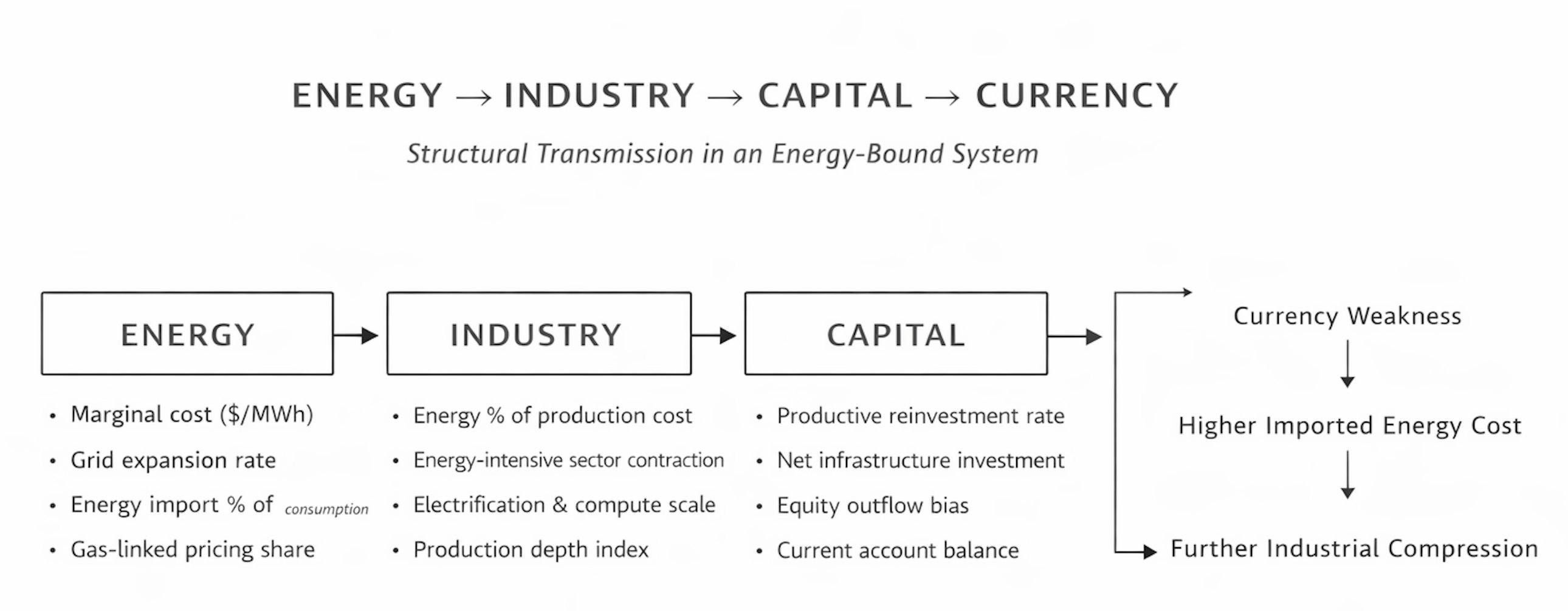
I. Structural Transmission
The sequence is mechanical:
Energy Marginal Structure
→ Industrial Cost Base
→ Margin Durability
→ Capital Allocation Bias
→ External Balance Sensitivity
→ Monetary Flexibility
→ Currency Valuation Band
(see: Energy Shock Transmission Chain (Global))
If electricity spreads are cyclical, allocation stabilises.
If spreads are structural, allocation adjusts structurally.
Persistent differentials alter long-duration capital geography.
II. Energy Differential as Structural Variable
Indicative industrial electricity range:
| Region | Industrial Power |
|---|---|
| United States | $70–90/MWh |
| European Union | $130–200/MWh |
This differential conditions:
earnings durability
incremental capex location
AI and data infrastructure concentration
industrial clustering patterns
reinvestment velocity inside the euro area
Energy depth supports margin durability.
Margin durability supports capital retention.
Capital retention supports currency resilience.
Where retention weakens, structural allocation bias forms.
III. Capital Allocation & Productivity Divergence
Capital does not require panic to relocate.
It responds to relative margin stability, energy predictability, and infrastructure scalability.
If energy-abundant systems offer structurally higher margin durability, portfolios overweight them incrementally.
Incremental overweight becomes structural divergence.
Divergence compounds through:
market depth
innovation clustering
productivity trajectory
external balance composition
Currencies reflect compounded divergence.
This dynamic reflects a deeper structural asymmetry:
capital concentrates in scalable financial and digital layers,
while physical and industrial systems absorb cost and constraint
(see: Financial–Physical Asymmetry in an Energy-Bound System)
IV. Inflation Beta & Policy Constraint
Import-dependent energy systems exhibit higher inflation beta during commodity upcycles.
Energy Shock
→ Industrial Cost Transmission
→ CPI Sensitivity
→ Monetary Tightening Pressure
→ Earnings Compression
→ Fiscal Constraint
Higher beta narrows policy tolerance.
Narrower tolerance constrains monetary manoeuvre space.
Energy architecture therefore conditions ECB flexibility.
Flexibility conditions currency durability.
V. SME Structure & Margin Transmission
In SME-dominant systems, energy volatility transmits directly into operating margin.
Limited hedging capacity increases:
earnings dispersion
deferred capex
credit sensitivity
regional asymmetry
Volatility persistence elevates perceived allocation risk.
Risk pricing influences valuation bands.
VI. Cyclical Volatility vs Structural Compression
Cyclical FX weakness reflects rate differentials and sentiment.
Structural valuation compression reflects productive depth.
The monetary ceiling concerns the latter.
It implies:
narrower long-duration appreciation band
higher FX beta in commodity cycles
greater dependence on external capital conditions
structural underweight bias in global allocation
This is relative compression, not collapse.
Markets price cycles.
Structures compound.
VII. Raising the Monetary Ceiling
The ceiling shifts only when architecture shifts.
Convergence requires:
electricity marginal reform
grid acceleration and storage scaling
stable long-duration industrial power contracts
AI and compute co-location with renewable basins
reduced volatility transmission to SMEs
Monetary resilience is downstream of structural reform.
Absent convergence, divergence persists.
Conclusion
In an energy-bound system, monetary power is not autonomous.
Currency durability reflects:
Energy Marginal Structure
Industrial Scalability
Capital Formation Persistence
Shock Absorption Capacity
Energy sets the floor.
Architecture sets the ceiling.
Currency reflects both.
Monetary constraint is not autonomous.
It is the downstream expression of the Structural Ceiling, which itself
derives from Strategic Constraint.
Ultimately:
financial and monetary outcomes cannot override structural conditions — they reflect them
(see: Beyond Ideology)