Microprocessors, AI and Energy Sovereignty
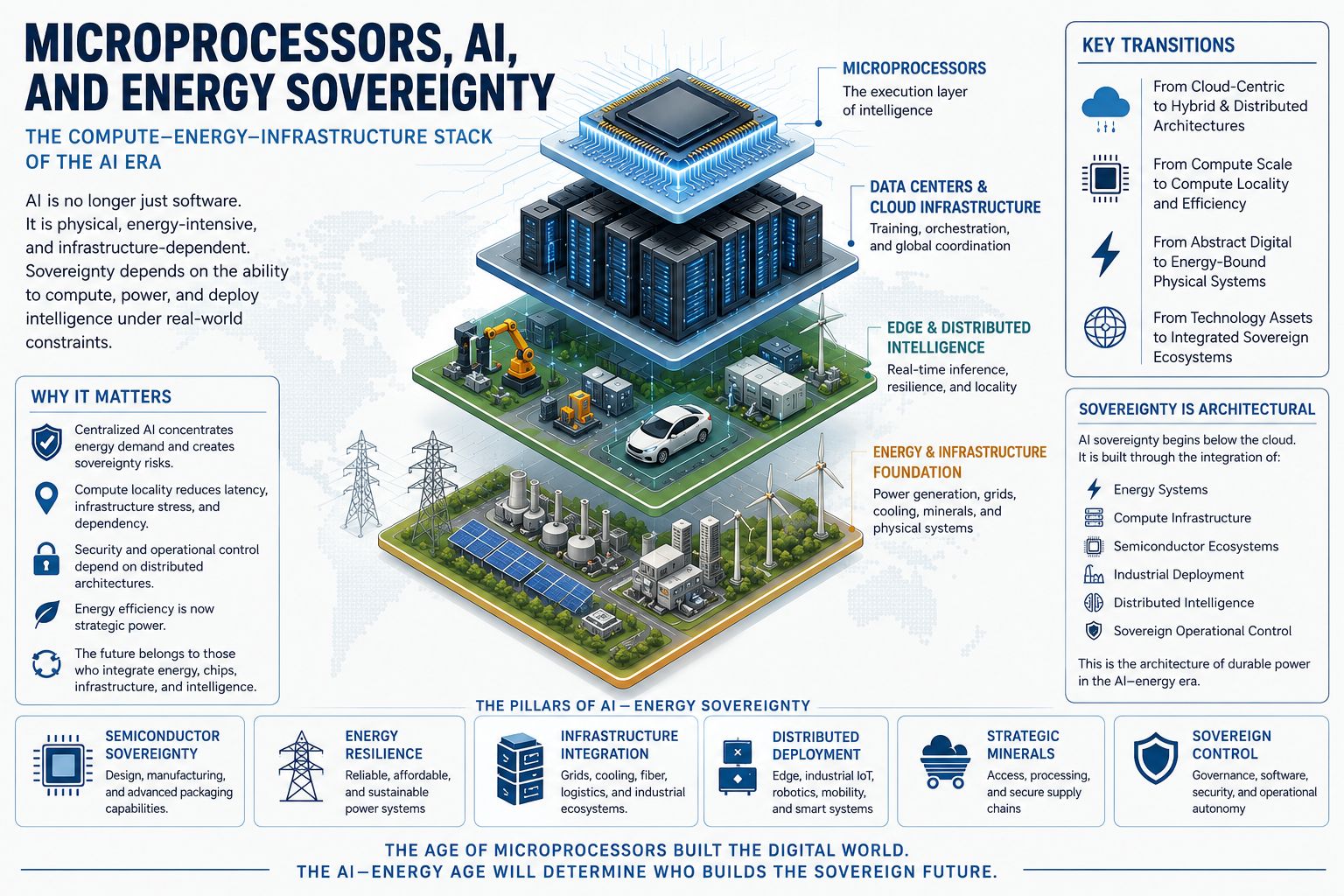
AI Compute Under Energy Constraint
System Navigation
This article should be read as the compute-energy transmission layer between semiconductor sovereignty, hyperscaler infrastructure, distributed intelligence, industrial AI systems, energy architectures, and European strategic autonomy.
It connects semiconductor systems to the wider physical architecture of artificial intelligence under Energy-Bound conditions.
It should be read alongside:
- Physical Constraint Doctrine
- Energy-Bound System
- System Stack Architecture
- Ecosystem Sovereignty
- Hybrid Infrastructure Sovereignty
- AI Has Become Physical
- AI, Energy, and the Future of Sovereignty
- Strategic Minerals in the AI-Energy System
- Energy–Industry–Compute Convergence
- Hyperscaler Infrastructure Sovereignty
- Energy–Industry–Compute Stack
- Cloud and Edge AI
- Semiconductor Ecosystems
- Semiconductor Control and Compute Sovereignty
- Compute Locality — Energy-Bound AI
- Europe — The Missing Conversion Layer
- European Conversion Architecture
- Mediterranean AI Infrastructure Geography
Core Thesis
The semiconductor era is evolving into a compute-energy era.
For several decades, technological power appeared increasingly detached from physical systems. Software, cloud platforms, financial abstraction, digital scalability, and network effects created the perception that computation could expand independently from geography, infrastructure, and material constraint.
Artificial intelligence is progressively reversing that assumption.
AI does not eliminate physical dependency. It intensifies it.
As computational systems scale, intelligence increasingly depends upon electricity generation, grid stability, cooling systems, semiconductor fabrication, mineral supply chains, datacentres, fibre infrastructure, transmission systems, industrial ecosystems, and regional infrastructure integration.
Under these conditions, microprocessors can no longer be understood merely as electronic components embedded inside devices. They increasingly function as execution layers within a much larger system architecture that connects energy, infrastructure, computation, logistics, industrial production, and geopolitical power.
The strategic bottleneck is therefore no longer limited to semiconductor fabrication alone.
The wider constraint increasingly involves:
- energy availability,
- infrastructure integration,
- cooling capacity,
- compute placement,
- transmission systems,
- deployment architecture,
- and sovereign operational control over intelligence systems.
This transition reconnects artificial intelligence to geography.
It also transforms the meaning of sovereignty in the digital age.
AI sovereignty increasingly depends not only upon who designs models, but upon who can physically sustain, distribute, optimise, govern, and deploy intelligence across real-world systems under conditions of energy constraint.
1. The Semiconductor Question Has Become an Infrastructure Question
The semiconductor industry initially emerged within the wider industrial logic of computing miniaturisation, processing speed, and computational efficiency.
For decades, technological competition focused heavily on:
- processor performance,
- transistor density,
- fabrication precision,
- and manufacturing scale.
These dimensions remain strategically important.
However, artificial intelligence changes the systemic position of semiconductors inside the wider technological architecture.
As AI expands into industrial systems, logistics, grids, defence infrastructure, financial systems, healthcare, transportation, manufacturing, robotics, and public administration, the question is no longer simply whether advanced chips can be fabricated.
The deeper question becomes whether entire intelligence systems can operate sustainably under conditions of physical constraint.
A processor without electricity cannot compute.
A datacentre without cooling cannot scale.
An AI model without infrastructure integration cannot operate reliably.
A cloud architecture without grid resilience becomes strategically fragile.
A semiconductor ecosystem without energy transmission capacity cannot sustain large-scale computation.
Under AI-energy conditions, computation itself becomes infrastructure-dependent.
This is the critical transition.
The semiconductor question is therefore no longer merely an industrial policy question.
It increasingly becomes:
- an energy systems question,
- an infrastructure coordination question,
- a territorial resilience question,
- and ultimately a sovereignty question.
2. AI Has Become Physical
Artificial intelligence is often described primarily through software language.
This framing is increasingly incomplete.
AI has become physical because the expansion of computational intelligence now requires enormous quantities of:
- electricity,
- cooling,
- transformers,
- substations,
- water systems,
- semiconductors,
- rare earth processing,
- cable infrastructure,
- industrial manufacturing,
- logistics capacity,
- and high-density compute infrastructure.
The wider AI system increasingly resembles industrial infrastructure rather than purely digital abstraction.
This transformation is critical because it reintroduces physical limits into the centre of technological power.
The modern AI stack now depends simultaneously upon:
- semiconductor fabrication,
- energy systems,
- mineral ecosystems,
- compute infrastructure,
- industrial deployment,
- and logistical coordination.
As AI scaling accelerates, these physical layers become progressively more interdependent.
The result is that intelligence itself becomes increasingly constrained by:
- electricity availability,
- infrastructure density,
- energy pricing,
- cooling efficiency,
- and territorial deployment capacity.
This is precisely why AI can no longer be understood solely through software frameworks.
The era of AI increasingly becomes an era of computational infrastructure competition.
3. Centralised AI Concentrates Energy and Sovereignty Risk
The dominant AI model emerging globally is highly centralised.
Large-scale frontier systems increasingly depend upon:
- hyperscale datacentres,
- concentrated compute clusters,
- vertically integrated cloud platforms,
- proprietary accelerators,
- and massive electricity consumption.
This architecture provides substantial advantages for:
- large-scale model training,
- platform integration,
- capital concentration,
- and computational scale.
However, it also creates systemic vulnerabilities.
Centralised AI concentrates electricity demand geographically.
It intensifies pressure upon:
- transmission systems,
- cooling infrastructure,
- local grids,
- water systems,
- industrial electricity allocation,
- and regional energy markets.
As AI deployment expands, these pressures increasingly collide with wider electrification demands arising from:
- industrial decarbonisation,
- transport electrification,
- heating systems,
- grid modernisation,
- and renewable integration.
Under Energy-Bound conditions, this creates a structural competition for energy allocation.
The issue is not merely whether enough electricity can theoretically be generated.
The issue is whether intelligence systems can scale without destabilising the wider infrastructure architecture upon which industrial societies depend.
This creates a sovereignty problem.
A purely cloud-centric AI strategy may increase dependency simultaneously upon:
- external cloud providers,
- imported accelerators,
- foreign orchestration layers,
- external software ecosystems,
- concentrated infrastructure nodes,
- and increasingly fragile energy architectures.
Under such conditions, sovereignty weakens even as computational capability expands.
4. Compute Locality as a Sovereignty Doctrine
Compute locality emerges as an alternative system logic.
Rather than assuming that intelligence should execute primarily within centralised hyperscale infrastructure, compute locality argues that significant portions of AI execution should occur as close as possible to where data is generated and operational decisions are required.
This includes:
- industrial systems,
- energy grids,
- logistics systems,
- ports,
- vehicles,
- healthcare systems,
- manufacturing facilities,
- public infrastructure,
- and local operational environments.
Under this architecture, intelligence becomes increasingly distributed.
The cloud remains important for:
- model training,
- aggregation,
- coordination,
- large-scale optimisation,
- and ecosystem orchestration.
However, the cloud no longer functions as the exclusive execution layer.
This transition fundamentally changes the strategic architecture of AI.
Distributed inference reduces:
- unnecessary data movement,
- latency exposure,
- bandwidth dependency,
- centralised infrastructure stress,
- and concentrated energy demand.
At the same time, it increases:
- territorial resilience,
- operational continuity,
- infrastructure redundancy,
- local autonomy,
- and energy efficiency.
Most importantly, compute locality reconnects intelligence to physical deployment environments.
AI becomes embedded within infrastructure itself.
This is why compute locality increasingly functions not merely as a technical optimisation strategy, but as a sovereignty doctrine.
5. Microprocessors Become the Execution Layer of Distributed Intelligence
Compute locality is only possible because microprocessor architectures are evolving.
Modern system-on-chip architectures increasingly integrate:
- CPUs,
- GPUs,
- NPUs,
- memory systems,
- sensor integration,
- security functions,
- and energy-management capabilities
within highly optimised local environments.
This allows AI workloads to execute directly on devices, machines, vehicles, industrial systems, robotics platforms, and local infrastructure nodes.
The strategic importance of this transition is profound.
Microprocessors increasingly determine:
- whether inference can execute locally,
- whether infrastructure can remain operational under degraded connectivity,
- whether industrial systems retain autonomy,
- whether energy intensity can be reduced,
- and whether intelligence architectures remain resilient under systemic stress.
The most important lesson is architectural rather than corporate.
Apple’s silicon ecosystem, ARM-based efficiency models, industrial AI processors, edge accelerators, embedded AI systems, robotics processors, and low-energy inference architectures all point toward the same structural transition:
The future of AI scaling increasingly depends upon energy-efficient intelligence deployment rather than purely brute-force compute expansion.
Under AI-energy conditions, efficiency itself becomes strategic power.
6. IoT and Industrial AI Reveal the Limits of Cloud-Centric Architecture
The European cloud-edge continuum correctly recognises that intelligence systems cannot remain entirely centralised.
However, the strategic importance of this transition is frequently underestimated because IoT systems are often treated merely as secondary use cases rather than as foundational drivers of distributed intelligence.
Industrial systems increasingly generate continuous, real-time operational data across:
- grids,
- ports,
- logistics,
- manufacturing,
- agriculture,
- transportation,
- healthcare,
- defence systems,
- and urban infrastructure.
These systems operate under strict requirements of:
- latency,
- reliability,
- continuity,
- cybersecurity,
- and energy efficiency.
Under such conditions, cloud-dependent intelligence architectures become increasingly fragile.
A factory cannot permanently depend upon remote execution for operational continuity.
A grid balancing system cannot rely entirely upon distant cloud coordination during instability.
A logistics network cannot suspend local decision-making because connectivity degrades.
An industrial AI system cannot fully outsource operational intelligence to external control planes without creating systemic vulnerability.
This is why industrial AI increasingly drives distributed compute architectures.
The strategic issue is not decentralisation for its own sake.
The strategic issue is whether intelligence remains operational under real-world physical conditions.
7. Hybrid AI Architecture and the Future of Compute
The future AI system will likely be hybrid rather than fully centralised or fully distributed.
Frontier model training will remain concentrated because advanced training systems require:
- massive energy supply,
- dense infrastructure,
- advanced accelerators,
- hyperscale capital pools,
- and specialised ecosystem concentration.
However, inference increasingly distributes outward into operational systems.
As AI moves from model development into societal deployment, intelligence increasingly executes across:
- devices,
- industrial systems,
- robotics,
- vehicles,
- grids,
- logistics systems,
- edge infrastructure,
- and local compute environments.
This creates a structural transition from concentrated training toward distributed operational intelligence.
The strategic conflict therefore shifts.
The central question is no longer simply who possesses the largest models.
The deeper question increasingly becomes who governs the wider architecture through which intelligence is deployed across society.
Under hybrid AI architectures, power increasingly depends upon the integration of:
- semiconductors,
- energy systems,
- edge infrastructure,
- cloud coordination,
- industrial ecosystems,
- connectivity,
- and compute placement.
This transition strongly favours ecosystem-based sovereignty models over isolated technological capabilities.
8. Connectivity Becomes Part of the Compute Architecture
Once intelligence becomes real-time and distributed, connectivity itself becomes part of the computational system.
5G, fibre systems, edge orchestration, private industrial networks, satellite systems, and subsea cables increasingly function as components of the wider intelligence architecture.
This transforms the strategic meaning of telecommunications infrastructure.
The issue is no longer merely communication speed.
The issue increasingly becomes operational control over:
- update systems,
- orchestration layers,
- software governance,
- maintenance cycles,
- infrastructure interoperability,
- and real-time system coordination.
This explains why telecommunications infrastructure became geopolitical.
The deeper strategic issue was never simply espionage.
It was control over the operational fabric through which intelligence systems function.
In AI-energy systems, connectivity increasingly becomes inseparable from computation itself.
9. Strategic Minerals Reconnect AI to Industrial Sovereignty
Artificial intelligence also increasingly reconnects semiconductor systems to the underlying mineral architectures upon which advanced computation depends.
Semiconductor fabrication, electrical systems, batteries, robotics, transmission infrastructure, renewable energy systems, defence electronics, cooling systems, and hyperscale compute infrastructures all depend upon increasingly concentrated ecosystems of strategic minerals and rare earth processing.
Under AI-energy conditions, these materials no longer function merely as commodities within industrial supply chains.
They increasingly function as foundational inputs into computational civilisation itself.
This transition transforms strategic minerals into sovereignty infrastructure embedded within the wider architecture of:
- energy systems,
- industrial ecosystems,
- compute scaling,
- semiconductor production,
- and geopolitical power.
The strategic issue therefore extends beyond extraction alone.
The critical issue increasingly involves:
- processing,
- refining,
- manufacturing integration,
- industrial ecosystems,
- logistics coordination,
- and energy-intensive downstream production.
The future AI system is therefore inseparable from industrial sovereignty.
10. Europe’s Missing Conversion Layer
Europe possesses important strategic assets within the wider AI-energy system.
It possesses:
- industrial capacity,
- engineering expertise,
- infrastructure density,
- advanced research systems,
- semiconductor bottlenecks,
- renewable expansion capacity,
- and highly sophisticated manufacturing ecosystems.
However, Europe frequently struggles to integrate these capabilities into coherent systems of sovereign power.
This is the wider conversion problem.
AI policy, semiconductor policy, telecom policy, energy policy, industrial policy, infrastructure policy, and strategic autonomy policy often remain institutionally fragmented.
As a result, Europe risks producing partial capability without integrated sovereignty.
A semiconductor strategy without compute placement remains incomplete.
A cloud strategy without distributed intelligence reproduces dependency.
An energy transition without compute conversion weakens industrial competitiveness.
A digital strategy without infrastructure sovereignty leaves operational control externalised.
The European challenge is therefore architectural rather than purely technological.
Europe does not lack assets.
It lacks sufficiently integrated conversion architecture across the AI-energy stack.
11. The Mediterranean as a Compute-Energy Interface
The Mediterranean increasingly occupies an important position within Europe’s future compute-energy geography.
The region sits across:
- energy corridors,
- electricity interconnectors,
- maritime logistics routes,
- subsea cable systems,
- LNG infrastructure,
- renewable energy zones,
- industrial nodes,
- and strategic infrastructure interfaces connecting Europe, Africa, and the Middle East.
Under traditional economic models, these flows frequently passed through the Mediterranean without full strategic conversion into regional system power.
Under AI-energy conditions, this geography acquires new significance.
Distributed intelligence architectures increasingly benefit from:
- regional infrastructure density,
- energy availability,
- interconnector integration,
- resilient territorial distribution,
- and compute locality.
This creates the possibility for parts of the Mediterranean to evolve into distributed infrastructure nodes within Europe’s wider AI-energy architecture.
The opportunity is therefore not simply energy production.
It increasingly involves energy-to-compute conversion.
12. Strategic Risk if Europe Ignores Compute Locality
If Europe pursues artificial intelligence primarily through:
- hyperscale expansion,
- imported accelerators,
- centralised cloud dependence,
- and energy-intensive datacentre concentration,
it risks deepening structural dependency precisely while attempting to achieve sovereignty.
Under such a trajectory:
- electricity stress increases,
- infrastructure concentration intensifies,
- external platform dependency expands,
- operational control remains fragmented,
- and ecosystem sovereignty weakens.
Europe would then reproduce dependency inside a new technological architecture while describing the process as digital modernisation.
This would represent a systemic strategic failure.
Conclusion: Sovereignty Begins Below the Cloud
AI sovereignty does not begin primarily at the application layer.
It begins below the cloud.
It begins where:
- microprocessors,
- electricity systems,
- compute placement,
- cooling systems,
- industrial infrastructure,
- connectivity architectures,
- and operational control systems
interact to determine whether intelligence can function autonomously under conditions of physical constraint.
The future AI system will not be defined solely by who possesses the largest models or the greatest quantities of computation.
It will increasingly be defined by who can integrate:
energy systems → compute infrastructure → semiconductor ecosystems → industrial deployment → distributed intelligence → sovereign operational control
into coherent systems of durable power.
The semiconductor era created the hardware foundation of the digital age.
The AI-energy era will determine which societies can convert computation into resilient civilisational infrastructure.