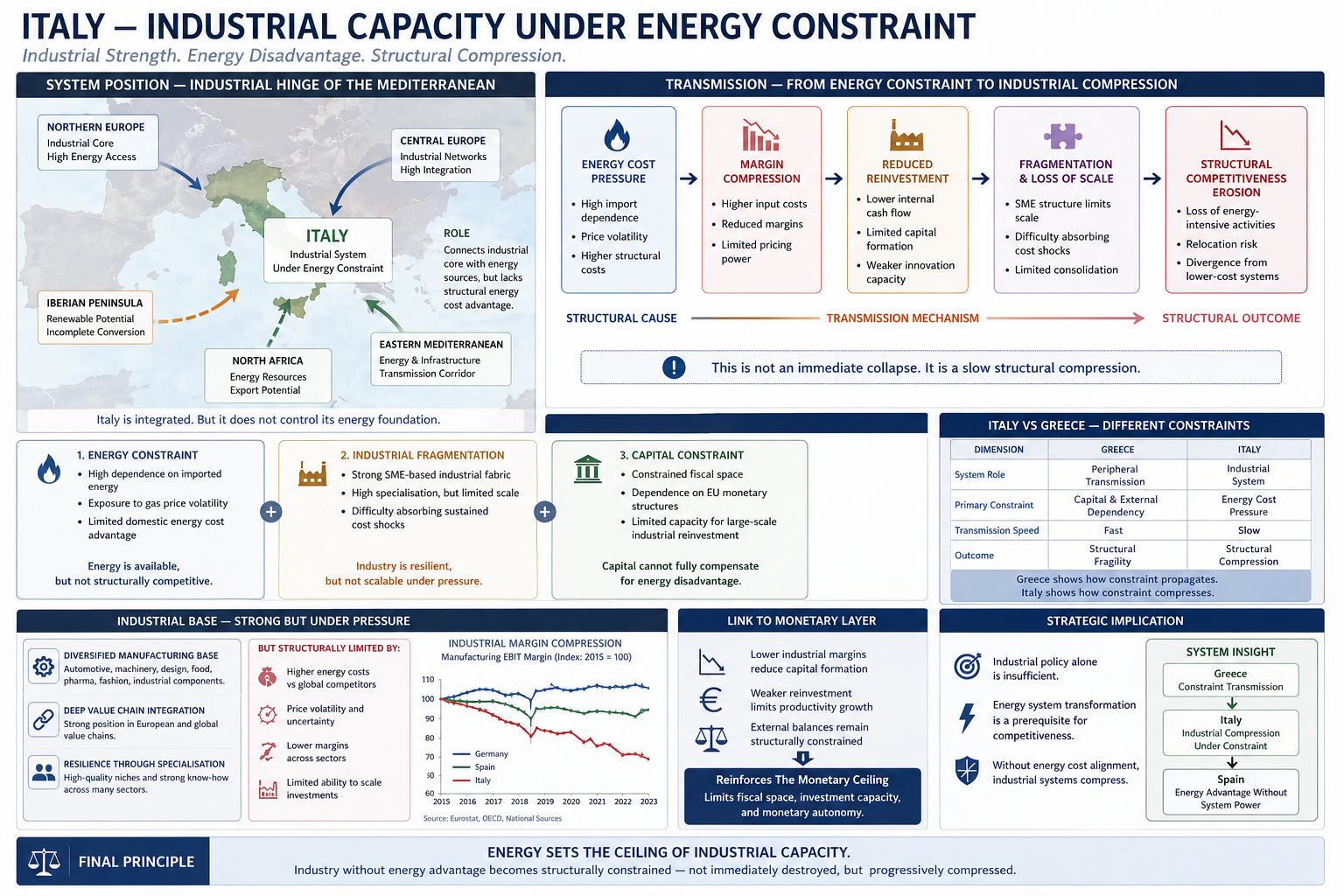
Italy — Industrial Capacity Under Energy Constraint
System Navigation: Mediterranean System Navigation
Keynote
Italy occupies a structurally distinct position within the European system.
It is not a peripheral economy.
It is an industrial economy operating under energy
constraint.
Unlike Greece, where constraint transmits primarily through capital dependency and external exposure, Italy demonstrates a different systemic dynamic:
Constraint operating directly on an existing industrial ecosystem.
This makes Italy a critical case within an Energy-Bound System.
Italy reveals not how systems fail to build industrial capacity, but how existing industrial ecosystems become progressively compressed when energy systems, infrastructure, capital, and industrial scaling cease to align structurally.
The Italian case therefore represents a broader European problem:
industrial capacity without a fully competitive energy foundation.
System Position — Industrial Layer Under Constraint
The system operates through a hierarchical chain:
Energy → Industry → Capital → Currency → Sovereignty
Italy sits primarily at the industrial layer of this chain.
The country retains significant structural advantages:
substantial manufacturing capacity
integration into European industrial value chains
advanced regional production clusters
specialised export-oriented industries
dense networks of SMEs and industrial ecosystems
Italy therefore remains one of Europe’s most important industrial systems.
However, these strengths operate within an increasingly constrained energy environment:
energy costs remain structurally elevated relative to major competitors
the system remains exposed to imported energy pricing
industrial scaling capacity remains uneven
monetary and fiscal flexibility remain constrained
As a result:
industrial capacity exists, but the energy foundation beneath it remains structurally unstable.
Core Mechanism
Industrial Systems Require Energy Cost Stability
Industrial competitiveness is not determined solely by:
labour cost
technological capability
productivity
market access
Industrial competitiveness increasingly depends upon:
energy cost, energy stability, infrastructure integration, and long-term scalability
This condition becomes even more important under conditions of industrial electrification, automation, AI integration, and compute-intensive production systems.
In Italy:
energy costs remain structurally elevated
electricity price volatility transmits directly into industrial production costs
industrial margins remain under sustained pressure
reinvestment capacity becomes progressively constrained
This produces a structural condition in which:
industrial capacity persists, but operates under continuous structural compression.
Structural Characteristics
Italy’s industrial system reflects three interacting structural constraints.
1. Energy Constraint
Italy remains heavily exposed to imported energy dependency.
The system experiences:
exposure to gas price volatility
elevated electricity costs
limited domestic low-cost energy advantage
uneven infrastructure integration
Energy therefore remains physically available within the system, but it does not provide a sufficiently competitive cost foundation for long-term industrial scaling.
Energy availability does not automatically produce energy competitiveness.
2. Industrial Fragmentation
Italy possesses a dense and historically resilient industrial ecosystem.
This ecosystem is built around:
regional manufacturing clusters
SME-based industrial networks
specialised production systems
export-oriented industrial districts
This structure provides flexibility and resilience.
However, fragmentation also creates structural limitations:
limited economies of scale
uneven access to capital
lower shock absorption capacity
difficulty sustaining large-scale reinvestment during prolonged energy stress
As a result:
the industrial ecosystem remains resilient, but structurally difficult to scale under sustained cost pressure.
3. Capital Constraint
Industrial systems require continuous reinvestment.
However, Italy operates within a constrained monetary and fiscal framework.
The system therefore experiences:
constrained fiscal space
dependence on European monetary structures
limited strategic industrial financing capacity
uneven capital allocation toward infrastructure transformation
This reduces the system’s ability to offset energy disadvantage through industrial policy alone.
Capital cannot fully compensate for structural energy disadvantage.
Transmission — From Energy Constraint to Industrial Compression
Energy constraint propagates through the industrial system via a clear structural transmission chain:
Energy cost pressure
→ industrial margin compression
→ reduced reinvestment capacity
→ fragmentation and reduced scaling ability
→ industrial competitiveness erosion
→ long-term structural compression
This process does not produce immediate industrial collapse.
Instead, it produces:
slow structural weakening within the industrial base itself.
Industrial Ecosystems and the New Competitive Layer
The Italian case becomes increasingly important within the emerging AI–energy transition.
Industrial competitiveness is no longer determined solely by manufacturing output.
It increasingly depends upon the alignment of:
energy systems
industrial ecosystems
compute infrastructure
automation capacity
logistics integration
capital coordination
Advanced manufacturing, AI-enabled production systems, industrial automation, and compute-intensive infrastructure all require:
stable, scalable, and competitively priced electricity systems
As the global system shifts toward energy-intensive compute architectures and electrified industrial production, industrial ecosystems operating under structurally elevated energy costs face increasing long-term competitive pressure.
This places Italy within a wider systemic divergence emerging across the global economy.
Comparison — Italy vs Greece
| Dimension | Greece | Italy |
|---|---|---|
| System role | Peripheral transmission | Industrial ecosystem |
| Primary constraint | Capital dependency and external exposure | Energy cost pressure |
| Transmission speed | Faster | Slower |
| Core dynamic | Structural fragility | Structural compression |
| System effect | Transmission instability | Industrial erosion |
Greece demonstrates how constraint propagates through dependency.
Italy demonstrates how constraint compresses existing industrial capacity.
System Consequence
Italy does not lose its industrial base immediately.
Instead, the system experiences:
gradual erosion of competitiveness
relocation pressure on energy-intensive industries
reduced long-term industrial scaling capacity
lower reinvestment intensity
increasing divergence from lower-cost industrial systems
This divergence becomes increasingly important under conditions of:
industrial electrification
AI-enabled manufacturing
compute-intensive infrastructure scaling
global energy competition
Industrial presence without structural energy advantage cannot sustain long-term system power.
Link to the Monetary Layer
Industrial compression feeds directly into the monetary layer of the system.
When industrial margins weaken:
capital formation weakens
reinvestment slows
productivity growth becomes constrained
external balances remain under pressure
This reinforces:
the Monetary Ceiling
Even within a major industrial economy, energy constraint limits:
fiscal flexibility
industrial investment capacity
infrastructure transformation
monetary autonomy
The result is a structurally constrained industrial system operating within a constrained monetary architecture.
Mediterranean Position — Industrial Hinge Within the Conversion Layer
Italy occupies a unique structural position within the Mediterranean system.
It functions simultaneously as:
an industrial node
a logistics corridor
an infrastructure interface
a Mediterranean conversion hinge
Italy connects:
Northern European industrial systems
Mediterranean energy corridors
regional infrastructure flows
industrial manufacturing networks
The country therefore occupies a potential conversion position between:
Mediterranean energy systems and European industrial demand
However:
connection does not automatically produce strategic control or conversion capacity.
The absence of fully aligned:
energy systems
industrial infrastructure
compute capacity
capital coordination
long-term industrial strategy
limits Italy’s capacity to convert its structural position into sustained system power.
Strategic Implication
Italy demonstrates a central principle of the Energy-Bound System:
industrial capacity alone cannot compensate for structural energy disadvantage.
This carries several strategic implications.
Industrial policy alone is insufficient.
Long-term industrial competitiveness increasingly depends upon:
energy system transformation
electricity cost competitiveness
infrastructure integration
compute and industrial coordination
ecosystem-scale reinvestment
Without these alignments:
industrial systems progressively compress under energy constraint.
System Insight
Italy represents the second layer of the Mediterranean system structure:
Greece → constraint transmission
Italy → industrial compression under constraint
This prepares the system for the next structural case:
Spain — Energy Advantage Without Full System Conversion
Final Principle
Energy establishes the structural ceiling of industrial capacity.
Industrial ecosystems operating without competitive energy foundations do not immediately disappear.
They become progressively compressed over time through cost pressure, fragmentation, and declining scalability.
Italy therefore represents more than an industrial economy under pressure.
It represents a broader European structural problem:
the incomplete alignment of energy systems, industrial ecosystems, infrastructure, compute capacity, and capital allocation into a coherent architecture of long-term system power.
In this sense, Italy functions simultaneously as:
a compressed industrial system
and a strategic hinge within the emerging Mediterranean energy–compute architecture
References — Italy, Energy, and Industrial Constraint
These sources support the structural dynamics described above.
They do not define the framework.
They validate its mechanisms.
Energy Systems and Cost Structure
International Energy Agency — Italy Energy Policy Review
European Commission — Energy Prices and Costs in Europe
Ember — European Electricity Review
Industrial Structure and Competitiveness
OECD — Italy Economic Surveys
World Bank — Manufacturing and Value Chain Integration Data
Confindustria — industrial reports on competitiveness and energy cost pressures
Monetary and Structural Constraint
European Central Bank — monetary policy and transmission reports
International Monetary Fund — Italy Article IV Consultations
Energy–Industry–Compute Dynamics
Bruegel — European energy crisis and industrial competitiveness
Centre for European Policy Studies — industrial policy and energy transition
International Energy Agency — electricity demand and industrial electrification
Cross-Reference Reading Architecture — Mediterranean System
From Energy Constraint to System Power in an Energy-Bound Europe
SYSTEM POSITION
This analysis sits within the Mediterranean conversion layer:
Energy → Industry → Compute → Capital → Sovereignty
Italy represents:
industrial capacity operating under structural energy constraint
I. FOUNDATIONS — System Logic
The system is structured by energy, infrastructure, and scaling capacity.
Extended Foundations
II. GLOBAL DYNAMICS — Constraint Formation
How the global system produces structural divergence
III. EUROPE — STRUCTURAL CONSTRAINT
Europe as a constrained industrial and monetary system
IV. MEDITERRANEAN — SYSTEM ARCHITECTURE
The Mediterranean as an energy–industry–compute interface
V. COUNTRY SYSTEMS — Comparative Layer
Greece — Constraint Transmission
Italy — Industrial Compression
- Italy — Industrial Capacity Under Energy Constraint (this article)
Planned (Evidence Layer)
- [Italy — Energy–Industrial Transmission Under Constraint]
Planned (Investor Layer)
Spain — Incomplete Conversion
Planned (Evidence Layer)
- Spain — Energy Advantage and Incomplete Transmission #review #mediterannean
Planned (Investor Layer)
- Spain — Energy Arbitrage Without Full Capture ??? #review #mediterannean
Spain — Energy Arbitrage and Capital Allocation
VI. ENERGY–COMPUTE LAYER — Future Scaling Constraint
Where future industrial competitiveness will increasingly be decided
VII. EVIDENCE — System Validation
Data, transmission mechanisms, and structural exposure
VIII. INVESTOR LAYER — Capital Allocation
Where structural divergence becomes actionable
Mediterranean Allocation
IX. SYSTEM SYNTHESIS (Planned)
Mediterranean — From Constraint to System Power
Europe — From Industrial Core to Constrained System
Energy–Industry–Capital Misalignment in Europe
Final Orientation
The system is not ultimately defined by individual economies.
It is defined by the degree to which energy systems, industrial ecosystems, compute infrastructure, and capital allocation align—or fail to align.
Greece demonstrates transmission.
Italy demonstrates industrial compression.
Spain demonstrates incomplete conversion.
Together, they define the structural logic of the Mediterranean system within an Energy-Bound Europe.