GEIYV — Phase 1 Asset Map (Investor Appendix)
From system assets to investable yield
Framework Context
This appendix operationalises GEIYV by identifying deployable asset clusters and translating them into investable return structures.
System Navigation: Mediterranean System Navigation
→ Investor Framework — Capital Allocation in an Energy-Bound System
→ Financial–Physical Asymmetry in an Energy-Bound System
→ Greece — Peripheral Transmission Under Constraint
→ Energy-Bound System
Core Principle
Phase 1 does not create assets.
It aggregates, structures, and aligns existing system capacity into investable form.
Structural Context
The Greek energy system already contains:
operational renewable capacity
regulated infrastructure
pipeline storage assets
strategic corridor positions
However:
Financial capital and physical system capacity remain structurally misaligned.
This reflects a broader condition:
Financial–physical asymmetry — where assets exist, but are not structured into investable scale.
I. Asset Universe (Indicative Ranges)
1. Renewable Generation (Operational Base)
Solar — Central & Northern Greece
Capacity:
→ 200–400 MW (aggregatable portfolio)Asset type:
→ multi-site PV parks (10–100 MW units)Status:
→ operational, revenue-generatingRevenue:
→ FiT / CfD / PPA-backedYield:
→ 5–7% unlevered
Wind — Evia / Thrace / Aegean
Capacity:
→ 300–500 MW (clustered)Capacity factor:
→ 25–35%Constraint:
→ grid congestion / curtailmentYield:
→ 6–8% unlevered
2. Grid Infrastructure (Constraint Layer)
Interconnections & Transmission
Assets:
→ Cyclades / Crete interconnections
→ mainland reinforcementType:
→ regulated infrastructureReturn profile:
→ 4–6% regulated / quasi-regulated
System Role
Grid capacity defines the ceiling of renewable deployment, compute scaling, and system integration.
3. Storage (Pipeline Layer)
Battery Systems
Capacity:
→ 100–200 MW initial integrationStatus:
→ national tender / pipelineRevenue:
→ capacity payments + balancing + arbitrageExpected return:
→ 6–9% (post-structuring)
4. Corridor Assets (Strategic Layer)
Northern Greece Energy Node
Assets:
→ LNG-linked infrastructure
→ cross-border electricity systemsFunction:
→ European energy entry pointCurrent condition:
→ transit without full value capture
II. Ownership Structure (System Reality)
The Greek energy system is structurally layered:
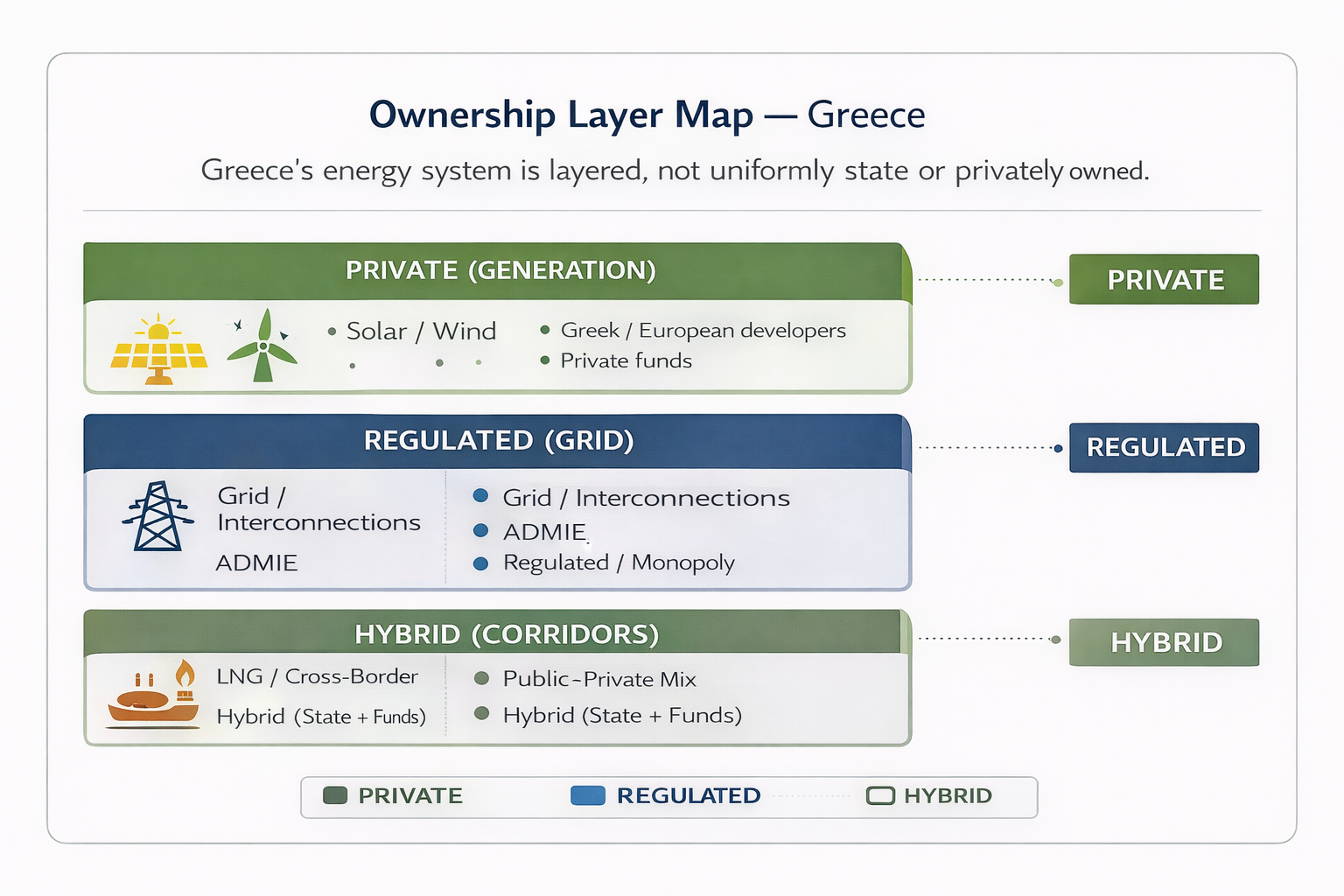
Generation — Primarily Private
solar and wind owned by:
domestic developers
European utilities
infrastructure funds
→ fragmented ownership
Grid — Regulated / State-Controlled
transmission and interconnections
monopoly / regulated returns
→ system-critical layer
Storage — Private + Supported
early-stage private developers
EU-supported frameworks
→ emerging growth layer
Corridors — Hybrid
public–private ownership
international capital participation
→ strategic but under-monetised
Core Constraint
Ownership is not the limitation.
Fragmentation prevents investability.
III. Entry Mechanisms (Capital Alignment Layer)
GEIYV enables structured capital entry through:
aggregation of operating SPVs
minority or controlling stakes in portfolios
refinancing of existing assets
co-investment alongside developers
integration of pipeline assets into a unified platform
Structural Shift
From project-level exposure → to platform-level allocation.
This is the mechanism through which:
financial capital is aligned with physical system capacity.
IV. Illustrative Phase 1 Platform
Aggregated Portfolio
Solar: ~300 MW
Wind: ~400 MW
Grid: 1–2 major assets
Storage: ~150 MW pipeline
Scale
- indicative asset base:
→ €1–2 billion equivalent platform
Portfolio Characteristics
brownfield + late-stage assets
diversified energy mix
integrated infrastructure exposure
V. Return Structure (Investor View)
Revenue Composition
60–70% contracted (PPAs / regulated)
20–30% capacity-linked / semi-contracted
0–10% merchant exposure
Target Returns
Core yield: 4–6%
Blended yield: 5–7%
Optimised: 6–8%
Duration
asset life: 20–30 years
contracted visibility: 10–20 years
VI. Financial–Physical Transformation
Without Structure
fragmented ownership
project-level risk concentration
volatile and non-scalable returns
limited institutional access
With GEIYV
portfolio aggregation
diversified risk exposure
contracted revenue base
institutional-grade yield profile
Mechanism
GEIYV converts physical system assets into investable financial structures.
VII. Risk Decomposition
Energy Price Risk
→ mitigated via PPAs / regulation
Grid Constraint Risk
→ mitigated via integrated grid exposure
Construction Risk
→ phased integration + public capital layer
Regulatory Risk
→ EU-aligned frameworks + long-duration visibility
VIII. Capital Structure (Indicative)
Public / EU (10–20%)
→ guarantees / first-lossInstitutional (50–70%)
→ pensions / insurersPrivate / strategic (10–30%)
→ sovereign wealth funds / family offices
Result
Risk is aligned with capital absorption capacity.
IX. Structural Return Driver
Returns are driven by:
energy cost reduction
infrastructure integration
system stability
Transmission Logic
Energy → Infrastructure → Cost Stability → Capital Formation
X. Strategic Relevance
This structure addresses:
capital misallocation
energy cost volatility
infrastructure gaps
external dependency
And supports:
SME competitiveness
domestic reinvestment
system resilience
XI. Monetary Link
This structure reduces exposure to:
Energy → Inflation → Capital → Currency
as defined in:
→ Energy
Constraint and the Monetary Ceiling
XII. Investor Positioning
This is:
not venture
not speculative
not purely financial
It is:
system-aligned infrastructure exposure under structural constraint
XIII. Key Insight
Greece does not lack assets.
It lacks structure, aggregation, and investability.
XIV. Bottom Line
The opportunity is not asset creation.
It is asset structuring.