Investor Index
Evidence, Reading Paths, and Strategic Navigation
System Navigation
Investor navigation architecture
Start with the Investor Framework — Capital Allocation in an Energy-Bound System for the conceptual structure.
Validate system conditions through the System Evidence (Validation Layer).
Explore the Evidence for Investors for applied empirical interpretation.
Applied investor briefs, mechanisms, and execution layers that translate system structure into capital allocation logic appear below.System Doctrines
System Flow — From Constraint to Allocation
This framework operates through a three-layer system:
Diagnostics → defines structural constraints and system architecture
Evidence → validates these constraints through data, transmission mechanisms, and comparative analysis
Investor → translates system structure into capital allocation, positioning, and investment vehicles
This is not a sequence of articles.
It is a capital allocation framework under energy
constraint.
→ Diagnostics: Greece
— Peripheral Transmission Under Constraint
→ Evidence: Greece
— Constraint Exposure Layer
→ Investor: Greek
Energy Infrastructure Yield Vehicle (GEIYV)
Core Principle
Capital allocation is determined by the relationship between financial expectations and physical system capacity.
How to Use This Index
Start → Investor Framework
Understand constraint → System Doctrine
Validate system conditions → System Evidence (Validation Layer)
Interpret allocation logic → Investor Briefs
Translate into execution → Mechanisms and Platforms
Validate outcomes → Evidence for Investors
System Evidence — Validation Layer
These materials validate the structural conditions underlying capital allocation.
They should not be read as standalone data.
They confirm whether:
system constraints are binding
transmission mechanisms are active
market pricing reflects physical system reality
→ System Evidence (Validation Layer)
Investor Layer — Structured Architecture
I. System Doctrine — Constraint Layer
Defines the structural relationship between financial systems and physical capacity:
System Architecture — From Constraint to Allocation
The transmission of energy constraint operates across three interacting layers:
Macro → global energy systems, geopolitical structure, and monetary hierarchy
Meso → infrastructure, industrial systems, regional integration, and ecosystem formation
Micro → firm-level production, SME networks, and compute deployment
Interpretation
Capital allocation does not operate at a single level.
It reflects the interaction between:
system-level constraint
infrastructure capacity
firm-level execution
This framework explains how:
Energy constraint propagates from system architecture into capital allocation and ultimately into returns.
Energy → Infrastructure → Compute → Industry → Capital
operating across macro, meso, and micro layers.
II. Capital Allocation Framework — Interpretation Layer
Translates system constraint into investor positioning and allocation logic:
III. National Mechanism — Greece (Execution Layer)
Defines how capital is structured into investable assets:
Asset and Structuring Layers
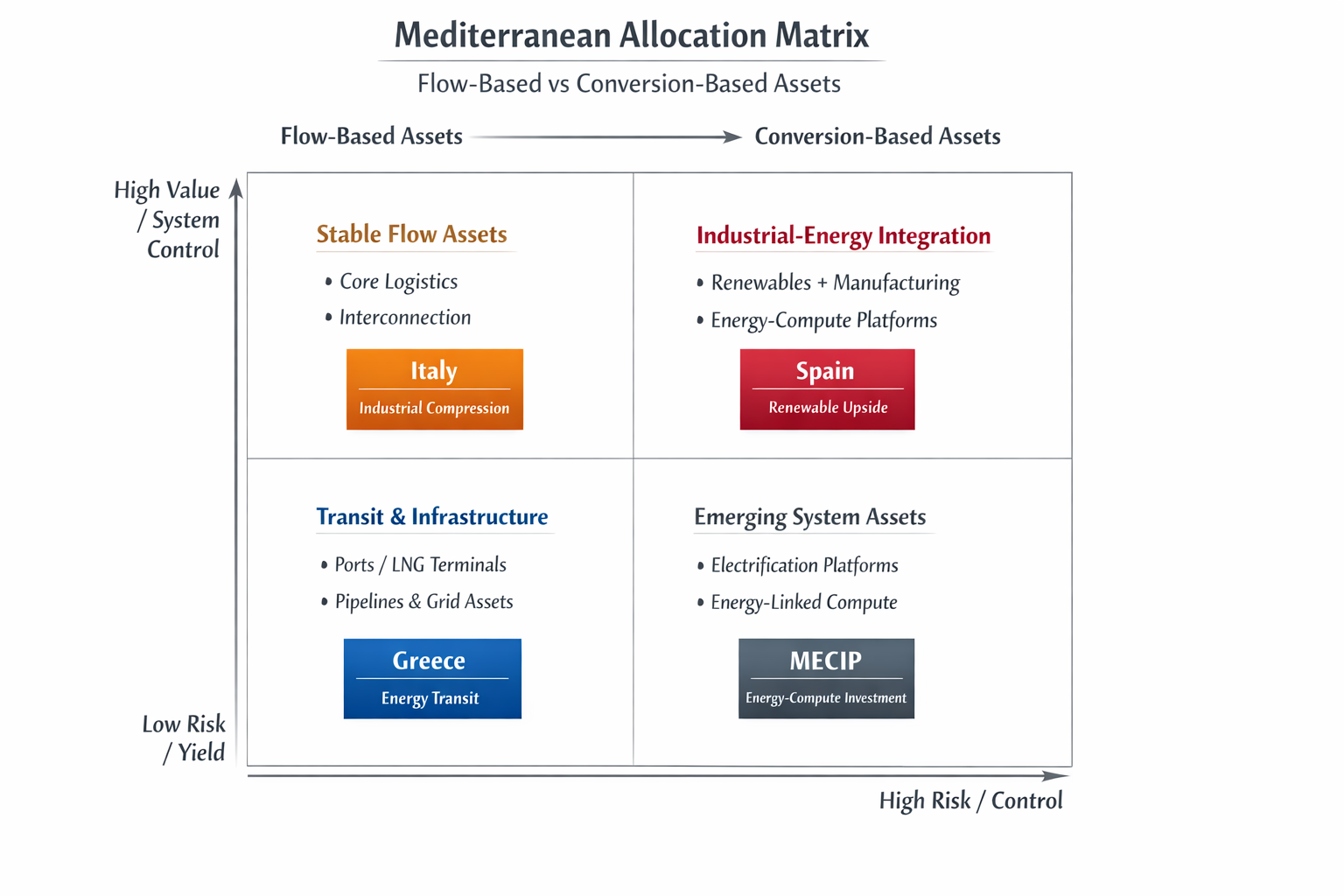
IV. Regional Platform — Mediterranean (Scaling Layer)
Extends national mechanisms into system-level capital allocation:
Investor Pack — System-Level Allocation
This section consolidates the framework into applied system-level positioning:
US System → energy abundance, capital depth, compute dominance
Europe System → structural compression under constraint
Mediterranean System → infrastructure-led convergence layer
For underlying system data and validation:
→ System
Evidence (Validation Layer)
→ Evidence for
Investors
Download Investor Packs (PDF)
Investor Outputs — System Allocation Packs
These materials translate the system framework into deployable allocation formats.
They are not additional analysis.
They are compressed system representations for decision-making,
communication, and capital deployment.
Full System Allocation
→ Integrated view across: - global system structure
- US–EU divergence
- Mediterranean positioning
- energy–compute–capital interaction
Regional System Packs
US System — Investor Pack
→ Energy abundance, compute scale, capital absorptionEurope System — Investor Pack
→ Structural compression, energy constraint, monetary ceilingMediterranean System — Investor Pack
→ Infrastructure-led convergence, system interface positioning

Energy → Infrastructure → Industry → Capital → System Power
Positioning
These materials should be read after the framework and evidence layers.
They represent:
- how the system is communicated
- how allocation decisions are structured
- how capital engages with system capacity
Investor Briefs — Allocation Layer
These briefs define how system constraint translates into returns.
They are not thematic commentaries.
They should be read as a coherent applied layer of the investor
framework.
System Returns — Structural Reframing
Energy Cost and Monetary Constraint
System Divergence — US vs Europe
Valuation Under Physical Constraint
System Transition — Repricing of Returns
Structural Asymmetry — System Positioning
United States
Europe
Regional Allocation — Mediterranean Layer
Final Orientation
This index is not designed to predict markets.
It structures a more fundamental question:
Where is capital structurally aligned with system capacity — and where is it not?
In an energy-bound system, capital does not move freely.
It follows the structure through which real capacity is built.