Evidence for Investors
Energy Systems, Capital Allocation, and Strategic Returns
System Navigation
This section validates the system framework developed in:
Investor Framework — Capital Allocation in an Energy-Bound System
Full System Position — Evidence Layer
This section operates within the three-layer system:
Diagnostics → define structural constraints and system architecture
Evidence (this section) → validates those constraints through data and transmission mechanisms
Investor → translates validated structure into capital allocation and execution
Direct Navigation Across Layers
→ Diagnostics:
Greece
— Peripheral Transmission Under Constraint
Mediterranean
Capital Allocation Problem
→ Investor Layer:
Investor
Framework
Investor Index
This section provides the empirical foundation supporting the system analysis developed across the site.
It is designed for investors, capital allocators, and strategic decision-makers seeking to understand how:
energy cost structures shape industrial competitiveness
industrial structure shapes capital allocation
capital allocation shapes technological capacity and returns
The materials assembled here validate a central proposition and its transmission across systems:
Energy systems increasingly determine the structure of returns.
Evidence does not precede the framework — it validates it.
Data, Strategic Validation, and System Signals
This section provides the empirical grounding for the analytical framework developed across the site.
It should be read in conjunction with:
→ Investor
Framework
→ Investor Index —
Navigation Hub
The objective is clarity rather than volume: a curated body of evidence illustrating how the emerging energy-bound system reshapes industrial competitiveness, capital allocation, and technological capacity.
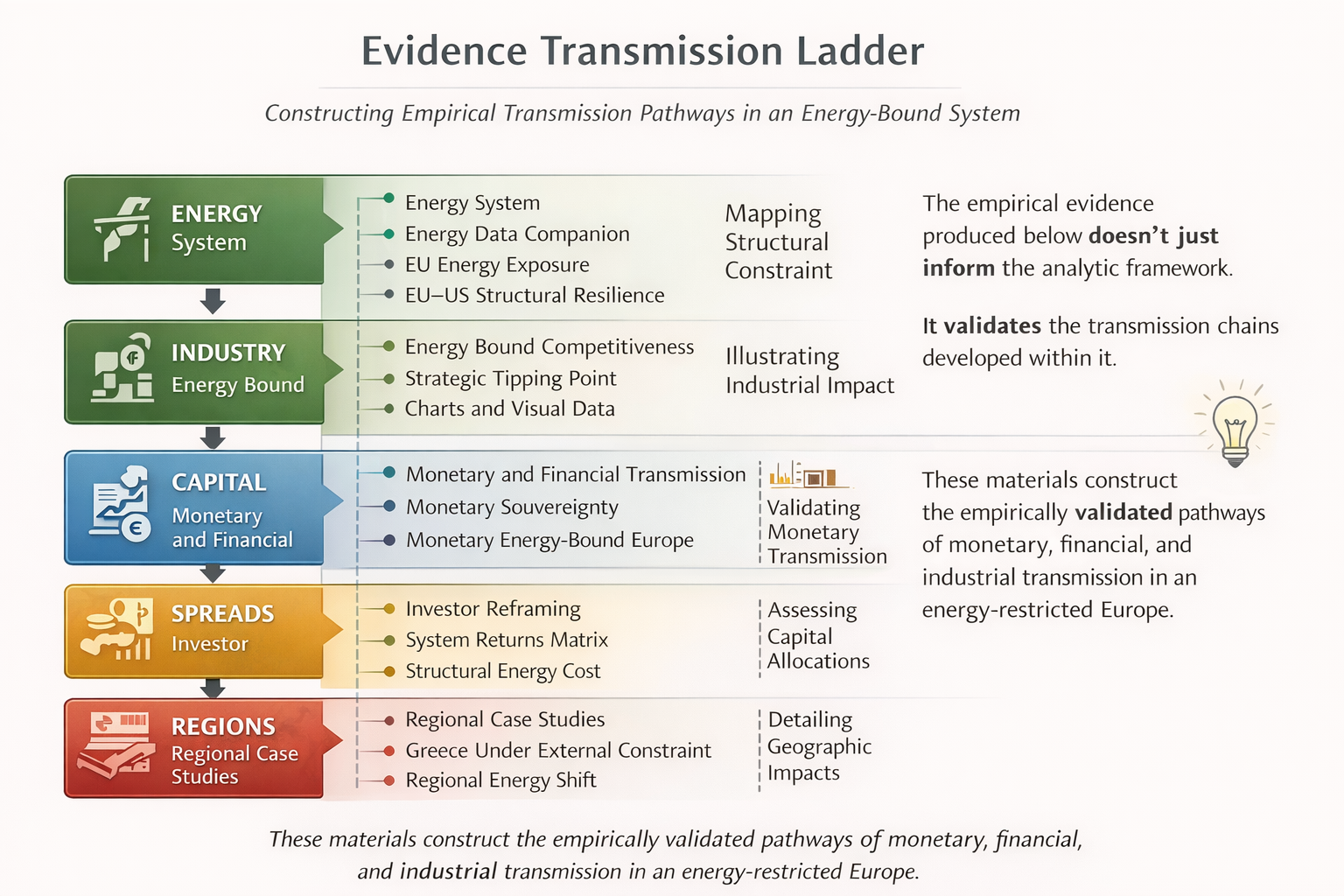
Evidence Transmission Ladder
The materials in this section correspond to successive layers of the energy-bound system:
Energy Systems
↓
Industrial Cost Structure
↓
Capital Allocation
↓
Financial Conditions (Spreads, Liquidity, Risk
Premia)
↓
Regional Transmission
Each layer validates a different stage of the system dynamics analysed across the site.
How Investors Should Use This Layer
This section is not a data repository.
It is designed to:
validate structural constraints
identify transmission mechanisms
confirm whether observed market behaviour reflects system conditions
Evidence confirms structure.
Structure determines allocation.

Global System Maps and Infrastructure Evidence
The following materials provide the system-level visual and structural evidence underlying the energy-bound framework.
They should be read as mapping the physical and financial architecture of the system, rather than as standalone datasets.
Core System Maps
Energy–Capital–Currency System Map
→ Maps the structural relationship between energy flows, capital formation, and monetary powerGlobal Energy–Capital–Currency Architecture (Map)
→ System-wide representation of how energy systems underpin financial and geopolitical structure
Energy Infrastructure and Flow Systems
Global LNG Routes
→ Illustrates the physical infrastructure and geopolitical routing of energy flowsEnergy Shock Transmission Chain (Diagram)
→ Visualises how energy shocks propagate through industrial, financial, and monetary systems
Financial Architecture and Energy Systems
- Gulf
Petrodollar Architecture (Case Study)
→ Examines the linkage between energy exports, capital recycling, and global monetary structure
These materials collectively demonstrate that:
Energy systems are not a sector — they are the underlying architecture through which capital and monetary systems operate.
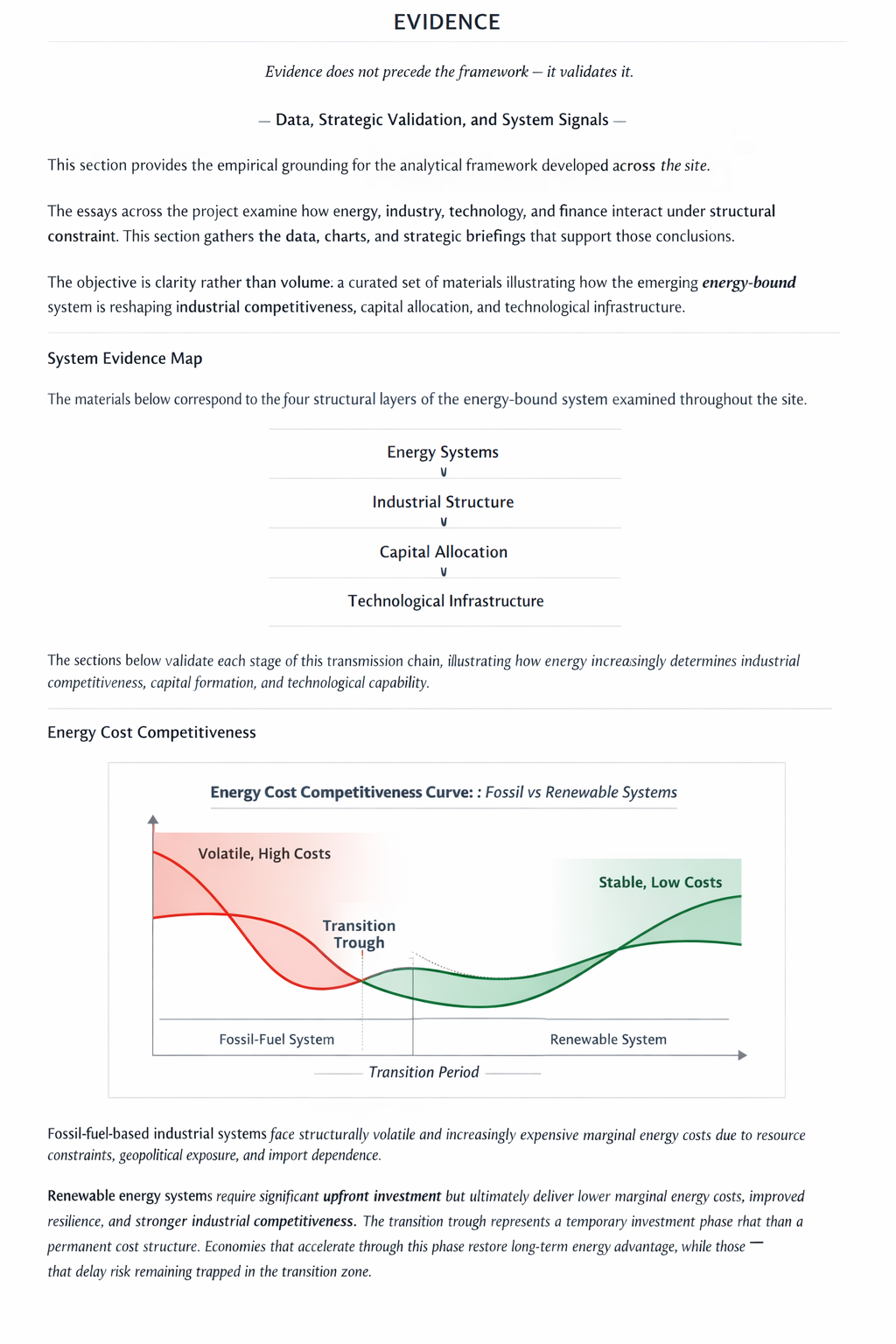
Energy Cost Competitiveness
Energy Cost Competitiveness Curve
Fossil vs Renewable Systems
Industrial systems based on fossil fuels increasingly face volatile and structurally rising marginal energy costs, driven by resource constraints, geopolitical exposure, and import dependence.
Renewable energy systems require substantial upfront investment, but once deployed they provide:
structurally lower marginal energy costs
greater energy security
improved industrial competitiveness
stronger long-term system resilience
The transition trough represents a temporary investment phase rather than a permanent cost structure.
Economies that accelerate through this phase regain long-term energy
advantage.
Those that delay risk remaining trapped in a high-cost
industrial equilibrium.
For investors, this dynamic increasingly determines:
industrial margin stability
capital formation
long-term return potential
Strategic System Signals
The analyses below highlight the structural shift emerging across Europe’s energy, industrial, and financial systems.
These materials provide a macro-interpretation layer grounded in empirical evidence, bridging data and strategic positioning.
Energy System Evidence
Energy remains the upstream constraint shaping economic and strategic outcomes.
The materials below provide the empirical foundation underlying the energy analysis developed across the site.
Together these materials provide the empirical layer supporting the system analysis developed across the site.
Monetary Transmission and Structural Constraint
Energy shocks increasingly propagate through monetary and financial channels.
The materials below examine how energy costs influence:
inflation dynamics
sovereign risk
fiscal capacity
monetary policy space
These materials illustrate how energy constraint propagates through currency stability, sovereign risk, and monetary policy capacity.
Capital Allocation Diagnostics and System Capacity
Energy constraints increasingly influence industrial investment patterns, infrastructure deployment, and long-term system capacity.
→ These diagnostics explain how structural constraints shape capital deployment across regions.
Regional Structural Evidence
Energy constraint produces uneven regional effects across Europe and the Mediterranean.
The following analyses examine how these dynamics interact with regional industrial structure and strategic positioning.
Strategic Orientation
The materials assembled in this section illustrate a consistent structural pattern:
Energy systems increasingly determine:
industrial competitiveness
capital formation
technological capability
monetary stability
For investors, this implies a structural shift:
energy is no longer a sectoral variable
it is a primary driver of industrial margins and capital allocation
→ and increasingly, the foundation of long-term returns
Suggested Strategic Reading
Core Essays on this Site
Strategic Context
Vaclav Smil — Energy and Civilization
Daniel Yergin — The New Map
International Energy Agency — Energy Investment and Transition Reports
International Monetary Fund — Energy Price Transmission Studies