Monetary Ceiling Doctrine
Peripheral Transmission: The Greek Case
I. The Core Doctrine (Recap)
The Monetary Ceiling doctrine establishes that in an Energy-Bound System, currency durability is conditioned by:
- marginal energy cost stability
- industrial reinvestment intensity
- current account resilience
- capital allocation preference
- discount rate volatility
A persistent structural energy cost disadvantage imposes a structural monetary ceiling unless corrected.
This ceiling operates gradually — not crisis-driven, but cumulative.
II. Euro Architecture: Internal Asymmetry
The euro is not a single industrial economy.
It is a shared currency across structurally heterogeneous systems.
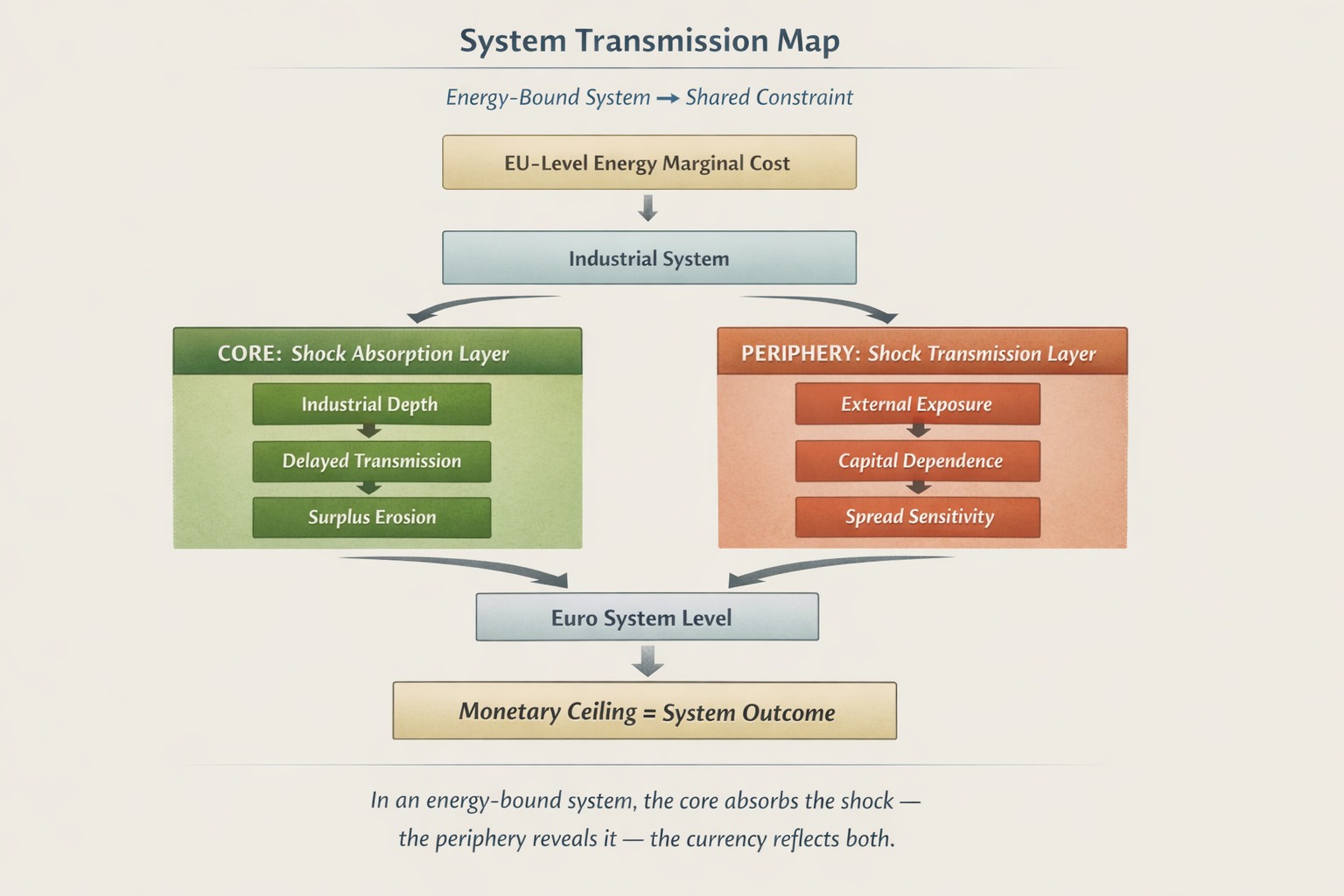
When structural energy cost disadvantage emerges across the euro area:
- core industrial economies absorb through scale, capital depth, and industrial resilience
- peripheral economies absorb through spreads, growth sensitivity, and financing conditions
The Monetary Ceiling therefore transmits asymmetrically within the euro system.
Greece provides a clear illustration.
III. Transmission to Greece
1. Energy Import Exposure → External Sensitivity
Greece remains structurally energy import-dependent.
European structural energy cost disadvantage
→ higher import bill
→ current account sensitivity
→ reliance on capital inflows
This increases exposure to shifts in capital preference.
Energy architecture becomes a sovereign spread variable.
2. Growth Differential → Debt Sustainability Channel
Greece’s public debt sustainability depends on:
Nominal GDP growth exceeding effective borrowing cost
Structural energy disadvantage at the European level reduces:
- industrial competitiveness
- margin resilience
- productivity growth
Lower productivity narrows the growth–interest differential buffer.
Energy cost architecture therefore conditions debt sustainability indirectly but structurally.
3. Spread Sensitivity and Discount Rate Channel
Greek sovereign spreads are influenced by:
- euro-area growth expectations
- ECB policy stability
- external shock exposure
Energy-driven inflation volatility:
- increases rate uncertainty
- raises peripheral spread sensitivity
- elevates long-duration discount rates
Under persistent structural disadvantage, peripheral spreads embed higher risk premia.
This is not crisis dynamics.
It is structural monetary conditioning.
4. Capital Allocation Asymmetry
When capital reallocates toward lower marginal energy-cost systems (e.g. US):
- the euro weakens structurally
- peripheral spreads widen relatively
- smaller markets face higher discount rates
Energy stability compresses spreads.
Energy instability amplifies asymmetry.
IV. The Integrated Transmission Chain
Structural energy cost disadvantage (euro system)
→ industrial margin compression
→ weaker productivity growth
→ capital allocation preference toward lower-cost systems
→ euro structural sensitivity
→ higher peripheral spread beta
→ elevated discount rates in smaller member states
Greece becomes a transmission amplifier — not a causal origin — of the Monetary Ceiling.
V. Structural Mitigation (Doctrinal Consistency)
The Monetary Ceiling is not fixed.
It can be lifted through:
- structural reduction of marginal electricity cost
- pricing architecture redesign
- grid expansion and storage integration
- industrial electrification depth
- coordination across euro-area energy systems
For Greece specifically:
- domestic renewable scaling
- storage deployment
- grid reinforcement
- strategic positioning within Mediterranean energy corridors
European energy sovereignty reduces peripheral sovereign risk.
Energy architecture conditions spread architecture.
VI. Cross-Panel Coherence
This section integrates:
- Energy-Bound System → base constraint
- Energy as the Operating System of Power → structural primacy
- Energy–Capital–Currency Hierarchy → transmission chain
- Agency Under Constraint → strategic response
- Monetary Ceiling → financial expression
The Greek case is not separate from the doctrine.
It operationalises it.
VII. Strategic Insight
The key insight for investors and policymakers:
Energy policy is not separate from monetary stability.
It is upstream of it.
Currency durability in an energy-bound system is conditioned by physical cost architecture.
Peripheral spread stability is conditioned by euro-level energy system design.
The Monetary Ceiling is therefore:
A system-level constraint
With member-state-level transmission effects
Final Doctrine Line (aligned with global anchor)
The Monetary Ceiling does not originate at the
periphery.
It becomes visible there.