Greece — System Node Case Studies Guide
Energy, Constraint, Strategic Conversion, and System Adaptation in Europe’s Southern Gateway
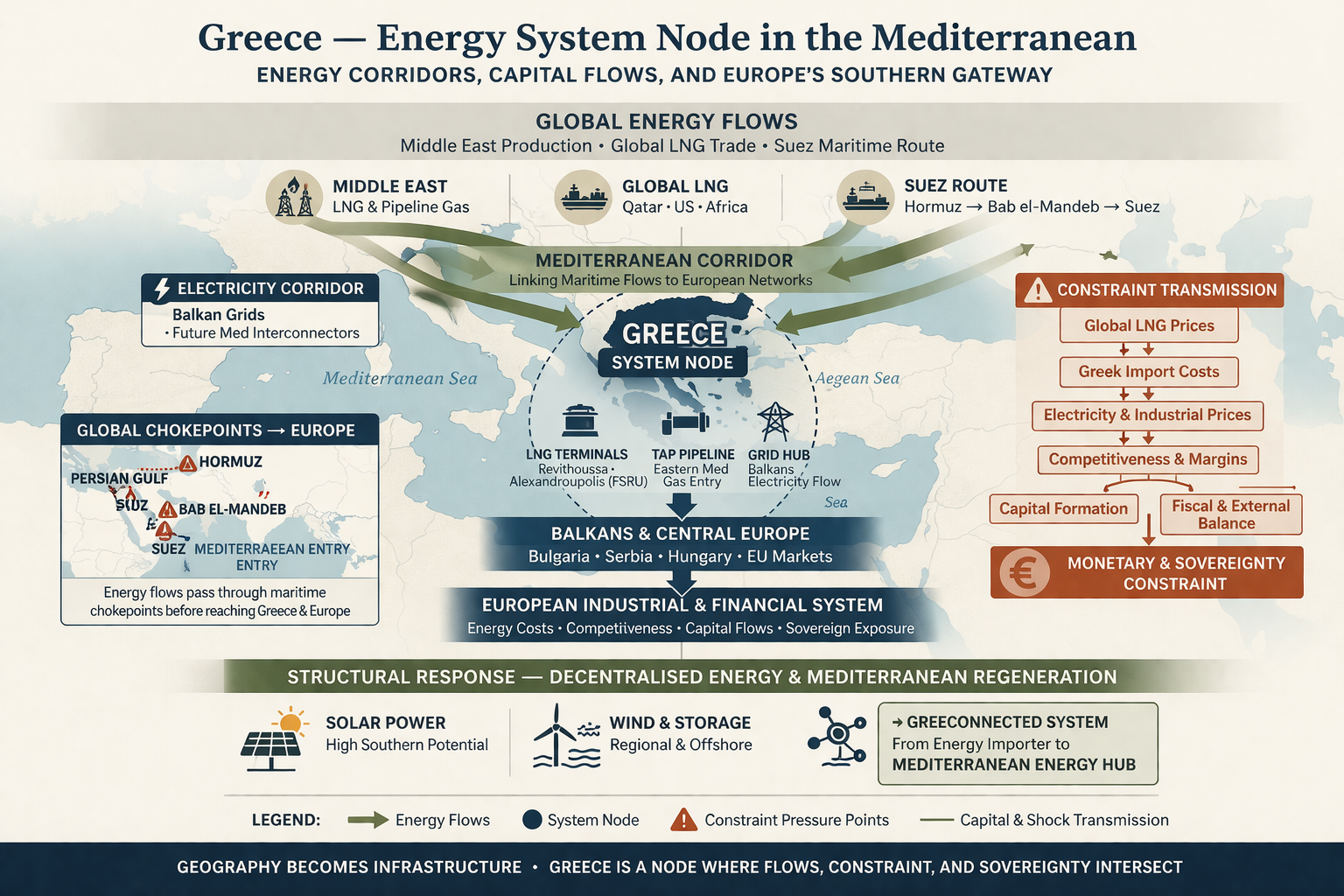
Keynote
Greece is often framed as a peripheral European economy.
Within an energy-bound system, it emerges instead as a strategic system node positioned at the intersection of energy transmission, infrastructure integration, maritime geography, capital dependency, and European structural constraint.
Across multiple dimensions — energy systems, infrastructure corridors, logistics networks, digital connectivity, capital transmission, and geography — Greece illustrates how:
global energy flows enter Europe
constraint propagates through monetary and economic systems
infrastructure reshapes regional positioning
digital and compute infrastructure increasingly follows energy geography
and structural adaptation begins under pressure
This section brings together a set of interlinked analyses that examine Greece not as a standalone economy, but as:
→ a strategic interface between global systems, Mediterranean transition, and European constraint
System Position
These case studies sit within:
→ EU Sovereignty → Regional Systems and Strategic Adaptation
They connect directly to:
GLOBAL → energy systems, geopolitical flows, maritime corridors, systemic asymmetry
TECHWAR → compute infrastructure, stack dependency, industrial ecosystems, and digital coordination systems
EU SOVEREIGNTY → monetary transmission, infrastructure sovereignty, adaptation under constraint, and strategic conversion capacity
System Navigation: Mediterranean System Navigation
I. System Position — Greece as a Node
Greece as a System Node Framework
→ Energy systems, capital allocation, monetary transmission, and systemic exposureGreece as a Strategic Node
→ Energy corridors, maritime infrastructure, logistics systems, and Europe’s southern gateway
II. System Interpretation — Transmission and Control
Transit Without Control — Energy Flows, Capital Extraction, and System Position
→ Infrastructure participation without full sovereign conversionMonetary Ceiling — Peripheral Transmission: Greece
→ Energy, capital, and currency transmission operating under structural constraint
III. Transmission Mechanism — Constraint Propagation
- Energy
Shock Transmission Chain
→ Mechanism of system-wide shock propagation across energy prices, inflation, capital conditions, and monetary systems
IV. Comparative System Context
- Monetary
Ceiling — Core Transmission: Northern Europe
→ Structural divergence between core and peripheral transmission systems
V. Global & Mediterranean System Context
Greece — Energy, Capital, and Monetary Transmission (Evidence Case)
→ Full transmission chain linking energy systems, capital conditions, and monetary exposureMediterranean Energy–Compute Transition
→ Infrastructure transition linking energy systems to compute capacity and digital infrastructureAI Energy Stress Test
→ Energy availability as a future constraint on compute systems, industrial competitiveness, and digital sovereignty
VI. Structural Constraint — Exposure Layer
- Greece
Under External Constraint — Energy, Demographics, and System
Pressure
→ Real-economy constraint linking energy costs, demographic pressure, infrastructure dependency, and capital exposure
VII. Market & Capital Transmission
Core Analysis
- Market
Transmission Under Energy Constraint — Greece
→ How markets price energy constraint, sovereign risk, spreads, volatility, and structural exposure
Investor Layer
- Investor
Structural Note — Energy Constraint and Long-Duration Capital
Positioning
→ Capital allocation and infrastructure positioning under energy constraint
Executive Brief
- Greece
Market Transmission — Investor Brief
→ Executive summary for strategic and long-horizon positioning
VIII. Structural Response — System Adaptation
→ Transition from import dependence
→ toward distributed, decentralised, infrastructure-resilient
energy architecture
IX. System Transformation — Paradigm Shift
→ Long-term transformation of:
infrastructure systems
coordination systems
energy–compute integration
regional industrial positioning
digital architecture
and sovereignty systems
X. Infrastructure, Compute, and Sovereign Conversion
Greece increasingly occupies a strategic position within the emerging energy–compute geography of Europe.
As artificial intelligence systems become progressively more energy-intensive, infrastructure corridors, electricity networks, subsea connectivity, logistics systems, and regional energy stability become directly linked to future compute allocation and digital sovereignty.
This transformation extends beyond energy supply alone.
It increasingly concerns the capacity to participate in:
compute infrastructure
digital coordination systems
industrial ecosystems
platform architectures
regional stack integration
and long-duration infrastructure investment
Energy corridors alone do not generate sovereignty.
Infrastructure participation alone does not generate system power.
Strategic conversion increasingly depends on the ability to connect:
→ energy systems
→ infrastructure systems
→ compute systems
→ industrial ecosystems
→ capital retention
→ and sovereign coordination capacity
Greece therefore represents a broader Mediterranean strategic question:
whether Southern European infrastructure nodes can evolve from transit systems into partially sovereign conversion systems within an energy-bound technological order.
System Logic
Global energy flows
↓
Mediterranean infrastructure corridors
↓
Greek node (energy + infrastructure + maritime geography +
connectivity)
↓
Constraint transmission across energy costs, capital conditions, and
monetary systems
↓
Market pricing across spreads, credit conditions, volatility, and
capital allocation preference
↓
Structural adaptation through decentralisation, infrastructure
integration, and energy–compute transition

Strategic Insight
Greece is not structurally weak.
It is:
→ structurally exposed, but systemically central within the Mediterranean transmission architecture
Its strategic importance derives not from economic scale alone, but from its position inside the emerging interaction between:
energy systems
maritime corridors
infrastructure integration
digital infrastructure
compute geography
regional industrial ecosystems
capital transmission
and European adaptation under constraint
The central strategic question is therefore no longer whether Greece participates in European systems.
The question is whether participation evolves into:
→ partial sovereign conversion capacity within the wider Mediterranean energy–compute transition
Link to Global Framework
Reading Path
What Greece is
→ Greece as a Strategic NodeHow the node functions
→ Greece as a System Node FrameworkHow constraint transmits
→ Monetary Ceiling — Peripheral Transmission: GreeceHow markets price systemic exposure
→ Market Transmission Under Energy Constraint — GreeceHow adaptation begins
→ Decentralised Energy and Greece’s Strategic RenewalHow the Mediterranean transition evolves
→ Mediterranean Energy–Compute Transition
Global Evidence Anchor
→ Analytical backbone linking the Greek case to the wider global energy, infrastructure, compute, and sovereignty system