Defence, Energy, and Strategic Autonomy
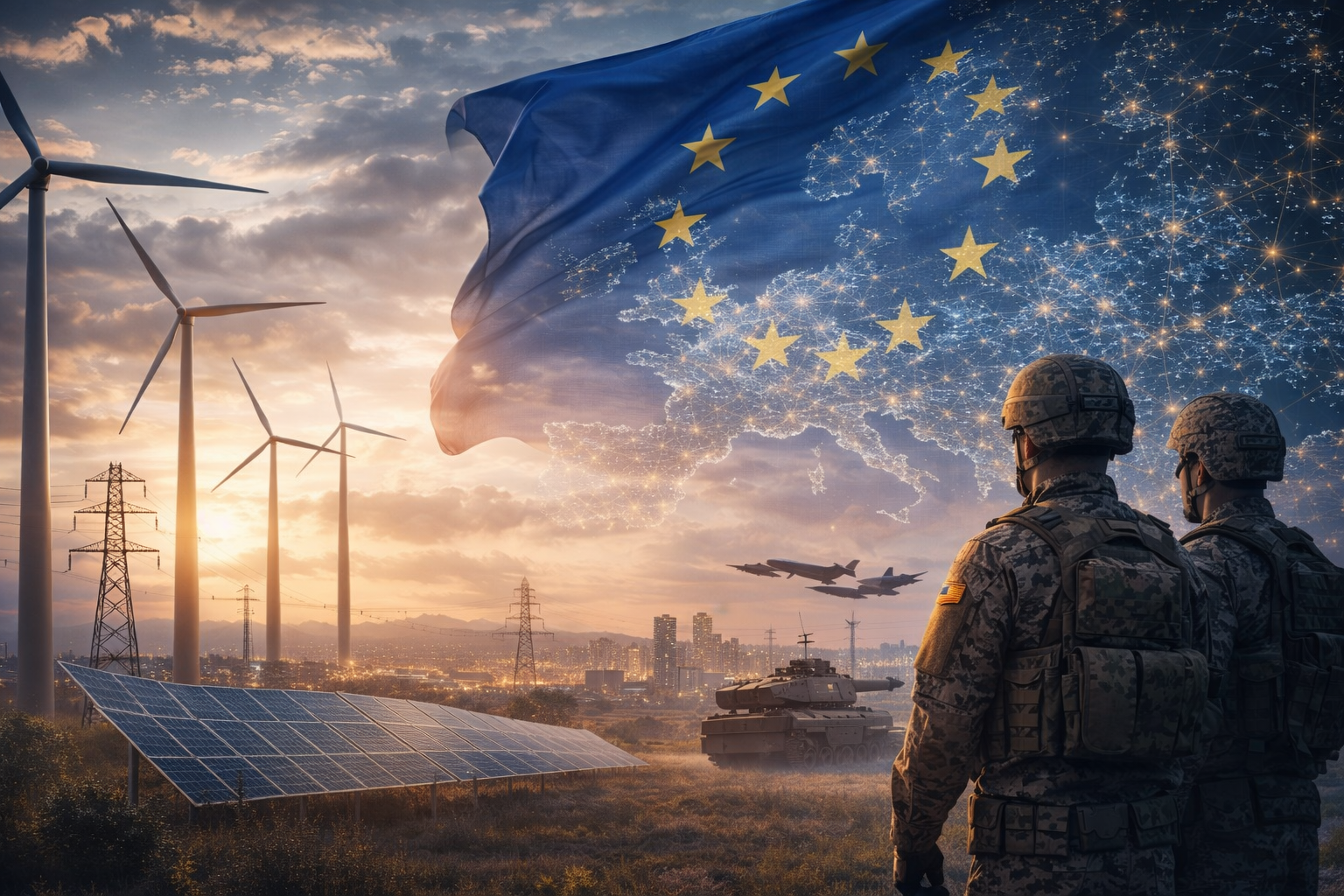
Why Rearmament Without Energy Sovereignty Reproduces Dependency
Following the series on sovereignty, energy, and industrial capability, this addendum applies the same material logic to European defence and rearmament.
Europe is undergoing a rapid phase of military rearmament. Defence budgets are rising, procurement cycles have accelerated, and industrial capacity is being reactivated after decades of underinvestment. This response has been widely justified by reference to acute security threats and alliance commitments.
Yet recent events — including open strategic friction within the Atlantic alliance and renewed uncertainty over NATO’s future orientation — have exposed a deeper structural weakness: Europe has rearmed largely by deepening dependence on external energy, platforms, and suppliers, including those of a former anchor ally.
What has increasingly become clear is that rearmament has functioned as a surrogate for reindustrialisation — politically easier to justify, faster to mobilise, and institutionally familiar — but strategically incomplete. In the absence of energy sovereignty, this defence-led reindustrialisation risks reproducing the very dependencies it was meant to overcome.
The argument here is not that rearmament is misguided. It is that rearmament without energy autonomy cannot deliver strategic autonomy, and under present conditions may even weaken it.
The global system conditions that make this misalignment strategically consequential are examined in System Default: Energy, Anarchy, and the G2 Order.
Defence Capability Is an Energy System
Military power is often discussed in terms of platforms: aircraft, armour, missiles, ships. In practice, defence capability is a logistical and energy system before it is a weapons system. Mobility, sustainment, readiness, training, and resupply all depend on:
- reliable fuel and electricity
- secure supply chains
- resilient infrastructure
- predictable operating costs
An armed force that cannot power, fuel, maintain, or resupply itself autonomously is structurally constrained, regardless of procurement volume. In this sense, defence capability is downstream of the energy–industry–compute stack.
The Fossil Lock-In Risk in Current Rearmament
Much of Europe’s current rearmament trajectory reflects legacy assumptions:
- fossil-fuel–intensive platforms
- long, exposed supply chains
- high operational energy demand
- dependence on externally produced systems and components
These investments may close immediate gaps, but they also:
- lock in long-term fuel dependency
- increase logistical vulnerability
- expose defence readiness to price volatility and geopolitical leverage
For Europe—already structurally import-dependent for fossil fuels—this creates a strategic contradiction. Electrification without decarbonisation deepens exposure; rearmament without energy reform embeds it.
This is not a critique of capability-building, but a warning about path dependence.
Defence in an Electrified, AI-Driven Era
Modern defence systems are increasingly digital and electricity-intensive:
- AI-enabled command and control
- sensor fusion and ISR
- cyber and electronic warfare
- autonomous and semi-autonomous systems
The Fourth Industrial Revolution reshapes defence just as it reshapes industry. Compute, data, and connectivity become decisive—but all depend on stable power.
As with the civilian economy, defence systems face rising electricity demand alongside greater sensitivity to disruption. Energy resilience therefore becomes a core component of deterrence credibility.
Decarbonisation as a Defence Enabler, Not a Constraint
Within this context, decarbonisation should be understood not as a normative agenda, but as a defence enabler.
Electrified and low-carbon energy systems—where appropriate, hybridised with storage and resilient generation—offer:
- reduced fuel logistics
- improved base resilience
- lower exposure to external supply shocks
- greater operational predictability
Decentralised energy systems at bases and logistics hubs can enhance:
- survivability
- continuity of operations
- autonomy under stress
These advantages are not theoretical. They are increasingly recognised in military planning, including within NATO, where energy resilience is now understood as a force multiplier rather than a peripheral concern.
Industrial Defence Capacity and Energy Constraints
Defence sovereignty also depends on industrial capacity: the ability to produce, repair, and scale systems domestically.
Defence manufacturing is energy-intensive. Munitions production, advanced materials, electronics, and maintenance facilities all depend on stable electricity and heat. Where energy is volatile or constrained, surge capacity becomes unreliable.
This reinforces a core insight of the series: industrial and defence sovereignty share the same energy foundation. Investment in defence production without parallel investment in energy systems risks creating bottlenecks that no procurement budget can resolve.
Alliances, Autonomy, and Credible Contribution
This argument is not anti-alliance. On the contrary, it is alliance-realistic.
Alliances are strongest when contributions are credible and dependencies are symmetrical. Excessive energy dependence weakens strategic choice and constrains collective decision-making.
For Europe, strengthening energy autonomy enhances its capacity to contribute meaningfully within alliances such as NATO, rather than relying disproportionately on external energy, technology, or sustainment.
Autonomy, in this sense, is not isolation. It is the ability to act without coercion.
Defence, SMEs, and the Civil–Military Interface
Europe’s defence industrial base increasingly overlaps with its civilian industrial and SME ecosystem:
- advanced manufacturing
- electronics
- software
- materials
- logistics and maintenance
Decentralised, resilient energy systems support this interface by:
- stabilising operating costs
- enabling regional production
- improving supply-chain resilience
This strengthens not only defence readiness, but also local economic regeneration and industrial depth—aligning security objectives with broader sovereignty goals.
The Strategic Risk of Misalignment
The central risk Europe faces is not underinvestment in defence, but misaligned investment:
- short-term urgency overriding long-term resilience
- platform acquisition outpacing system integration
- defence planning detached from energy strategy In an era defined by energy constraint and technological acceleration, this misalignment becomes a strategic liability.
Conclusion: No Defence Autonomy Without Energy Autonomy
Europe’s rearmament debate cannot be separated from its energy debate. Defence capability, industrial capacity, and strategic autonomy now form a single system. Rearmament without energy autonomy reproduces dependency.
Energy autonomy without defence integration remains incomplete.
A credible European defence posture in the twenty-first century requires:
- electrified and resilient energy systems
- decarbonised supply chains where feasible
- decentralised infrastructure for robustness
- industrial capacity aligned with energy reality
These are not environmental preferences. They are conditions of sovereignty.
The challenge before Europe is not whether to rearm, but how—and whether today’s choices build lasting autonomy or merely postpone vulnerability within the European Union and its alliances.
The defence debate cannot be separated from Europe’s energy architecture. Rearmament layered onto an externally dependent system does not produce autonomy; it reorganises dependency. .
References
NATO — Work on energy security, operational resilience, fuel logistics, and military readiness, including analyses of energy dependence as a strategic vulnerability.
European Defence Agency — Assessments of European defence industrial capacity, production bottlenecks, and supply-chain resilience in the context of rearmament.
International Energy Agency — Analysis of electricity demand growth driven by data centres, AI, and electrification, with implications for system resilience and security.
European Commission — Defence Industrial Strategy, Energy System Integration, and resilience-related communications linking energy infrastructure, industry, and strategic autonomy.
Academic and policy literature on military logistics, sustainment, and energy dependence, including studies on fuel vulnerability, base resilience, and decentralised energy systems in defence contexts. This addendum should be read as an application of the Energy–Industry–Compute stack to defence planning under conditions of systemic stress.