Italy — Industrial Structure Deep Dive
Resilience, Fragmentation, and Constraint in an Energy-Bound System
Keynote
Italy possesses one of the most sophisticated industrial systems in Europe.
It combines advanced manufacturing capabilities, highly specialised production, deeply embedded regional ecosystems, and dense networks of industrial coordination.
However, this industrial capacity does not translate into sustained system-level power.
This outcome is not the result of insufficient capability.
It results from the interaction between energy constraint, industrial fragmentation, capital limitations, incomplete compute integration, and weak platform control.
In an energy-bound system, industrial strength alone is not sufficient to generate durable strategic power.
Industrial systems must also be aligned with:
stable and competitively priced energy
scalable infrastructure
compute capacity
digital coordination systems
technological ecosystems
and capital capable of supporting long-term expansion
Italy therefore represents a distinct structural condition within the European system:
a high-capacity industrial ecosystem operating under persistent structural constraint and incomplete system conversion
System Navigation
This article extends the Mediterranean diagnostic layer by analysing the internal structure of Italy’s industrial system under conditions of energy, capital, and technological constraint.
It should be read alongside:
– Italy —
Industrial Capacity Under Energy Constraint
– Italy
— Energy–Industrial Transmission Under Constraint
– Spain — Iberian
Constraint
– Greece — Capital
Allocation Problem
– France
— Nuclear Continuity and Hybrid Infrastructure Sovereignty
– Mediterranean System Architecture — Western, Eastern, and Hinge Nodes
And within the broader system:
– EU Systemic
Asymmetry
– Europe — The
Missing Conversion Layer
– AI–Energy–Cost
Chasm
– Energy–Industry–Compute
Stack
– Industrial
Ecosystems — Cross-Panel Index
– Digital
Sovereignty Index
System Position
Italy occupies a central position within the European industrial system.
It sits between the energy-constrained Mediterranean periphery and the industrial and financial core of Northern Europe.
Within the broader system chain:
Energy → Infrastructure → Compute → Ecosystems → Capital → Sovereignty
Italy is strongly positioned in industrial production and manufacturing ecosystems, but less aligned in the surrounding layers that increasingly determine long-term system power.
Its condition reflects a structural imbalance.
Industrial capability is advanced and resilient, but energy remains externally exposed and volatile. Capital is fragmented and constrained, and integration into compute infrastructure, software ecosystems, platform layers, and digital coordination systems remains incomplete.
As a result, Italy sustains industrial production, but does not fully convert industrial capability into system-level power.
I. The Structure of Italian Industry
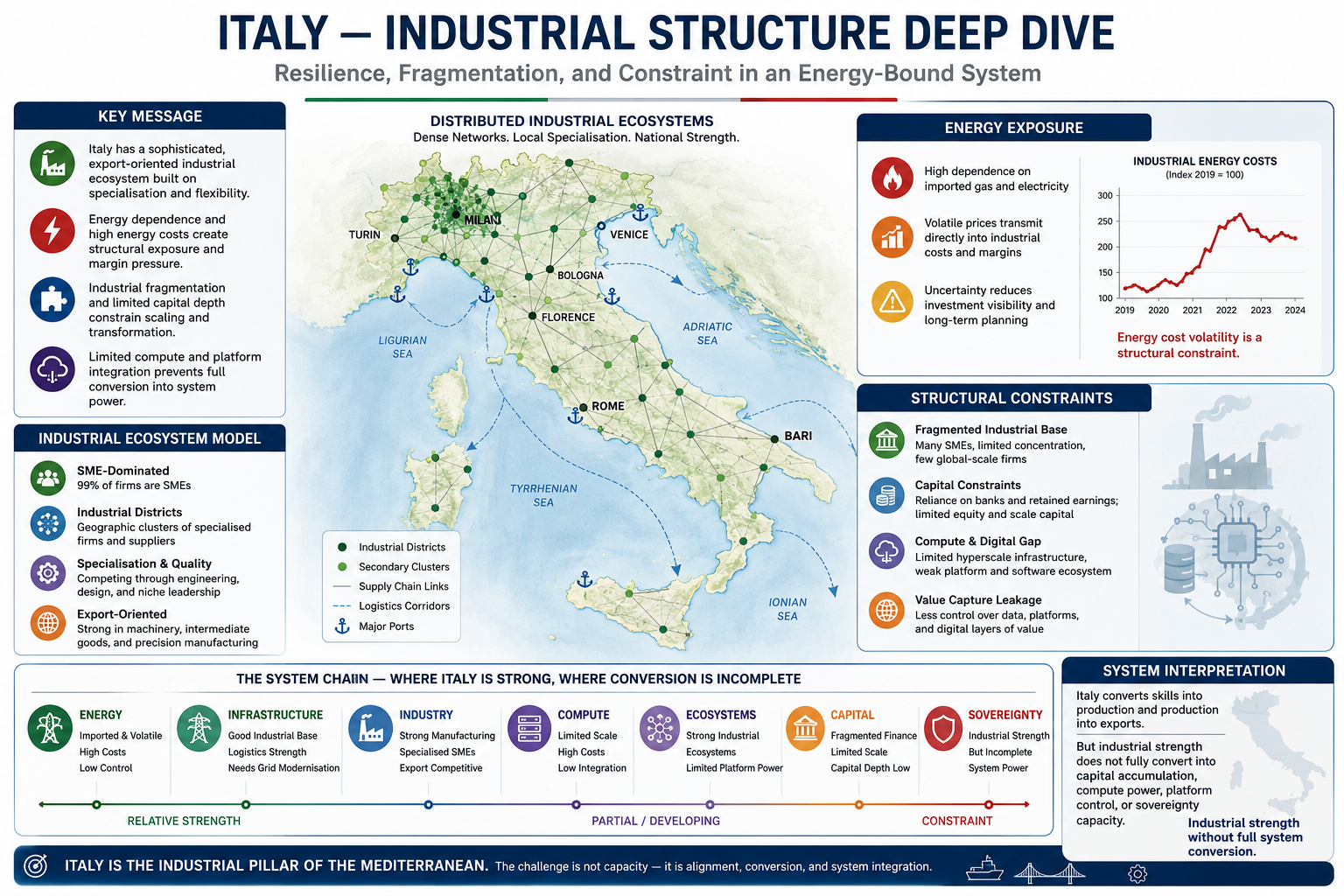
Italy’s industrial system is defined by a distinctive organisational model based on distributed industrial ecosystems rather than large-scale concentration.
Small and medium-sized enterprises form the core of this structure. These firms are highly specialised, export-oriented, and deeply embedded within regional production networks and supply chains.
Production is organised geographically into industrial districts, particularly across Northern Italy. These districts concentrate suppliers, technical knowledge, engineering capability, specialised labour, and production infrastructure within dense local ecosystems.
This organisational structure enables high levels of flexibility, resilience, technical specialisation, and adaptive manufacturing capacity.
Firms are often able to respond rapidly to changing demand conditions, shifting market requirements, and supply-chain disruptions.
Italy’s export profile reflects this structure.
The country remains a major exporter of machinery, intermediate industrial goods, precision manufacturing products, and specialised industrial systems.
Its competitiveness is based less on scale and more on:
quality
flexibility
technical depth
specialised manufacturing capability
and ecosystem density
However, this structure also imposes systemic limitations.
The prevalence of small firms leads to fragmented ownership structures and limited industrial concentration.
This fragmentation reduces the capacity for:
large-scale capital accumulation
vertically integrated industrial scaling
platform development
strategic technology coordination
and long-term industrial consolidation
As a result, Italy possesses strong industrial density, but weaker systemic concentration.
II. Energy Exposure and Cost Transmission
Italy’s industrial system is structurally exposed to energy costs due to its reliance on imported energy.
Historically, a significant share of gas supply was linked to Russian flows. This dependence created vulnerability to external shocks, including supply disruptions, geopolitical instability, and extreme price volatility.
In an energy-bound system, energy costs transmit directly into industrial structure.
Higher electricity and gas prices increase production costs, compress industrial margins, reduce investment visibility, and weaken long-term competitiveness, particularly in energy-intensive sectors.
However, the effect extends beyond immediate profitability.
Volatile energy systems undermine the long-term coordination mechanisms required for industrial scaling, compute deployment, infrastructure investment, and technological upgrading.
Under these conditions, firms prioritise operational resilience over strategic expansion.
This creates a broader system outcome.
Industrial systems remain operational, but become progressively constrained in their ability to scale, consolidate, digitise, and transform.
System Transmission Map — Distributed Industry and Energy Alignment

III. Industrial Ecosystems and Resilience
Despite these constraints, Italy’s industrial system remains highly resilient.
This resilience emerges primarily from the structure of its industrial ecosystems.
Small and medium-sized enterprises are able to adapt production processes, reconfigure supplier relationships, and respond rapidly to changes in cost conditions and market demand.
Industrial districts reinforce this flexibility through:
dense supplier coordination
knowledge spillovers
informal industrial networks
technical specialisation
and geographically concentrated expertise
In many sectors, competition is based on engineering capability, specialised production, and technical quality rather than low-cost mass manufacturing alone.
This reduces vulnerability to certain forms of price competition.
However, resilience at the ecosystem level does not automatically produce system-level power.
Italy demonstrates strong adaptive capability at the microeconomic level, but limited scaling capability at the macro-system level.
The industrial ecosystem can absorb shocks efficiently.
It cannot easily expand into dominant platform, compute, or capital architectures.
IV. Fragmentation and Capital Constraints
The limitations of the industrial structure become more pronounced at the level of capital formation.
Italy exhibits a lower degree of industrial concentration than Germany and fewer globally dominant industrial firms.
It possesses:
less vertical integration
weaker capital-market depth
reduced large-scale equity financing
and more limited strategic consolidation mechanisms
The financial structure of Italian firms reinforces this condition.
Firms rely heavily on:
bank financing
retained earnings
family ownership structures
and regional financial systems
rather than deep capital markets and large-scale institutional investment.
As a result, firms often face constrained access to long-duration growth capital.
This reduces their capacity to invest in:
technological upgrading
compute integration
automation
artificial intelligence systems
software coordination layers
and long-term industrial transformation
Capital fragmentation therefore reinforces industrial fragmentation.
It constrains scaling, consolidation, technological integration, and strategic investment across the wider system.
V. Missing Layers — Compute, Platforms, and Digital Coordination
The structural constraint extends beyond manufacturing into the digital and technological layers of the system.
Italy is not a primary hub for hyperscale data centres, large-scale AI infrastructure, or dominant cloud ecosystems.
This condition reflects the interaction between:
energy cost instability
infrastructure limitations
fragmented capital
and weaker integration into global digital ecosystems
As industrial systems increasingly integrate artificial intelligence, industrial software, cloud coordination, machine learning systems, and data-driven optimisation, compute infrastructure becomes part of industrial competitiveness itself.
Industrial capability can no longer be separated from digital coordination capacity.
This creates a major structural challenge for Italy.
Although the country maintains strong manufacturing ecosystems, it captures a smaller share of:
platform control
software ecosystems
industrial data value
AI infrastructure
and digital scaling dynamics
Italian firms often operate inside global supply chains without controlling the surrounding digital architectures through which value increasingly accumulates.
As a result, industrial production generates value, but substantial portions of digital capture, data coordination, and platform scaling occur outside the domestic system.
This limits Italy’s ability to move upward within an increasingly AI-driven industrial environment.
VI. System Interpretation
Italy should not be understood as an industrially weak economy.
It is a structurally capable but systemically constrained industrial ecosystem.
It successfully converts:
skills into production
production into exports
and industrial ecosystems into resilience
However, it struggles to convert:
production into large-scale capital accumulation
industrial ecosystems into platform ecosystems
and industrial capability into sovereignty capacity
This produces a defining system condition:
industrial strength without full system conversion
Strategic Role in the Mediterranean System
Italy represents the industrial pillar of the Mediterranean system.
Within the wider Mediterranean architecture:
Spain provides energy potential but lacks full transmission and conversion integration
Italy provides industrial capacity but lacks energy alignment, compute integration, and capital scaling
Greece reflects capital allocation constraints, financial fragmentation, and external dependency
Together, these conditions reveal a broader structural pattern.
The Mediterranean already contains many of the foundational layers required for long-term strategic autonomy:
energy
infrastructure
industrial ecosystems
logistics corridors
maritime connectivity
compute potential
and capital flows
However, these layers remain geographically fragmented, institutionally disconnected, and insufficiently integrated into a coherent system architecture.
The core Mediterranean challenge is therefore not the absence of capability.
It is incomplete system integration and weak conversion capacity.
Strategic Implications
Italy’s constraints are structural, but they are not permanent.
Improvement depends on alignment across multiple system layers.
First, energy alignment is required.
This includes access to stable and competitively priced electricity, stronger grid integration, infrastructure expansion, and deeper integration into European and Mediterranean energy systems.
Second, industrial scaling mechanisms must be strengthened.
This includes enabling firms to move beyond fragmented structures where appropriate and supporting larger industrial coordination frameworks capable of sustaining long-term technological transformation.
Third, compute and digital integration must expand.
Industrial ecosystems increasingly depend on:
AI-enabled production
industrial software
cloud coordination
automation
data infrastructure
and compute scalability
Without these layers, industrial systems risk remaining operationally capable but strategically subordinated.
Fourth, capital deepening is necessary.
This requires stronger capital markets, improved access to equity financing, long-term investment coordination, and mechanisms capable of supporting industrial and technological scaling.
Without alignment across these layers, structural constraints will persist.
Final Synthesis
Italy demonstrates a central principle of the energy-bound system:
industrial capability alone does not generate system power
System power emerges only when:
energy systems
industrial ecosystems
compute infrastructure
digital coordination layers
capital formation
and platform architectures
are aligned within a coherent strategic system.
When this alignment remains incomplete, systems can remain productive, resilient, and technologically capable, but they cannot scale efficiently into durable sovereignty capacity.
Italy therefore represents a structurally constrained industrial ecosystem:
capable of sustained production
resilient under pressure
but limited in conversion, scaling, and strategic expansion
System Continuity
Italy’s condition connects directly to the broader European system.
It highlights the widening gap between:
industrial capability
energy alignment
compute integration
capital formation
and system-level sovereignty capacity
across Europe’s wider architecture.
This leads directly to the next analytical layer:
→ Europe — The Missing Conversion Layer
Where the central question becomes whether Europe can align energy, infrastructure, industry, compute, ecosystems, and capital into a functioning system of strategic power.