Defence, Energy, and Strategic Autonomy
Addendum
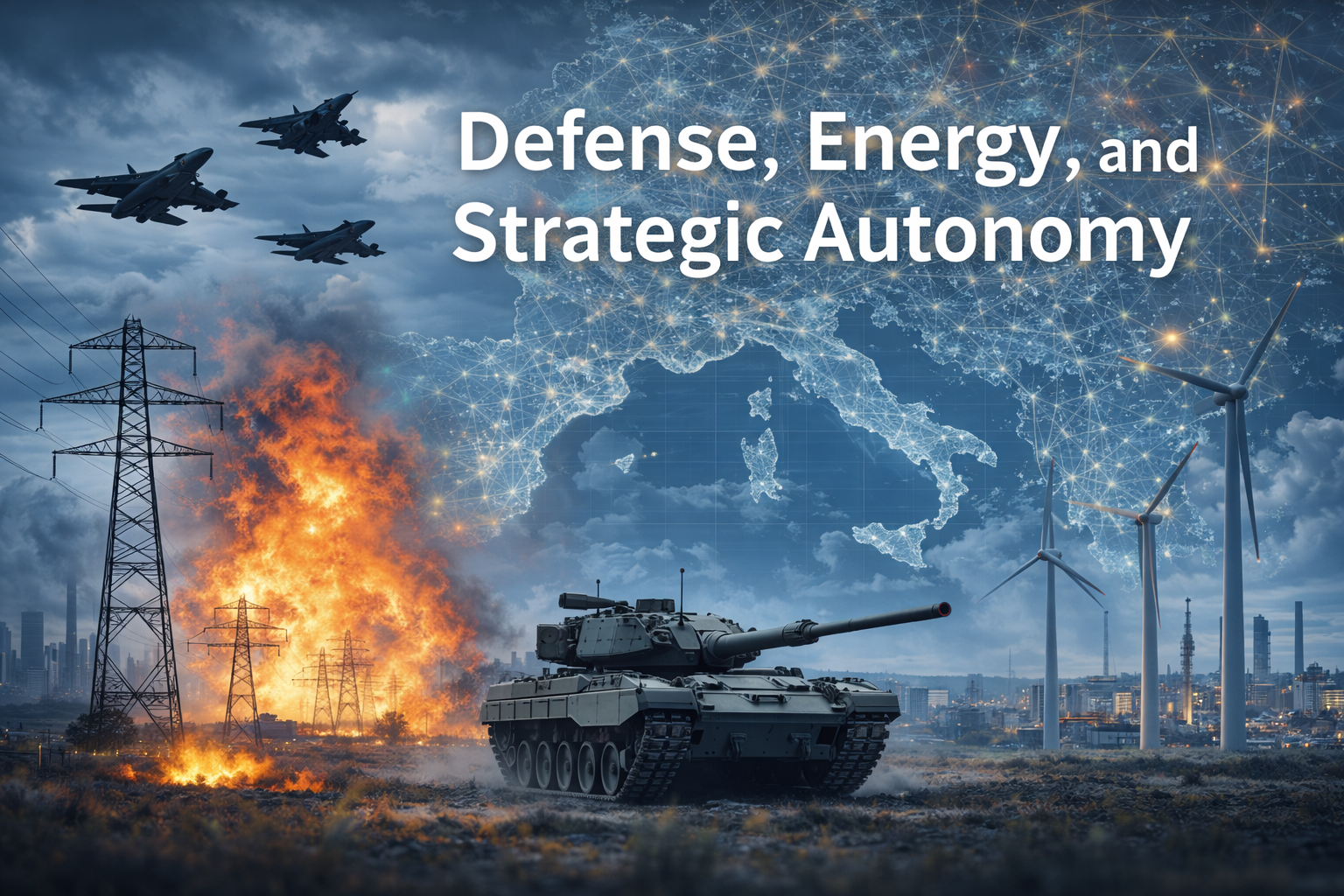
Keynote
Rearmament without energy sovereignty reproduces dependency.
In an electrified, AI-driven world, defence capability is downstream of the energy–industry–compute system. Without energy autonomy—electrified, resilient, and strategically aligned—military investment risks reinforcing the very vulnerabilities it seeks to overcome.
Executive Summary
Europe is rearming rapidly in response to acute security threats. Defence budgets are rising, industrial production is accelerating, and procurement cycles have shortened.
Yet rearmament is unfolding within an externally dependent energy and supply structure. This creates a structural contradiction: defence capability cannot be autonomous if the energy systems that sustain it remain volatile, import-dependent, and geopolitically exposed.
Military power is not only platforms. It is logistics, fuel, electricity, maintenance, and supply chains. In the Fourth Industrial Revolution, defence systems are increasingly electricity-intensive and digitally integrated. Energy resilience becomes a determinant of deterrence credibility.
Decarbonised and decentralised energy systems should therefore be understood as defence enablers, not environmental constraints. They reduce fuel logistics vulnerability, improve base resilience, and stabilise operational costs.
The central risk for Europe is misalignment:
rearmament without energy reform
platform acquisition without system integration
short-term urgency overriding long-term resilience
Strategic autonomy in defence requires alignment between:
Energy autonomy
Industrial capacity
Technological integration
Democratic legitimacy
Rearmament layered onto an externally dependent system does not produce autonomy. It reorganises dependency.
Why Alignment Now Matters
Europe’s rearmament debate is unfolding at speed. Political consensus around military strengthening is widening. Production lines are being reactivated. Procurement decisions are being fast-tracked.
But the decisive policy question is not whether Europe should rearm.
It is whether rearmament is being aligned with the energy, industrial, and institutional conditions required to make strategic autonomy durable.
Rearmament is currently occurring inside an energy architecture that remains structurally exposed: fossil import dependence, electricity price volatility, fragmented grids, and insufficient storage capacity. Unless that architecture evolves in parallel, increased defence spending may expand capability on paper while leaving systemic vulnerabilities intact.
This is not a question of military ambition. It is a question of policy coherence.
Defence Capability Is an Energy System
Military power is often measured in platforms—aircraft, armour, missiles, ships. In practice, defence capability is first a logistical and energy system before it is a weapons system.
Mobility, sustainment, readiness, training, and resupply depend on:
reliable fuel and electricity
secure supply chains
resilient infrastructure
predictable operating costs
An armed force that cannot power, fuel, maintain, or resupply itself autonomously is structurally constrained, regardless of procurement volume.
In an electrified and digitally integrated defence environment, energy resilience becomes foundational to operational credibility.
The Lock-In Risk in Current Rearmament
Much of Europe’s current rearmament trajectory reflects legacy assumptions:
fossil-fuel–intensive platforms
long and exposed supply chains
high operational energy demand
reliance on externally produced systems and components
These investments may close immediate capability gaps, but they risk embedding long-term vulnerability.
For Europe—already structurally dependent on imported fossil fuels—this creates a sequencing problem. Electrification without decarbonisation increases exposure to price shocks. Platform acquisition without energy reform institutionalises external leverage.
The danger is not underinvestment in defence.
The danger is misaligned investment.
Defence in an Electrified, AI-Driven Era
Modern defence systems are increasingly electricity-intensive:
AI-enabled command and control
sensor fusion and ISR
cyber and electronic warfare
autonomous and semi-autonomous systems
The Fourth Industrial Revolution reshapes defence as it reshapes industry. Compute, data, and connectivity become decisive—but all depend on stable power.
As electricity demand rises, so does sensitivity to disruption. Energy resilience therefore becomes a core component of deterrence credibility, not a secondary consideration.
Decarbonisation as Strategic Infrastructure
Within this context, decarbonisation should be understood not as a normative environmental agenda, but as strategic infrastructure reform.
Electrified and low-carbon energy systems—combined with storage and resilient generation—can:
reduce fuel logistics vulnerability
stabilise operating costs
increase base survivability
lower exposure to geopolitical supply shocks
Decentralised energy systems at bases and logistics hubs enhance operational continuity under stress.
Energy reform is not separate from defence planning. It is integral to it.
Industrial Capacity and Energy Constraint
Defence sovereignty depends on industrial capacity: the ability to produce, repair, and scale systems domestically.
Defence manufacturing is energy-intensive. Munitions, advanced materials, electronics, and maintenance facilities all require stable electricity and heat. Where energy is volatile or constrained, surge capacity becomes unreliable.
Investment in defence production without parallel investment in energy systems risks creating bottlenecks that no procurement budget can resolve.
Industrial resilience and energy resilience are inseparable.
Alliances and Credible Contribution
This argument is not anti-alliance. It is alliance-realistic.
Alliances are strongest when contributions are credible and dependencies are symmetrical. Excessive energy dependence constrains strategic choice and limits bargaining power.
Strengthening energy autonomy enhances Europe’s ability to contribute meaningfully within alliances such as NATO, rather than relying disproportionately on external energy, technology, or sustainment.
Autonomy is not isolation.
It is the capacity to act without coercion.
The Strategic Risk of Misalignment
The central risk Europe faces is not insufficient defence spending, but structural misalignment:
short-term urgency overriding long-term resilience
procurement outpacing system integration
defence planning detached from energy strategy
political consensus forming around spending, but not around structural reform
If rearmament substitutes for deeper industrial and energy reform—because it is faster and more visible—it may displace rather than resolve Europe’s sovereignty challenge.
Conclusion: Alignment Determines Autonomy
Europe’s rearmament debate cannot be separated from its energy debate. Defence capability, industrial capacity, technological integration, and democratic legitimacy now form a single system.
Rearmament without energy autonomy reproduces dependency.
Energy autonomy without defence integration remains incomplete.
A credible European defence posture in the twenty-first century requires:
electrified and resilient energy systems
decarbonised supply chains where feasible
decentralised infrastructure for robustness
industrial capacity aligned with energy reality
political alignment capable of sustaining long-term reform
The question before Europe is not whether to rearm.
It is whether current defence decisions are reinforcing systemic resilience—or reorganising structural vulnerability within the European Union and its alliances.
The structural sovereignty analysis underpinning this argument is
developed in
Defence,
Energy, and Strategic Autonomy in the European Sovereignty
panel.