Nations, Europe, and the Future of Sovereignty
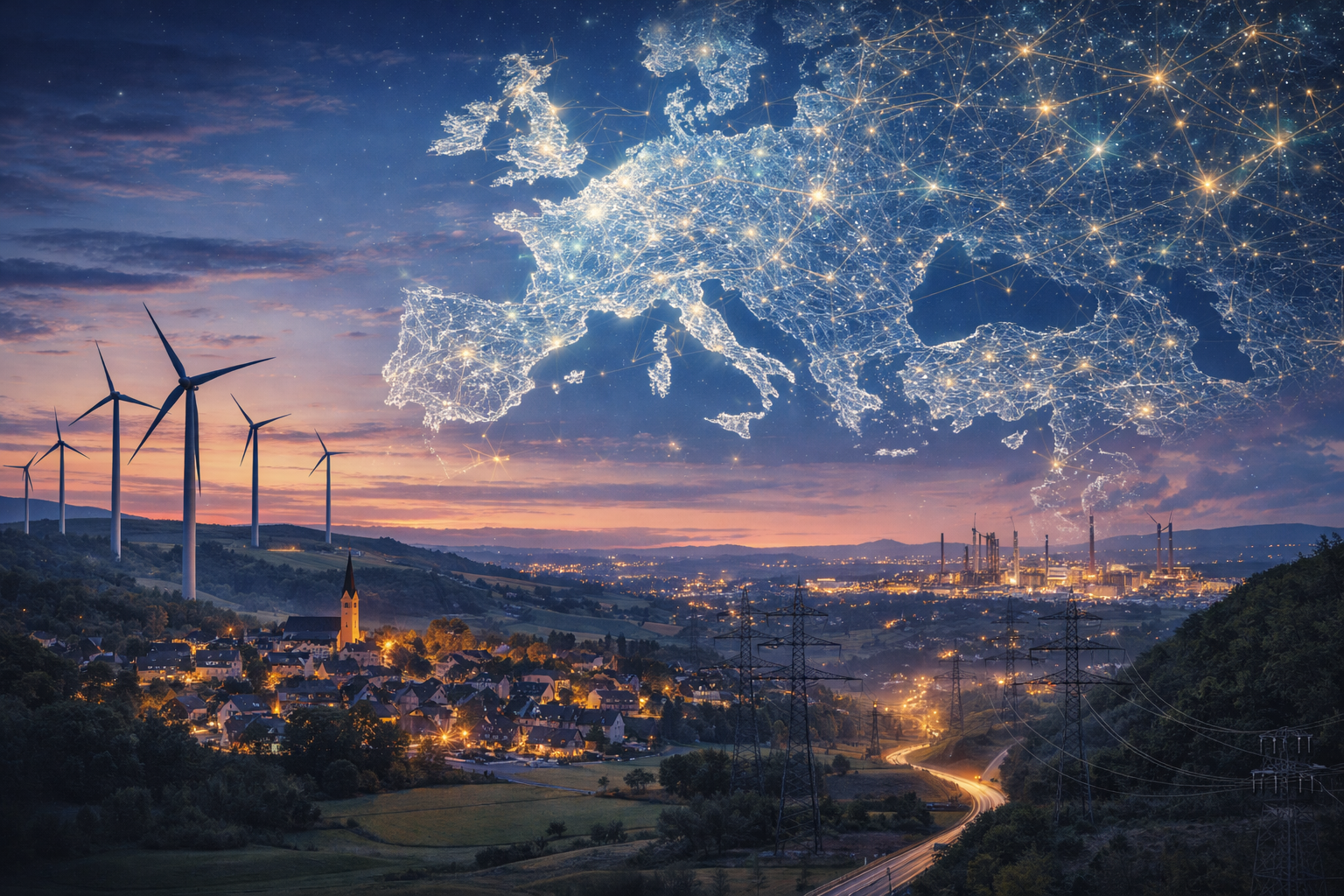
Why Energy Autonomy Is the Only Sustainable Basis for Democratic Power
Keynote
European sovereignty cannot endure without democratic legitimacy.
In an energy-constrained, AI-driven world, capability increasingly requires European scale, yet legitimacy remains rooted in national democracy. Energy autonomy is the only structural foundation that allows national sovereignty and European cooperation to reinforce rather than undermine one another.
Executive Summary
Nations, Europe, and the Future of Sovereignty
Sovereignty in the 21st century is not an identity claim but a material capability. Energy autonomy, industrial competitiveness, AI capacity, and institutional alignment form a single strategic system. Yet this system can endure only if it is democratically sustained.
Across Europe, national politics have reasserted themselves because citizens continue to vote nationally while key economic determinants—energy prices, industrial location, capital flows—have moved beyond national control. This gap between political responsibility and material capability has weakened trust.
The solution is not retreat from cooperation, but structural alignment. Energy autonomy—electrified, decarbonised, and decentralised—provides the missing link. It can be built collectively at European scale while being experienced locally through stable costs, SME resilience, and regional investment.
Decentralisation reconnects political agency to economic outcomes. When energy systems allow firms and regions to participate directly, sovereignty becomes tangible. European integration then functions not as a replacement for national democracy, but as a sovereignty multiplier.
Strategic autonomy therefore depends on three conditions:
Energy autonomy as material foundation
Capability diffusion across SMEs and regions
Democratic legitimacy sustained through visible gains
Sovereignty in an AI-driven world must be built collectively, experienced locally, and legitimated democratically. Energy autonomy is the only durable basis for that reconciliation.
Throughout this series, sovereignty has been treated not as an abstract ideal, but as a material capability. Energy autonomy, industrial competitiveness, AI capacity, and institutional alignment have been shown to form a single strategic system. Yet one dimension remains decisive: If legitimacy determines whether capability endures, the final question is how national democracy and European scale can reinforce rather than undermine one another.
No sovereignty project can endure without democratic consent. In Europe, that consent is expressed primarily through nations, even as capability increasingly depends on continental scale. This article addresses the most sensitive question in the series: how national democracy remains the primary source of legitimacy, even as capability increasingly requires European scale. European integration, and strategic autonomy can be reconciled in an electrified, AI-driven world.
This article does not introduce a new layer to the argument; it resolves the tension that has run through all the preceding ones.
The argument is not ideological. It is structural. Energy autonomy is the only foundation on which national sovereignty and European cooperation can reinforce—rather than undermine—each other.
The Return of the National Question
Across Europe, national politics have reasserted themselves. This is often described as a backlash against globalisation or European integration. In reality, it reflects a deeper tension.
For decades, national governments retained democratic responsibility while losing control over:
- energy prices
- industrial location
- capital flows
- technological scale
Citizens continued to vote nationally, but key determinants of prosperity moved beyond national reach. This gap between political responsibility and material capability weakened trust.
The result has not been a rejection of cooperation per se, but a demand that sovereignty once again deliver tangible security and opportunity.
Sovereignty Is Experienced Nationally, Even When Built Collectively
European sovereignty is often misunderstood as a zero-sum transfer from nations to institutions. In practice, sovereignty today is exercised at multiple levels simultaneously.
- Capability increasingly requires continental coordination
- Legitimacy remains rooted in national and local communities
This is not a contradiction—it is a design challenge.
The mistake is to treat national sovereignty as an identity claim rather than as a functional expectation: that democratic choices should meaningfully influence economic and social outcomes.
When they do not, political resistance is rational.
Energy Autonomy as the Missing Link
Energy is where this tension becomes most visible—and most resolvable.
As established throughout this series, energy autonomy—electrified, decarbonised, and increasingly decentralised—is the non-negotiable foundation of modern sovereignty. Without it, industrial competitiveness erodes, AI capability stalls, and institutions lose credibility.
Crucially, energy autonomy can be built collectively while being experienced locally.
This is what distinguishes it from other domains of globalisation. Energy systems shape:
- household costs
- SME viability
- regional investment
- employment and regeneration
When energy systems are decentralised and resilient, sovereignty becomes visible in daily life.
Decentralised energy systems are therefore not only an economic or technical solution; they are the political hinge that allows European coordination to reinforce, rather than displace, national democratic control.
Decentralisation and the Reconnection of Power
Decentralised energy systems do more than improve resilience. They reconnect political agency to economic outcomes.
Local generation, storage, and digitally managed grids allow:
- regions to retain value
- SMEs to stabilise costs
- communities to participate in strategic infrastructure
This does not fragment sovereignty. It grounds it.
In this sense, decentralisation restores a key element of national sovereignty that was lost under highly centralised, import-dependent energy models: a sense of control.
National Democracy as a Pillar of European Strategy
European strategy cannot succeed by bypassing national democracies. It must work through them.
National governments remain:
- the primary locus of democratic legitimacy
- the interface between citizens and strategy
- the guarantors of consent over time
A European project that strengthens national capacity—rather than hollowing it out—will command far greater durability.
Energy autonomy provides that opportunity. It allows Europe to act at scale while enabling nations and regions to see concrete returns from cooperation.
Reframing Nationalism Without Denial
The political vocabulary around nationalism has become polarised. But analytically, nationalism is not inherently destructive. It becomes destabilising when expectations of control collide with persistent dependency.
What citizens demand is not isolation, but:
- security
- predictability
- agency
When European cooperation delivers these, national politics stabilise. When it does not, opposition hardens.
The choice is not between nationalism and Europe. It is between capability-based sovereignty and symbolic politics.
The Energy–Democracy Feedback Loop
A critical feedback loop now emerges:
- Energy autonomy improves economic resilience
- Resilience strengthens trust in institutions
- Trust enables long-term investment and coordination
- Coordination reinforces energy autonomy
This loop can operate at national, regional, and European levels simultaneously.
Without energy autonomy, the loop reverses: volatility undermines trust, trust constrains strategy, and sovereignty erodes.
Europe as a Sovereignty Multiplier
Understood correctly, Europe is not a replacement for national sovereignty, but a sovereignty multiplier.
By pooling scale where scale is required—energy systems, industrial capacity, digital infrastructure—Europe enables nations to deliver outcomes they can no longer secure alone.
The condition is alignment: European strategy must reinforce national resilience, SME viability, and regional regeneration. When it does, legitimacy follows.
Conclusion: Sovereignty Rebuilt From the Ground Up
The future of European sovereignty will not be decided by declarations, treaties, or identity debates alone. It will be decided by whether citizens experience greater control, stability, and opportunity in their economic lives.
Energy autonomy is the foundation of that experience. Industrial competitiveness and AI capability build upon it. Institutions coordinate it. But legitimacy sustains it.
Where energy autonomy is built, capability follows; where capability is shared, legitimacy endures; and where legitimacy endures, sovereignty remains a choice rather than a constraint.
In an electrified, AI-driven world, sovereignty must be built collectively, experienced locally, and legitimated democratically. Where energy autonomy is built, capability follows; where capability is shared, legitimacy endures; and where legitimacy endures, sovereignty remains a choice rather than a constraint.
References
OECD
Inequality, Trust, and Policy Legitimacy
European Commission
Social Fairness and the Green Transition
Amartya Sen
Development as Freedom
https://www.hup.harvard.edu/books/9780674007913
World Economic Forum
Global Risks Report
https://www.weforum.org/reports/global-risks-report-2024
European Council
Democratic Resilience in the EU
https://www.consilium.europa.eu/en/policies/rule-of-law/