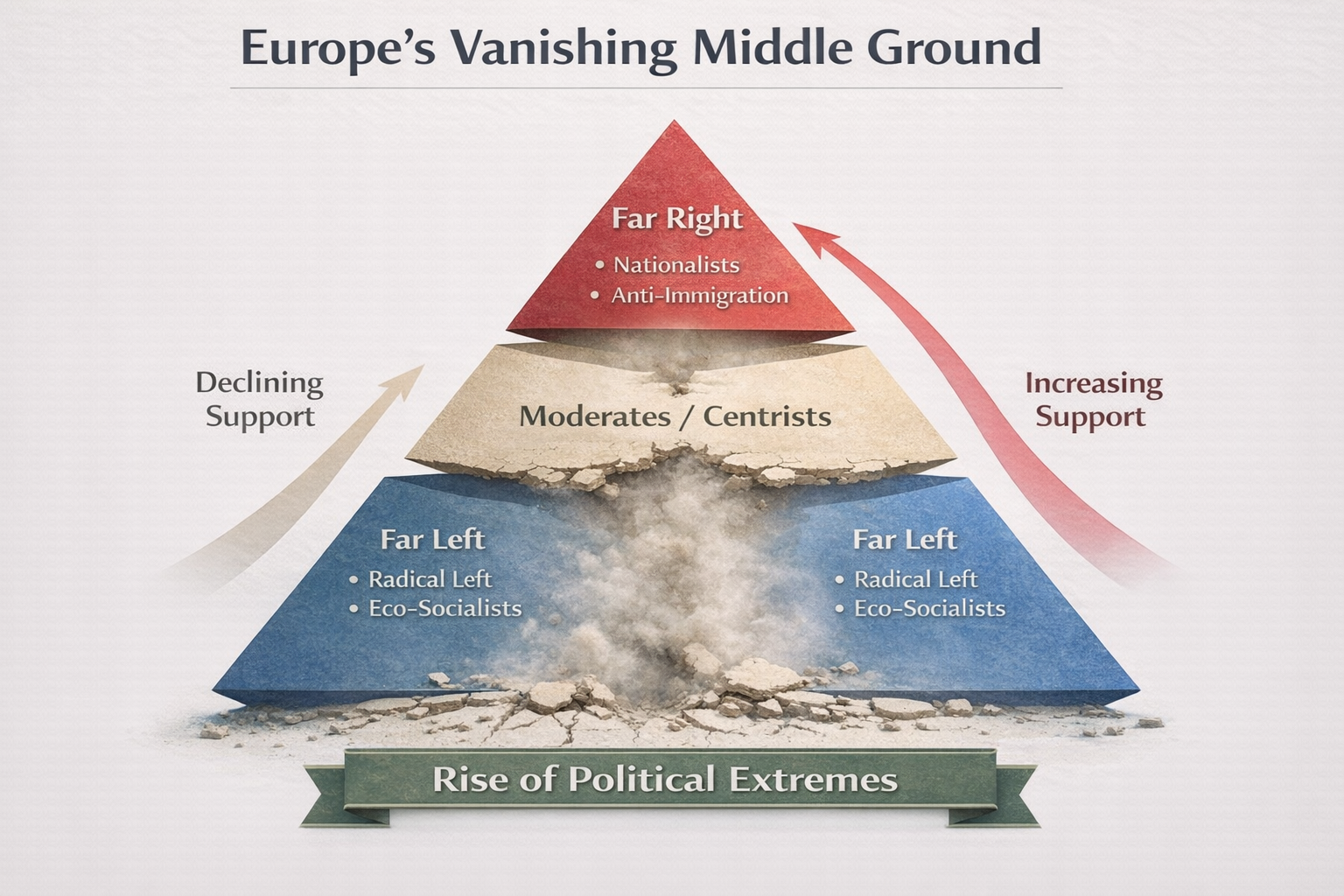
Europe’s Vanishing Middle Ground
Asymmetry, Energy Constraint, and the Erosion of Europe’s Buffering Role
Why alignment without local resilience becomes exposure
Keynote
Europe’s historical stability depended on its ability to buffer asymmetry — externally between power blocs, and internally between regions exposed to different adjustment pressures.
In an energy-bound global system defined by accelerating structural divergence, that buffering capacity is eroding.
When asymmetry transmits faster than resilience is built, alignment becomes exposure.
Preface — Buffering Was a Function of Material Conditions
For much of the post-war period, Europe occupied a distinctive systemic position. It was neither a continental superpower nor a peripheral dependency. Instead, it functioned as a stabilised intermediary within a relatively predictable global order.
That role was not purely institutional. It was material.
It rested on:
abundant and relatively stable external energy supplies
expanding trade regimes
gradual industrial adjustment
deepening but manageable financial integration
demographic momentum
Under those conditions, divergence could be absorbed. Economic imbalance did not immediately translate into political fracture.
Those conditions no longer hold.
Energy has re-emerged as the binding constraint of modern power. Electrification, compute intensity, and industrial re-concentration accelerate divergence across regions and systems. Adjustment now transmits rapidly through energy costs, capital markets, technology stacks, and demographic strain.
Europe’s middle ground was not erased by ideology.
It is being compressed by structural constraint.
I. From External Buffer to Internal Transmission
In the earlier paradigm, Europe absorbed global asymmetry at its edges.
External shocks — oil crises, trade disputes, currency shifts — were mediated through institutional coordination and gradual adjustment. Energy abundance and global liquidity allowed time.
In the current paradigm:
energy costs diverge structurally
compute capacity concentrates geographically
capital mobility accelerates
industrial ecosystems re-cluster
security pressures intensify
Adjustment pressures no longer dissipate gradually. They transmit.
What once functioned as a buffer increasingly acts as a transmission mechanism.
Global asymmetry is internalised within Europe itself.
This is not merely an economic development.
It is a shift in the material foundations of sovereignty.
II. Surplus Without Accumulation
Europe’s predicament illustrates the difference between competitiveness and control.
Several member states maintain persistent trade surpluses. Yet surplus does not reliably translate into strategic autonomy.
As documented by the International Monetary Fund, export windfalls do not automatically raise national saving when profits are:
financialised
internationally mobile
offset by currency appreciation
recycled through globally integrated capital markets
In Europe’s case, strong currencies, fragmented fiscal authority, and deep financial openness combine to produce a structural paradox:
surplus without accumulation
growth without retained power
The constraint is not insufficient competitiveness.
It is insufficient control over the monetary and financial channels
through which competitiveness is monetised.
In an energy-bound system, this matters profoundly.
Energy cost differentials compound through industry, finance, and
technology.
(See Energy System Data Companion and Investor Reframing for supporting metrics.)
III. Structural Exposure Within Europe
Europe’s internal divergence is often described in national terms. It is more accurately understood as differentiated exposure to systemic constraint.
Regions vary in their proximity to:
capital flows
advanced compute infrastructure
low-cost energy
demographic vitality
industrial upgrading capacity
Metropolitan centres cluster capital and technology but concentrate congestion, housing pressure, and inequality. Peripheral and rural regions face depopulation, ageing workforces, and declining industrial capacity.
These patterns do not map neatly onto the traditional North–South divide. They reflect structural positioning within an energy- and compute-constrained system.
When adjustment recurs without visible renewal, constraint ceases to feel cyclical. It becomes permanent.
IV. The Moralisation of Structural Outcomes
Europe’s most destabilising fracture is not divergence itself. It is the interpretation of divergence.
In surplus regions, stability is attributed to discipline and
institutional strength.
In deficit regions, adjustment is experienced as extraction and
externally imposed constraint.
Both experiences are rooted in material reality.
Both become corrosive when framed as moral verdicts rather than
structural outcomes.
When structural asymmetry is moralised:
responsibility becomes accusation
solidarity becomes suspicion
integration becomes perceived hierarchy
Trust erodes not because divergence exists, but because its causes are misidentified.
In an energy-bound system, asymmetry is structural before it is behavioural.
V. Institutions Under Constraint
European institutions sit at the intersection of:
limited national policy space
exposure to global financial volatility
energy price shocks
fragmented capital markets
uneven demographic trajectories
They are blamed because they are visible.
Yet institutional strain reflects deeper constraint. When fiscal and industrial buffers weaken, political fragmentation increases. This is not unique to Europe; it is a recurring feature of constrained systems.
Institutions cannot buffer indefinitely when material divergence accelerates.
VI. Geography, Demography, and Compression
The vanishing middle ground is spatial as well as economic.
Urban cores concentrate innovation and capital but amplify congestion and inequality. Large parts of Europe face:
rural depopulation
ageing populations
shrinking tax bases
declining public services
Energy cost exposure and industrial reconfiguration intersect with demographic imbalance.
Where local capacity erodes, integration feels extractive.
Where adjustment is permanent, solidarity feels asymmetrical.
The erosion of buffering is therefore experienced geographically.
VII. Decentralised Resilience as Structural Counterweight
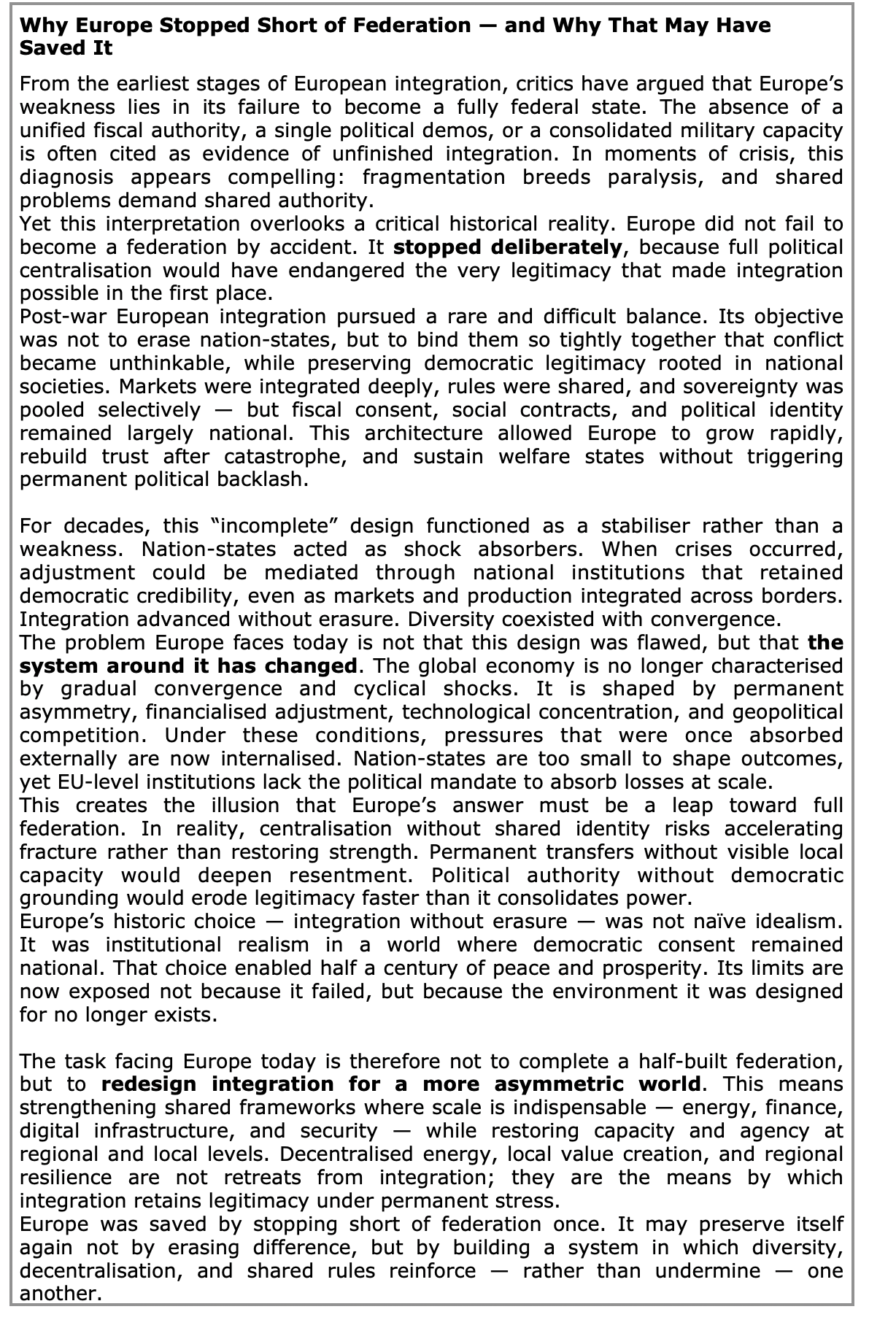
Centralisation alone cannot restore buffering capacity in an energy-bound system.
Scale advantages accrue to continental powers able to integrate energy, compute, finance, and industry within unified architectures. Europe cannot replicate that model.
Its comparative advantage lies elsewhere: in distributed industrial ecosystems, regional governance capacity, and technological sophistication.
Decentralised energy systems and locally embedded industrial capacity do not eliminate asymmetry. They alter how it propagates.
By:
generating energy regionally
retaining value locally
coupling industry with infrastructure
reducing exposure to external price shocks
decentralisation transforms transmission into absorption.
Resilience becomes visible where people live.
This is not fragmentation.
It is distributed stabilisation.
(See Reconstructing Europe and The Architecture of Europe’s Strategic Renewal for system design implications.)
VIII. Europe Between Concentration and Fragmentation
Externally, Europe faces a global order increasingly structured around G2-scale energy–compute systems.
Internally, it risks fragmentation if adjustment continues to fall unevenly and persistently on the same regions.
The vanishing middle ground reflects this dual pressure:
concentration at the global level
divergence at the regional level
Europe cannot match the scale centralisation of continental
powers.
It cannot survive as a loose collection of permanently exposed
regions.
Its historical strength lay in combining integration with diversity — shared frameworks with local autonomy.
Rebuilding that balance requires embedding resilience materially, not rhetorically.
IX. What Is at Stake
The danger is not sudden collapse.
It is gradual erosion.
A Europe that loses its buffering capacity becomes:
slower in adjustment
more defensive politically
increasingly divided regionally
structurally dependent externally
Innovation migrates.
Trust declines.
Adjustment becomes normalised.
In a fragmented global order, this trajectory hardens asymmetry rather than mitigating it.
Europe retains the institutional depth and industrial capability to avoid this outcome. But buffering must be rebuilt through system design, not assumption.
Conclusion — Restoring the Material Basis of the Middle Ground
Europe’s middle ground was never an abstraction.
It was a function of material conditions.
As energy re-emerges as the binding constraint of modern power, buffering cannot rely on gradualism alone. It must be engineered.
Preserving Europe’s middle ground is not an ideological
ambition.
It is a structural necessity in an energy-bound, G2-structured
world.
How Europe reconstructs resilience — by embedding energy, industry, and governance capacity where people live — determines whether asymmetry becomes fracture or adaptation.
For the structural diagnosis underlying these dynamics, see Europe’s Challenge.
Further Reading
Structural Foundations
The Energy Paradigm Shift
Energy as the Operating System of Power
System Default — Energy, Anarchy, and the Emerging G2 Order
European Structural Diagnosis
Europe’s Challenge
Europe’s Strategic Opportunity
Reconstructing Europe
The Architecture of Europe’s Strategic Renewal
Technology and Constraint
System Foundations of the Energy–AI–Industrial Economy
Energy–Industry–Compute Stack
Data and Empirical Companions
For quantitative grounding:
Energy System Data Companion
Investor Reframing
Strategic Tipping Point — Brief and Extended Versions
Charts and Visual Data
Reference
International Monetary Fund (2026). Who Captures Export Windfalls? Exchange Rates, Export Profitability, and National Saving. IMF Working Paper, January 2026.