From Petrodollars to Infrastructure Currency
War, energy systems, and the reconfiguration of monetary power

Keynote
For half a century, the global monetary system has been anchored in a simple loop.
Energy exported in dollars. Surpluses recycled into dollar
assets.
Liquidity returned to the system that priced the energy.
This was the petrodollar system.
Today, that system is not disappearing.
But it is no longer sufficient to describe how monetary power
operates.
A new layer is emerging.
Energy flows are now interacting with:
compute infrastructure
digital payment rails
sovereign capital
electrification systems
and geopolitical fragmentation
The result is not a replacement of the old order.
It is a recomposition.

I. The Petrodollar System (Recap)
The original architecture functioned as a reinforcing loop:
oil exports (USD)
↓
current account surpluses
↓
recycling into US financial assets
↓
deepening dollar liquidity
Its strength was not oil pricing alone.
It was system design:
energy demand anchored currency demand
capital markets absorbed global surpluses
financial depth reinforced monetary dominance
This created a closed loop:
Energy → Capital → Currency
The United States sat at its centre.
II. Why the System Is Under Stress
The pressure on this system does not come from currency competition alone.
It comes from structural change in the energy system itself.
Three forces are converging:
1. Electrification
Energy is shifting from globally traded fuels to locally generated electricity systems.
This reduces the automatic recycling loop embedded in oil trade.
2. Infrastructure Intensity
Power is no longer defined only by resource extraction.
It is defined by:
grids
storage
LNG terminals
semiconductor fabs
data centres
Energy is becoming infrastructure-bound.
3. Compute as an Energy System
Artificial intelligence transforms electricity into economic output.
Compute is no longer a digital layer.
It is an energy conversion layer.
These shifts do not eliminate the existing system.
They deepen it—and change where power sits within it.
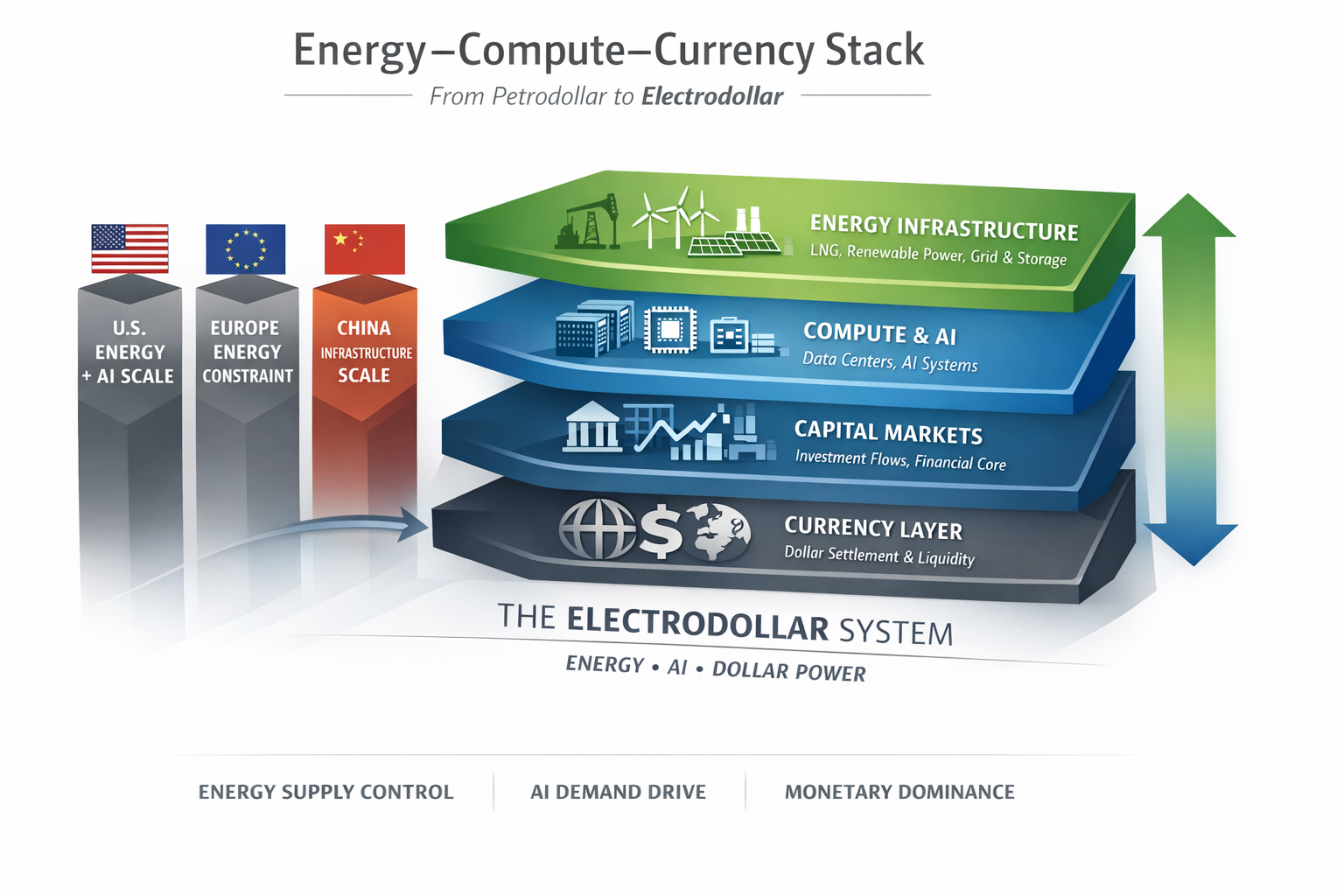 ## III. Beyond
the Petrodollar: The Infrastructure Layer of Monetary Power
## III. Beyond
the Petrodollar: The Infrastructure Layer of Monetary Power
The transition is often described as a shift from a petrodollar system to an electrodollar system.
This framing is intuitive.
It is also incomplete.
The system is not moving from one currency regime to another.
It is moving toward a deeper architecture:
Energy → Infrastructure → Capital → Currency
Electricity does not replace oil as a monetary anchor.
Infrastructure replaces commodity flows as the critical layer of control.
What matters is no longer only:
- who produces energy
But:
- who builds and controls the systems that generate, transport, store, and convert it
This includes:
grid-scale electrification
LNG export infrastructure
hyperscale data centres
semiconductor manufacturing
transmission and interconnection systems
Monetary power now emerges from the ability to:
stabilise energy at scale
convert energy into industrial and digital output
absorb capital into infrastructure systems
anchor returns in real capacity
The implication is structural:
Currency dominance no longer rests primarily on pricing energy.
It rests on controlling the infrastructure through which energy becomes economic power.
IV. The United States: Reinforcing Monetary Power Through Infrastructure
The United States is not losing monetary dominance in this transition.
It is repositioning it.
It combines:
energy abundance (oil, gas, LNG)
deep capital markets
technological leadership
control of compute infrastructure
This allows it to:
price energy (via LNG and global markets)
attract global capital
host the majority of AI infrastructure
convert energy into high-value output
The result is not the erosion of the dollar.
It is its reinforcement through a broader system architecture.
V. Fragmentation and Parallel Systems
Other actors respond differently.
China:
builds state-coordinated infrastructure
secures energy inputs
expands industrial capacity
develops parallel financial channels
Europe:
faces structural energy cost disadvantages
remains fragmented at the infrastructure level
experiences capital leakage
operates under a tightening monetary ceiling
The system does not split cleanly.
It becomes layered and asymmetric.
VI. The New Monetary Logic
The emerging system is no longer defined by a single loop.
It is defined by a hierarchy:
Energy
↓
Infrastructure
↓
Compute
↓
Industry
↓
Capital
↓
Currency
Each layer reinforces the next.
But the lower layers dominate the system.
In this structure:
energy sets the constraint
infrastructure determines scalability
compute defines conversion efficiency
capital follows capacity
currency reflects system strength
VII. Strategic Implication
The key shift is this:
Monetary power is no longer anchored in energy trade alone.
It is anchored in energy systems.
This changes the strategic question.
From:
- Who prices energy?
To:
- Who controls the systems that convert energy into power?
Countries that:
align energy supply
build infrastructure
scale compute
coordinate capital
will sustain monetary strength.
Those that do not:
will experience structural compression.
Further Reading
Core Doctrine
System Architecture
Monetary Layer
Series Context
One Line Doctrine
The next phase of monetary power will be determined less by who prices energy, and more by who builds the systems through which energy becomes infrastructure, computation, and economic activity.
Position in the Framework
This article sits in:
GLOBAL → System Power in an Energy-Bound World
It connects directly to:
- Energy Geopolitics
- Chokepoints Under Compression
- Energy Constraint and the Monetary Ceiling
- Energy–Industry–Compute Stack
- Agency Under Constraint
- Execution Under Compression
- Monetary Ceiling(Europe)
Related — Monetary Foundations
- Energy Constraint and the Monetary Ceiling
- Energy, Financialisation, and Capital Hierarchy
- Infrastructure Currency Doctrine
System Power Link
System Transition
From Petrodollar to Electrodollar System
The Energy J-Curve — AI, War, and Europe’s Point of No Return
Physical Constraint ## Transmission Mechanism
European Constraint Layer
Europe’s Challenge — Structural Compression ## Compute and Infrastructure Layer