Annex — Legacy Formulation and Extended Notes
Core Mechanism
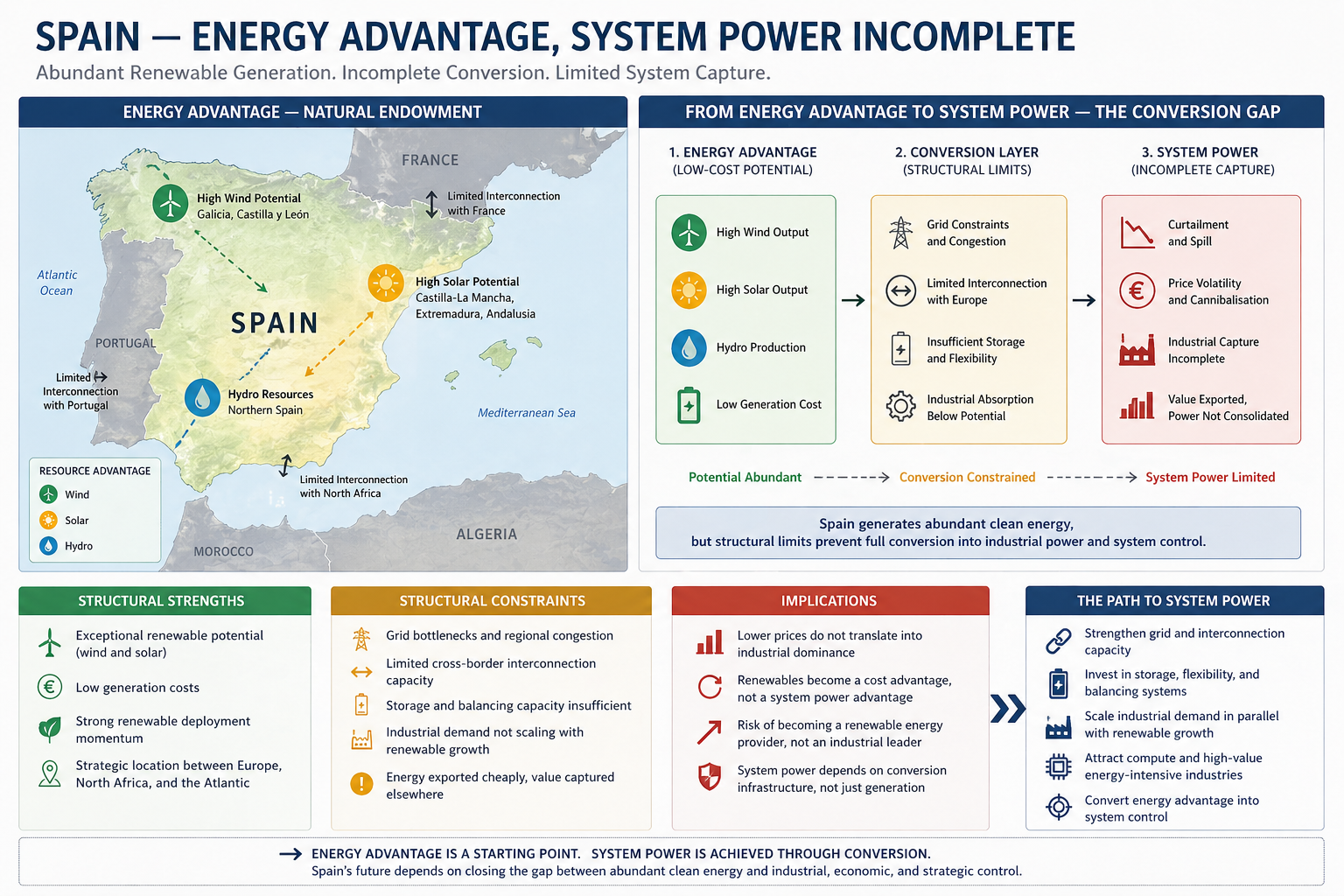
Energy Advantage Does Not Automatically Produce System Power
In an Energy-Bound System, lower-cost energy provides:
a foundation for industrial expansion
potential for capital attraction
improved competitiveness
But this only materialises if:
infrastructure enables scaling
industry absorbs the advantage
capital is aligned with the system
In Spain:
The chain is not fully completed.
Structural Characteristics
Spain’s system reflects three interacting limitations:
1. Energy Strength
high renewable deployment (solar, wind)
improving marginal cost dynamics
increasing electricity system flexibility
→ Energy is becoming structurally competitive
2. Infrastructure Constraint (Iberian Isolation)
limited interconnection with France and core Europe
constrained electricity export capacity
partial integration into the European grid
→ Energy advantage is geographically contained
3. Industrial and Capital Gap
weaker large-scale industrial absorption
limited hyperscale compute ecosystem
capital allocation not fully aligned with energy advantage
→ Conversion into system power remains incomplete
Transmission — Partial Propagation
Spain demonstrates a different transmission dynamic from Greece and Italy.
Energy advantage → partial industrial benefit → limited capital reinforcement
This produces:
lower energy costs relative to peers
but incomplete industrial scaling
and limited system-wide impact
Transmission exists — but it is not system-complete.
Comparison — Spain vs Italy vs Greece
| Dimension | Greece | Italy | Spain |
|---|---|---|---|
| System role | Transmission | Industrial system | Energy system |
| Energy position | Weak | Constrained | Improving |
| Industrial base | Limited | Strong | Moderate |
| Transmission | Strong (constraint) | Slow compression | Partial |
| Outcome | Fragility | Compression | Incomplete conversion |
System Consequence
Spain does not experience the same level of constraint as Greece or Italy.
Instead, it experiences:
underutilisation of energy advantage
limited industrial scaling relative to potential
constrained capital capture
partial divergence from higher-cost systems
Energy advantage without conversion does not produce system power.
Link to the Monetary Layer
Spain’s improved energy position does not fully translate into monetary strength.
capital formation remains constrained
industrial scaling is incomplete
external competitiveness gains are partial
This results in:
a softened—but not eliminated—Monetary Ceiling
Technology and Compute Layer
Spain holds structural potential within the AI–energy system:
renewable-based electricity supply
capacity to host energy-intensive infrastructure
However:
limited hyperscale ecosystem
dependence on external technology platforms
insufficient co-location of energy and compute at scale
Compute potential exists — but system control does not.
Mediterranean Position — Western Node
Spain functions as the Western node of the Mediterranean system:
interface with Atlantic energy flows
proximity to North African energy potential
renewable-rich energy system
However:
node positioning without integration does not produce control
Spain connects:
energy
infrastructure
geography
But does not fully convert these into:
industrial dominance
capital concentration
system power
Strategic Implication
Spain demonstrates a critical system principle:
Energy advantage is a necessary—but not sufficient—condition for system power.
This has direct implications:
infrastructure integration is critical
industrial scaling must follow energy advantage
capital must align with physical systems
System Insight
Spain completes the third layer of the Mediterranean system:
Greece → constraint transmission
Italy → industrial compression under constraint
Spain → energy advantage without full conversion
Together, they demonstrate:
The Mediterranean connects energy, infrastructure, and capital—
but does not fully convert them into system power.
Final Principle
Energy defines the potential of a system.
Conversion determines whether that potential is realised.
Without infrastructure, industry, and capital alignment,
energy advantage remains structurally incomplete.