GLOBAL - System Power in an Energy-Bound World
I. Foundational System Logic - Core Doctrines
• Energy As Operating System Of Power
• Energie–Kapital–Währungs-Hierarchie
• Doktrin der Infrastrukturwährung
• Energy Sovereignty As System Control
• Doktrin — Systemsouveränität
• Centralised Vs Distributed Systems
• Souveränität hybrider Infrastrukturen
II. Energy Transition and System Transformation -Structural Transition
• Global Energy Paradigm Shift
• Transformation des globalen Energiesystems
• Transformation des Energiesystems
• Energy Geopolitics Global Shift
• Die J-Kurve der Energiewende
• Dekarbonisierung, Elektrifizierung und Kosten
• Der europäische Souveränitäts-Stack
III. AI, Compute, and Infrastructure - AI–Energy System Layer
• KI, Energie und die Zukunft der Souveränität
• Die Architektur von Energie, Kapital und Rechenleistung
• Konvergenz von Energie, Industrie und Rechenleistung
• Die globale Verschiebung der Rechenleistung
• Hyperscaler-Infrastruktur-Souveränität
• Strategische Mineralien im KI–Energie-System
• Systemische Re-Konzentration
IV. Monetary and Capital Architecture - Monetary Layer
• Energiebegrenzung und monetäre Obergrenze
• Energie, Finanzialisierung und Kapitalhierarchie
• Energy Capital Currency Index
• Vom Petrodollar zum Elektrodollar
• Energie- und Währungsmacht der USA
• Monetary Sovereignty Energy Bound System
V. Structural Asymmetry - Constraint and Divergence
• Systemischer Standardzustand
• Systemische Asymmetrie
• Periphere Knoten in einem energiegebundenen System
• Finanzialisierte KI und die Infrastrukturrealität
• Schwelle der KI–Energie-Souveränität
VI. Global Order Under Stress - Geopolitical System Stress
• Globale Ordnung unter Druck — Index
• Technologiekonflikt als Energiekrieg
• Der neu verdrahtete Petrodollar
• LNG, NATO und die Durchsetzung von Systemmacht
• Das industrielle System Chinas
• Chinas Technologie–Energie-Transformation
• Energieüberfluss der USA und Systemmacht
• Globale Systemmacht — vergleichende Architektur
VII. Systems Under Constraint - Execution Under Structural Limits
• Systeme unter Begrenzung — Index
• Energie als Basisschicht der Begrenzung
• Systemische fragmentierung in Eurasien
• Korridore, Engpässe und die Geografie strategischer Hebel
• Technologiestandards und digitale Kontrollschichten
• Industriepolitik innerhalb begrenzter Systeme
• Handlungsfähigkeit unter Begrenzung
VIII. Evidence Layer - Validation and Transmission
• Energy System Data Companionglobal
• Energie–Kapital–Währungs-Karte
• Übertragungskette des Energieschocks
IX. Strategic Interfaces - Mediterranean and Global South
• Mediterraner Leitfaden zum System
• Navigation des Mittelmeer-Systems

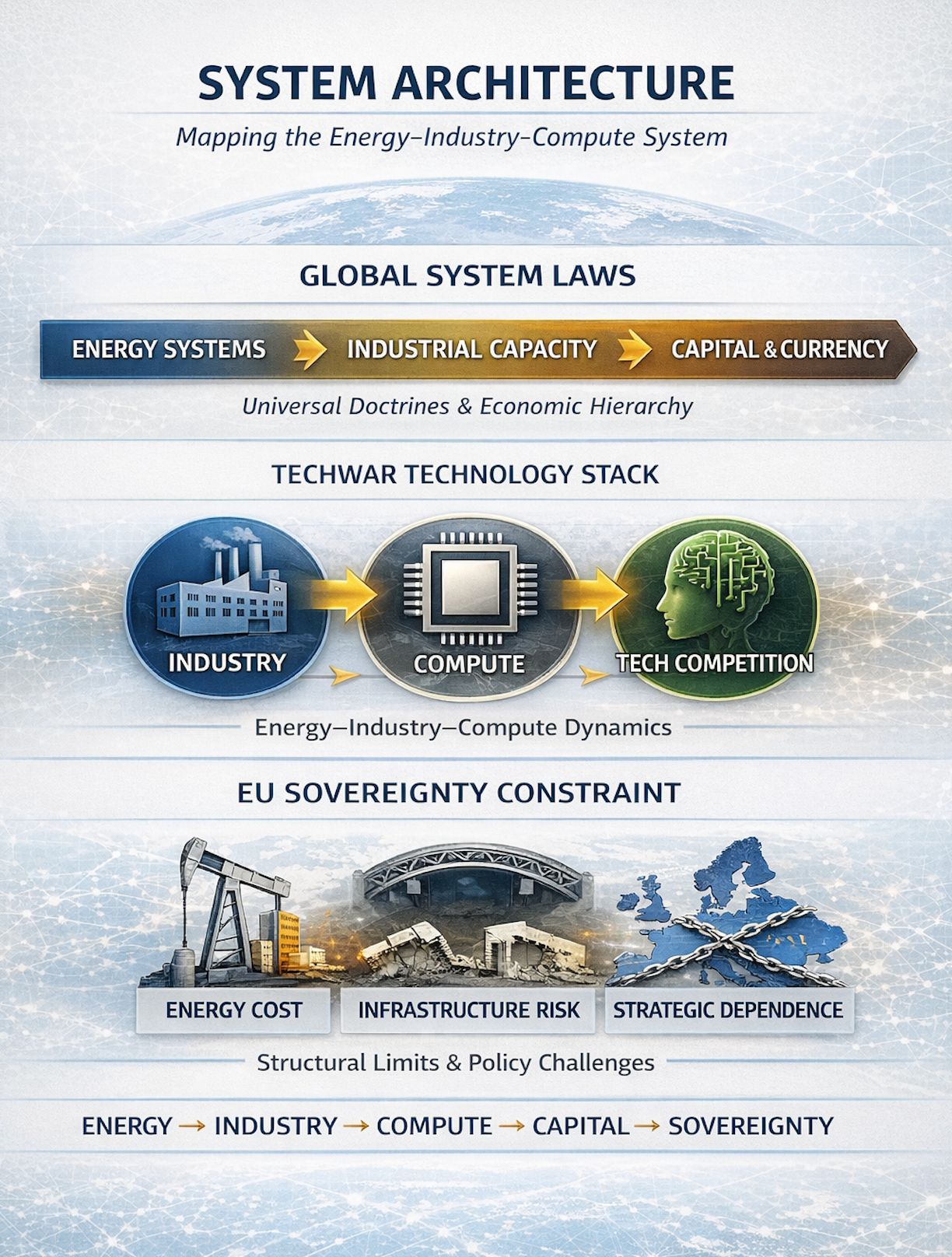
The analytical framework of this project is built around a simple structural observation:
Energy systems structure industrial capacity.
Industrial capacity structures compute infrastructure.
Compute infrastructure shapes capital formation, monetary stability, and
sovereignty.
In an energy-bound world, power therefore propagates through a system stack:
Energy → Industry → Compute → Capital → Currency → Sovereignty
This framework is analysed across three panels of the project.
The GLOBAL panel establishes the structural doctrines governing the emerging energy-bound system.
These analyses examine how energy systems shape industrial capacity, capital formation, and geopolitical power.
Key doctrines:
Energy as the Operating System of Power
Energy–Capital–Currency Hierarchy
The TECHWAR panel examines how technological competition unfolds across the energy–industry–compute stack.
It analyses the mechanisms through which power concentrates, propagates, or fractures within the technological system.
Key analyses:
System Foundations of the Energy–AI–Industrial Economy
Stack-Level Fractures in the Tech War
The EU Sovereignty panel examines how these structural dynamics affect Europe’s strategic position.
It analyses how energy cost, infrastructure, and industrial capacity constrain European sovereignty and technological competitiveness.
Key analyses:
EU Energy Paradigm Shift — Part I
EU Energy Paradigm Shift — Part II
Energy Constraint and the Monetary Ceiling
Across all panels, the same structural relationship applies:
Energy determines industrial capacity.
Industrial capacity anchors compute infrastructure.
Compute infrastructure shapes capital formation and monetary power.
Technological competition therefore increasingly functions as competition between integrated systems.