AI, Energy, and the Sovereignty Threshold
Why AI Reveals Which Systems Can Cross the Constraint
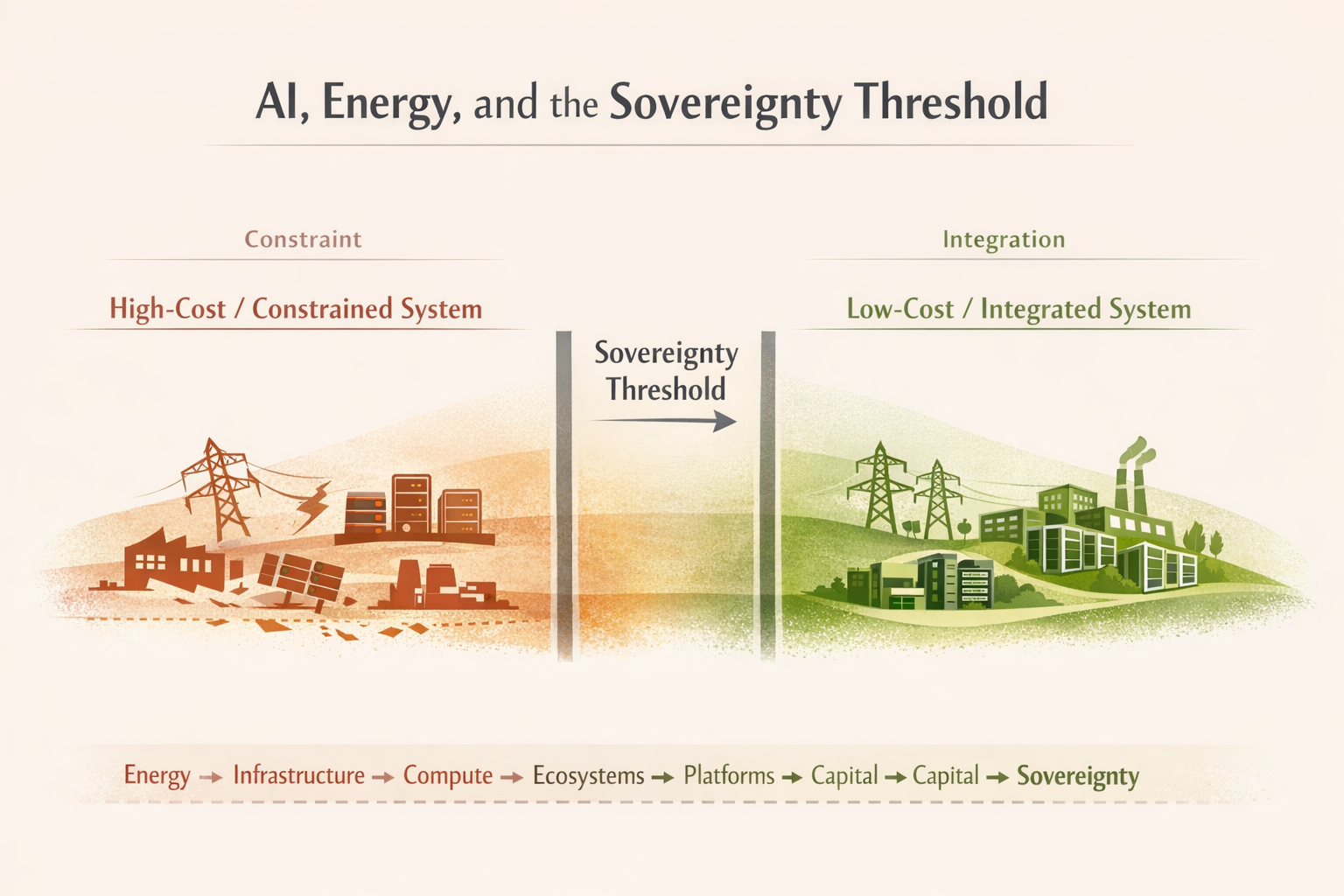
This reading path follows the system from physical constraint to sovereignty outcomes.
Keynote
Artificial intelligence is often described as a technological revolution.
It is not.
It is a system event—one that reveals the underlying structure of power.
In an electrified economy, AI is not a software layer.
It is an energy-intensive infrastructure system.
Its scale depends not on code alone, but on:
electricity cost
grid capacity
infrastructure depth
system integration
In an Energy-Bound System, this transforms AI into something far more consequential:
a test of sovereignty—and of democratic agency itself
Strategic Thesis — The Threshold
AI does not level the playing field.
It sorts it.
As computation scales, systems are forced toward a threshold:
those that can absorb energy constraint and scale infrastructure
cross itthose that cannot
remain trapped within it
This is the defining mechanism of the current phase.
AI is not a source of sovereignty.
It is a filter of sovereignty.
The System Beneath AI
AI does not operate independently of the system.
It enters at a specific moment in its evolution.
As established in
Energy-Bound
System
and
Energy
as Europe’s Strategic Constraint
energy cost structures define the outer boundary of economic and technological viability.
But the system is not in equilibrium.
It is in transition.
Energy-Bound System
→ Energy System Transformation
→ AI–Energy–Cost Chasm
→ Sovereignty outcomes
As shown in:
this transition is defined by a structural mismatch:
demand rises rapidly
infrastructure scales slowly
costs increase before they fall
AI enters precisely here.
It does not create the tension.
It accelerates it at its most fragile point.
What follows is not convergence.
It is divergence.
Crossing the Threshold
At scale, AI forces a binary outcome.
Some systems:
absorb transition costs
scale energy infrastructure
deploy compute at lower marginal cost
integrate it into production
→ and cross the threshold
Others:
remain exposed to high energy costs
face infrastructure bottlenecks
rely on external compute
lose industrial depth
→ and remain inside the constraint
This is not a temporary divergence.
It is a structural sorting mechanism.
The Stack Beneath Sovereignty
Crossing the threshold is not only a question of energy.
It is a question of system integration.
Across the stack:
Energy → Infrastructure → Compute → Ecosystems → Platforms → Capital → Sovereignty
Energy enables computation.
But control is exercised through the layers above it:
operating systems
standards
developer ecosystems
platform architectures
These determine:
who can deploy AI
who can scale it
who captures value
Systems that lack these layers may build infrastructure—
but fail to convert it into sovereignty.
This is the domain of:
Energy enables AI.
Control layers determine who owns it.
The Democratic Constraint
This system does not operate only externally.
It feeds back internally.
Energy cost structures propagate through society:
Energy → Cost → Industry → Society → Legitimacy → Governance
Where:
cost affects wages and industrial viability
industrial weakness erodes social stability
social instability constrains political capacity
AI intensifies this dynamic.
Because it raises the energy requirement of economic performance.
AI is not only a sovereignty filter.
It is a test of whether democratic systems can sustain material agency under constraint.
This is the domain of:
The Geography of AI
AI does not scale where policy intends.
It scales where systems allow it.
As shown in
Compute
Locality in an Energy-Bound AI System compute clusters form where
electricity is:
stable
affordable
scalable
AI geography follows energy geography.
The Sovereignty Threshold
At scale, AI produces a system-level verdict.
energy constraint becomes binding
infrastructure determines competitiveness
cost structures determine technological viability
control layers determine value capture
economic weakness becomes political fragility
If a system crosses the threshold:
→ AI amplifies strength
If it does not:
→ AI amplifies weakness
AI does not remove constraint.
It reveals it—and accelerates its consequences.
Conclusion — Sovereignty as a System Condition
The question is not whether systems adopt AI.
It is whether they can do so:
within their own energy and compute architecture
— or —within someone else’s
AI will scale regardless.
Sovereignty will not.
The next divide will not be technological.
It will be systemic.
In the AI era, sovereignty is not defined by ambition.
It is defined by the capacity to cross the constraint.
Reading Path — From Constraint to Sovereignty
Systemic_Asymmetry_Cross_Panel_Index
System Foundations
System Dynamics
System Architecture
System Outcomes