Global South Electrification Leapfrog
Energy Infrastructure, Industrial Development, and System Reconfiguration
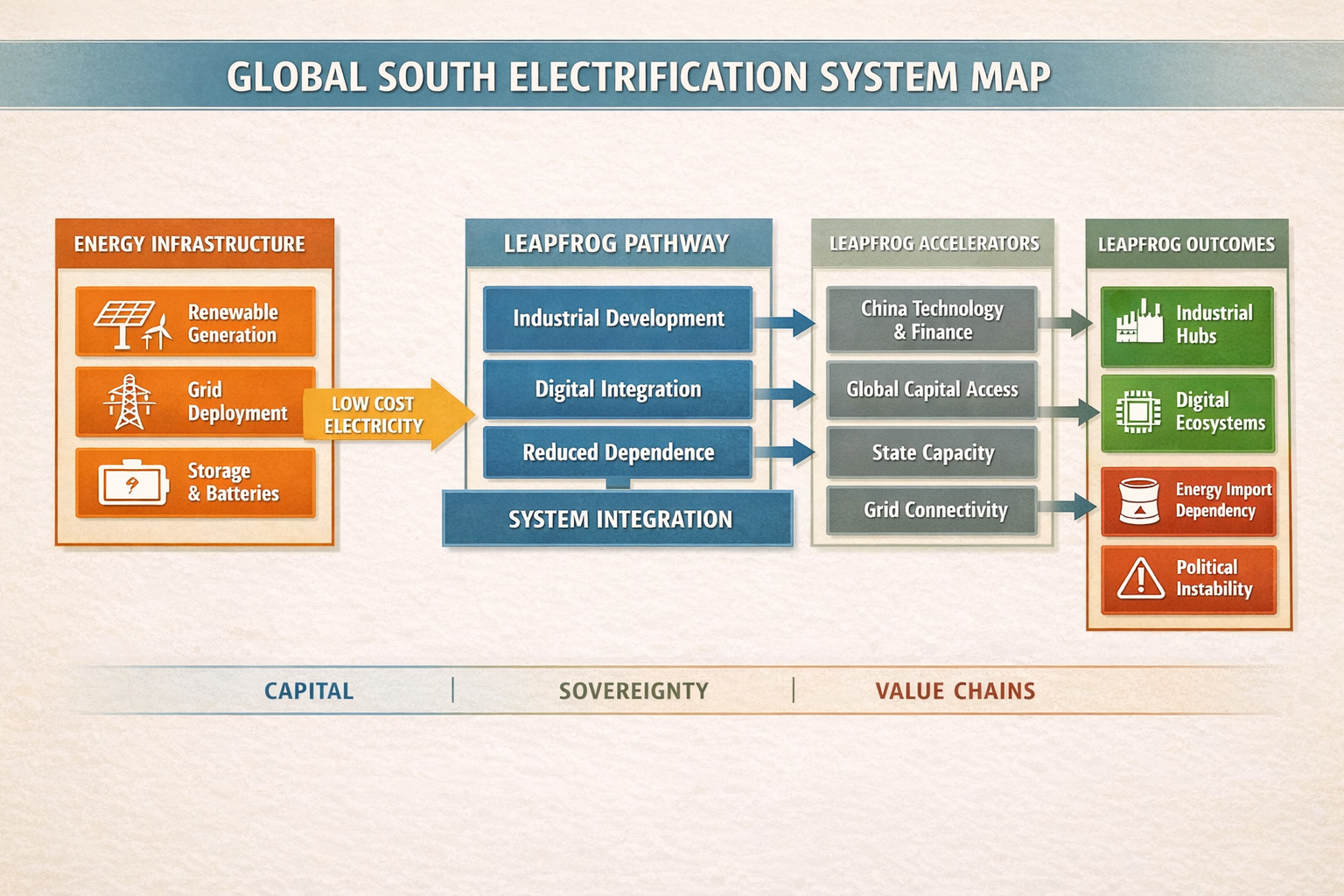
Framework → System Transformation Layer
This article explains how electrification enables structural leapfrogging in the Global South,
and how this process reshapes industrial geography, capital allocation, and global system power.It connects to:
→ Energy-Bound System
→ Electrostate Deployment and Industrial Scale
→ China: Technology Leadership and the Strategic Energy Transition
→ AI, Energy Constraint, and Compute Infrastructure
→ Europe Electrification Strategy or Decline
Keynote
The global energy transition is not only transforming advanced economies.
It is restructuring the development pathway of the Global South.
In an Energy-Bound System, development is no longer defined by gradual industrial accumulation through fossil-fuel systems.
It is increasingly defined by the ability to:
deploy electricity infrastructure rapidly
reduce marginal energy costs
bypass legacy systems
and integrate into emerging industrial and digital value chains
This creates the possibility of structural leapfrogging.
Not all countries will converge.
But those that successfully align energy systems, industrial policy, and capital access may bypass traditional development constraints and enter the global system at a different level of integration.
I. From Linear Development to System Leapfrogging
Traditional development followed a sequential model:
Agriculture → Industrialisation → Urbanisation → Services
This pathway was:
capital-intensive
fossil-fuel dependent
time-intensive (multi-decade transitions)
Electrification changes this structure.
Renewable energy systems:
can be deployed modularly
scale incrementally
reduce reliance on imported fuels
and operate at lower marginal cost once installed
This enables a different model:
Infrastructure → Electricity → Digital Integration → Industrial Entry
Development becomes less about historical accumulation
and more about system integration capacity.
II. Electrification as a Cost and Sovereignty Lever
Energy cost is the primary constraint in an energy-bound system.
For many Global South economies, fossil-fuel dependency creates:
exposure to global price volatility
balance of payments pressure
currency instability
and industrial fragility
Electrification alters this dynamic.
When countries develop:
domestic renewable generation
grid infrastructure
and storage capacity
they can:
stabilise energy costs
reduce import dependence
and improve macroeconomic resilience
This is not simply environmental.
It is monetary and sovereign.
→ aligns with:
Energy
Constraint and the Monetary Ceiling
III. Modular Infrastructure and Deployment Speed
A defining feature of renewable systems is modularity.
Unlike fossil systems, which require:
large centralised plants
complex logistics chains
long development timelines
renewables allow:
distributed generation (solar, wind)
rapid deployment cycles
decentralised scaling
This creates a structural advantage:
Deployment speed becomes a competitive variable
Countries that can:
mobilise capital
coordinate infrastructure
and deploy at scale
can compress decades of development into shorter timeframes.
→ connects to:
Electrostate
Deployment and Industrial Scale
IV. China’s Role in System Acceleration
China plays a central role in this transformation.
Through:
manufacturing dominance in solar, batteries, and grid components
infrastructure financing (state banks, Belt and Road)
integrated industrial policy
China enables:
rapid electrification deployment
cost reduction through scale
and technology diffusion across the Global South
This creates a new dynamic:
Development pathways become linked to external system providers
Electrification is not purely domestic.
It is embedded in global industrial and financial networks.
→ see:
China:
Technology Leadership and the Strategic Energy Transition
V. Electrification and Digital Leapfrogging
Electricity is not only an industrial input.
It is the foundation of digital systems.
As electrification expands, it enables:
telecommunications infrastructure
data processing capacity
AI deployment (at edge or regional level)
digital services ecosystems
This creates a second-order leapfrog:
Energy → Compute → Digital Economy
However, constraints remain:
compute infrastructure is energy-intensive
data centres require stable and scalable electricity
capital requirements remain high
→ connects to:
AI,
Energy Constraint, and Compute Infrastructure
VI. Divergence Within the Global South
Leapfrogging is not universal.
Outcomes depend on:
1. State Capacity
Ability to coordinate infrastructure, regulation, and capital.
2. Capital Access
Access to international financing or domestic investment capacity.
3. Grid Development
Transmission and distribution capacity, not just generation.
4. Political Stability
Long-term infrastructure requires stable governance frameworks.
5. Integration Strategy
Connection to regional and global value chains.
This creates internal divergence:
Electrified system integrators vs structurally constrained economies
Some countries may:
become industrial nodes
attract manufacturing relocation
integrate into digital supply chains
Others may remain:
energy import dependent
infrastructure constrained
and economically peripheral
VII. Implications for Global System Power
Global South electrification reshapes the system in three ways:
1. Industrial Geography Shifts
Manufacturing may relocate toward:
lower-cost energy regions
newly electrified economies
infrastructure-linked corridors
2. Capital Reallocation
Investment flows toward:
infrastructure
energy systems
and industrial platforms
→ aligns with:
Investor Framework
— Capital Allocation in an Energy-Bound System
3. System Multipolarity (with Structural Hierarchy)
Electrification enables broader participation in the global system.
But hierarchy persists.
The system becomes more distributed,
but not fully symmetrical.
Control remains concentrated in:
technology providers
capital allocators
and system integrators
VIII. Strategic Positioning — Leapfrog vs Dependency
The central strategic question is not whether electrification occurs.
It is how it is structured.
Two pathways emerge:
Leapfrog Path
domestic infrastructure development
integration into value chains
increasing system autonomy
Dependency Path
external financing dominance
limited industrial depth
continued structural vulnerability
The difference lies in:
Who controls the system architecture
IX. Conclusion
The Global South is not outside the energy transition.
It is becoming one of its central arenas.
Electrification enables a potential shift:
from delayed convergence
to accelerated system integration
But this transition is not automatic.
It depends on the alignment of:
energy systems
industrial policy
capital access
and geopolitical positioning
In an energy-bound system:
Development is no longer a linear path.
It is a function of infrastructure deployment and system integration.
Europe within a wider global context
The implications of this transformation extend beyond the Global
South itself.
Regions positioned at the intersection of energy flows, capital, and
infrastructure — particularly the Mediterranean — may function as
integration gateways between electrifying economies and European
industrial systems.