European Ecosystems Index
Industrial Ecosystems as the Meso Layer of System Power
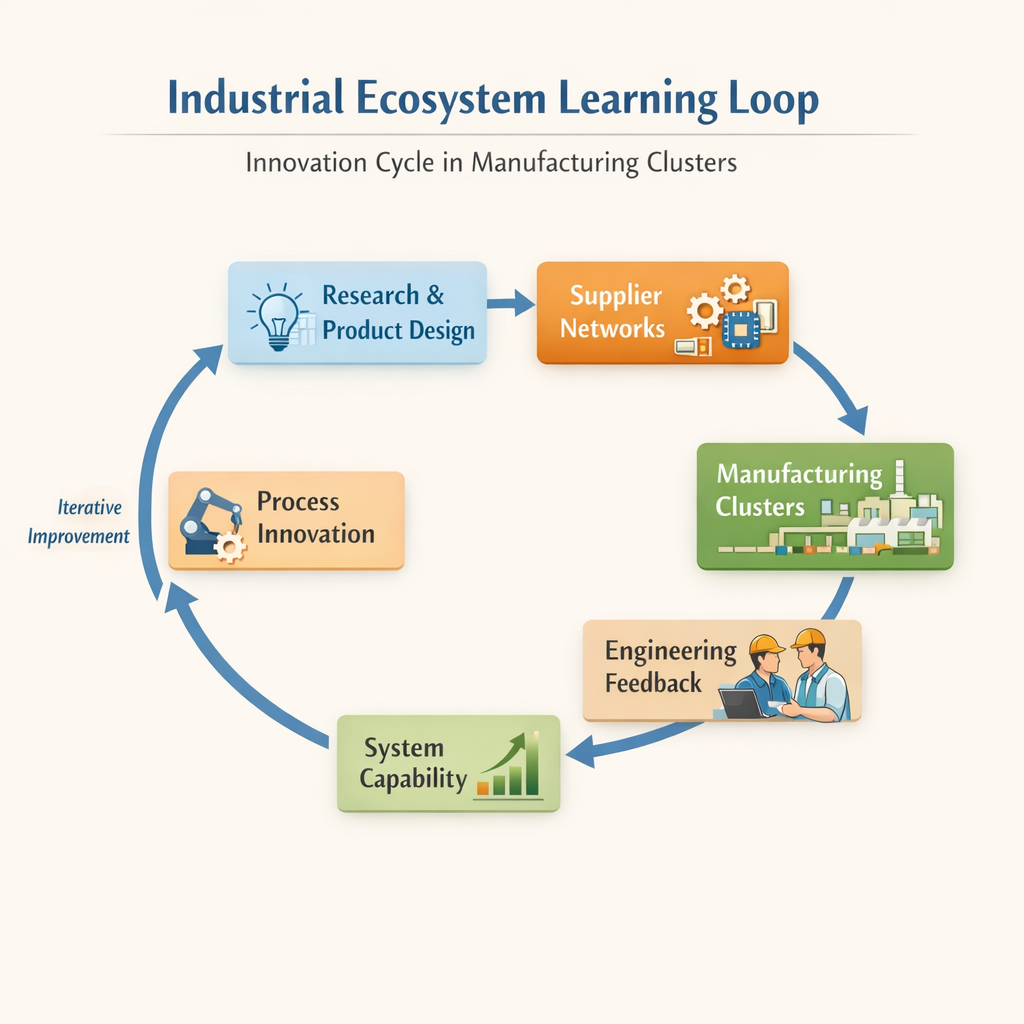
Technological competition no longer unfolds primarily through individual firms.
It unfolds through industrial ecosystems.
Supplier networks, manufacturing clusters, engineering talent flows, and production systems determine how technological capability is built, diffused, and scaled.
These ecosystems define:
how quickly innovation moves from lab to production
how efficiently energy is converted into industrial output
how resilient technological systems are under constraint
In an energy-bound technological system, ecosystems determine how effectively energy, industry, and computation are integrated into productive capacity.
They are not a background condition of competition.
They are the structure through which system power is
produced.
System Context — From Stack to Ecosystems
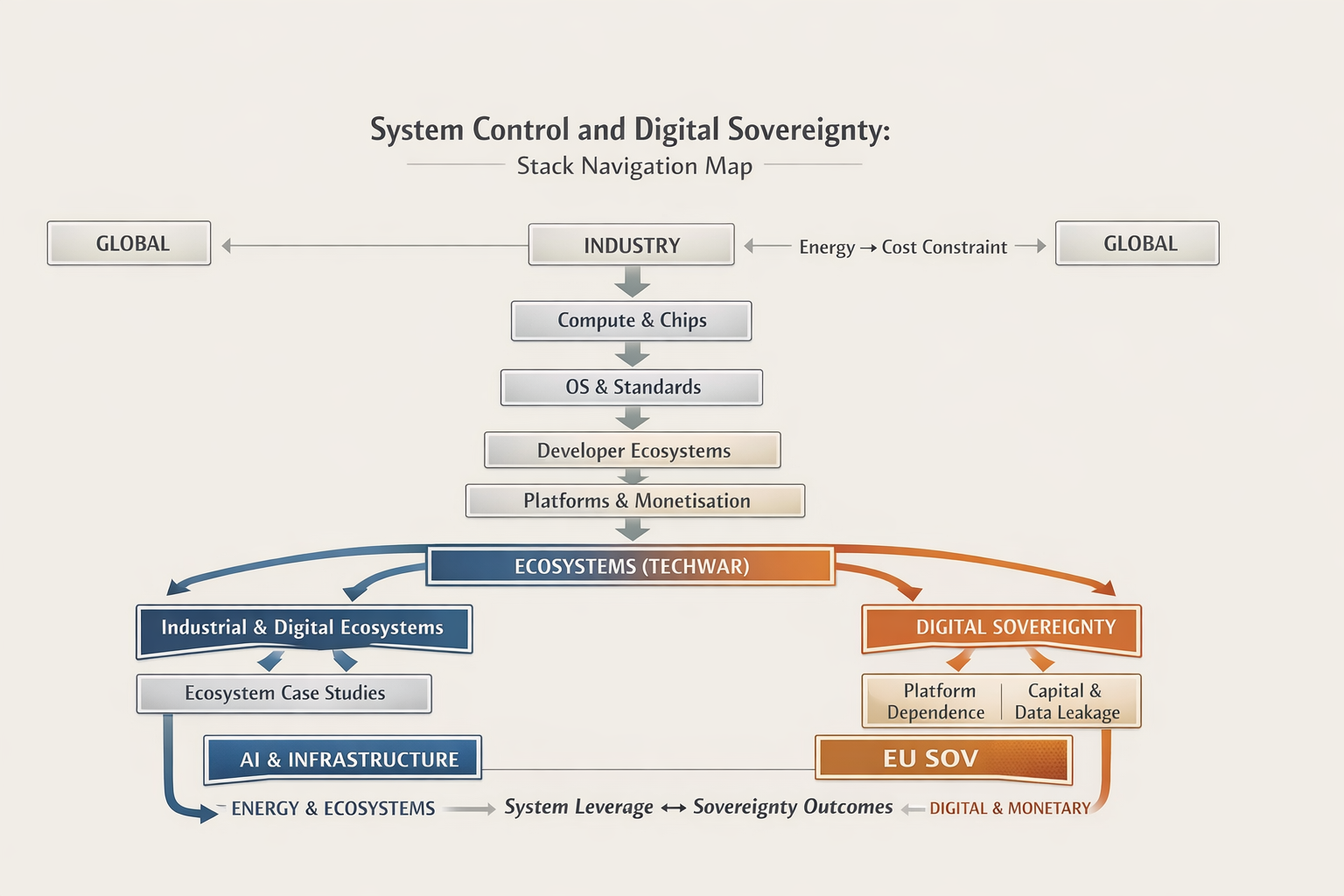
Industrial and digital ecosystems emerge from underlying stack architecture and control layers.
→ Digital Sovereignty
Stack
→ System Stack
Architecture
Position in the System
This section represents the meso layer of technological power.
It connects:
Energy systems (cost, availability, constraint)
Compute systems (AI, semiconductors, infrastructure)
Industrial systems (manufacturing, supply chains, scaling)
Ecosystems are the layer where systems become capability.
They translate:
energy → into production
compute → into application
infrastructure → into scale
Core System Anchors (AI–Energy Framework)
This section should be read together with:
AI Energy Sovereignty Framework
Defines the alignment of energy, compute, and sovereigntyAI and Energy — The Sovereignty Stress Test
Where system constraints become binding
These provide the macro and stress conditions within which ecosystems operate.
Articles in this Section
Ecosystem Formation and Industrial Learning
Global Value Chains as Innovation Systems
Production networks as systems of capability diffusionIndustrial Ecosystems and Technological Power
Why ecosystem density determines technological sovereigntySME Innovation Networks
Distributed industrial systems and Europe’s scaling constraint
System Architecture and Comparative Models
Why China Scales — Industrial Ecosystem Density
Ecosystem density and coordinated scalingChina–Europe Comparison
Contrasting system architectures under constraint
Compute, Platforms, and Control Layers
AI Compute Ecosystems
Energy, semiconductors, and compute integrationHyperscalers and Centralised Compute Power
Centralised scaling model of computePlatform Sovereignty — Apple
Ecosystem orchestration and edge control
Industrial and Hardware Ecosystems
Semiconductor Ecosystems
Hardware, supply chains, and industrial depthCase Study — Apple Industrial Ecosystem
Design–production separation and ecosystem learning
Standards and Coordination Layers
- Standards and
Protocol Sovereignty
Rules of interaction as instruments of power
Cross-System Navigation
- Industrial
Ecosystems — Cross-Panel Index
How ecosystems connect across energy, compute, and sovereignty
Role within the Digital Sovereignty Stack
Ecosystems form the operational layer of sovereignty.
Within the Digital Sovereignty Stack:
Energy layer → defines cost and constraint
Compute layer → defines capability
Ecosystem layer (this section) → defines scaling and diffusion
Platform layer → defines access
Standards layer → defines rules and control
Without ecosystems, energy and compute cannot translate into economic or geopolitical power.
Cross-Panel Integration
TECHWAR
EU SOVEREIGNTY
GLOBAL
Reading Path — From Infrastructure to Sovereignty
To understand how ecosystems translate system capacity into power:
Energy Constraint (Foundation)
→ Energy as the Operating System of PowerCompute and Infrastructure (Capability Layer)
→ AI Compute EcosystemsEcosystems (Meso Layer)
→ This sectionPlatform Sovereignty (Access Layer)
→ Platform Sovereignty — AppleStandards and Protocols (Control Layer)
→ Standards and Protocol SovereigntySystem Constraint and Stress
→ AI and Energy — The Sovereignty Stress Test
Closing Frame
Ecosystems determine whether a system can scale, adapt, and endure.
In an energy-bound system:
energy defines the constraint
compute defines the capability
ecosystems determine whether capability becomes power