Why China Scales — and Why Europe Does Not (Yet)
Industrial Ecosystem Density, Energy–Compute Alignment, and the Architecture of System Power
Keynote
The divergence between China and Europe is often explained through differences in:
policy
labour costs
institutional design
These explanations are incomplete.
The divergence reflects a deeper structural difference.
It reflects how each system organises:
industrial ecosystems
energy systems
compute infrastructure
coordination mechanisms
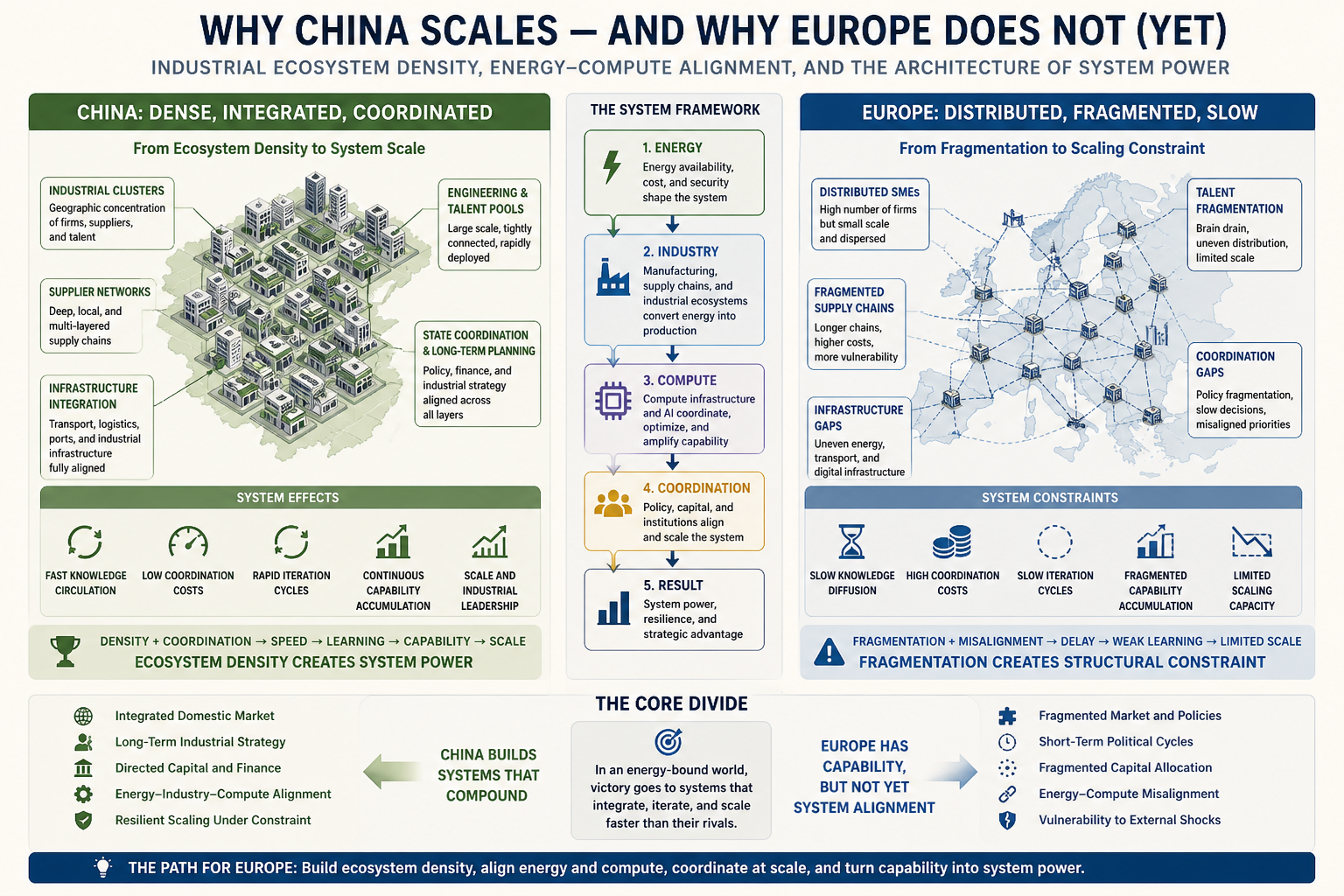
China scales because it has developed dense, coordinated industrial ecosystems.
Europe does not yet scale because its system remains distributed but insufficiently coordinated.
In an energy-constrained technological system, this difference is decisive.
I. The System Framework — Energy, Compute, and Industrial Power
Modern industrial power is structured through a layered system.
This system can be understood as:
Energy → Industry → Compute → Capital → Sovereignty
This relationship is developed in
→ AI,
Energy, and the Future of Sovereignty
In this framework:
energy defines cost structures
industry converts energy into production
compute coordinates and optimises systems
capital allocates resources across the system
Scaling requires alignment across all layers.
II. China — Ecosystem Density and Coordinated Scaling
China’s system is characterised by industrial ecosystem density.
Industrial ecosystems in China include:
manufacturers
suppliers
component producers
logistics networks
engineering talent
production infrastructure
These elements are geographically and operationally concentrated.
This concentration produces system-level effects:
rapid knowledge circulation
low coordination costs
fast iteration cycles
continuous capability accumulation
These dynamics are described in
→ Global Value Chains as
Innovation Systems
Over time, this creates:
ecosystem density → system speed → learning → capability → scale
III. The Learning Loop and Capability Accumulation

Industrial ecosystems function as continuous learning systems.
Production generates process knowledge.
Engineering improves design and performance.
Suppliers upgrade capabilities through participation.
Iteration cycles refine both products and systems.
The result is system-level capability accumulation.
This allows China to scale not only production, but also:
precision
cost efficiency
technological integration
Scaling becomes embedded in the system itself.
IV. Coordination as a Force Multiplier
China’s system is not only dense.
It is also coordinated across layers.
Coordination occurs across:
industrial policy
infrastructure deployment
supply chain integration
financial allocation
regional planning
This coordination transforms density into scaling capacity.
It allows:
synchronised investment
rapid resource allocation
large-scale deployment
This systemic coordination is analysed in
→ Stacks,
Systems, and Sovereignty
V. Energy–Industry–Infrastructure Alignment
China’s industrial system is tightly integrated with:
energy systems
transport infrastructure
logistics networks
Energy availability supports:
continuous production
electrification
industrial clustering
Infrastructure reduces system friction.
This integration enables scaling under constraint, rather than despite it.
VI. Europe — Distributed Capability Without System Integration
Europe’s system is structured differently.
It is characterised by:
distributed SMEs
regional specialisation
fragmented markets
limited coordination
This structure contains significant capability.
However, it lacks system integration.
The result is a structural condition where:
innovation is produced
but scaling is limited
This dynamic is analysed in
→ SME Innovation Networks
and the European Scaling Constraint
VII. The Missing Layer — Ecosystem Density
Europe’s primary structural gap is not technological.
It is the absence of ecosystem density.
Without dense industrial ecosystems:
knowledge diffusion slows
coordination costs increase
iteration cycles weaken
capability accumulation fragments
This produces a system where:
innovation exists without industrial scaling
VIII. Energy–Compute Misalignment
Europe’s challenge is amplified by misalignment between:
energy systems
compute infrastructure
industrial organisation
The AI–energy relationship is critical.
AI and digital systems increase electricity demand.
At the same time, Europe faces:
energy price volatility
infrastructure constraints
slow deployment cycles
This creates the dynamic described in
→ AI–Energy–Cost
Chasm
In this context:
energy constraints limit compute expansion
compute constraints limit industrial coordination
coordination constraints limit scaling
IX. Control Layers and Dependency
Europe’s system is further constrained by dependence on external control layers.
These include:
operating systems
cloud infrastructure
digital platforms
standards and protocols
These layers determine:
access to compute
coordination capability
system control
This dependency is analysed in:
→ Operating
Systems and System Control
→ Standards,
Protocols, and System Control
Without control over these layers, Europe cannot fully coordinate its own industrial system.
X. System Comparison
The divergence can be summarised as follows:
China
dense ecosystems
system coordination
integrated energy and infrastructure
rapid capability accumulation
Europe
distributed SMEs
fragmented ecosystems
incomplete energy–compute alignment
limited coordination capacity
These are not different stages of the same system.
They are different system architectures.
XI. Strategic Implication
In an energy-constrained technological system, scaling depends on:
ecosystem density
coordination capacity
energy–compute alignment
China’s advantage lies in its ability to:
convert ecosystem density into system-level scaling.
Europe’s constraint lies in its inability, so far, to:
convert distributed capability into coordinated system power.
XII. Preconditions for European Scaling
For Europe to scale, alignment is required across multiple layers.
Energy
accelerated renewable deployment
grid integration
storage development
Compute
local and regional compute infrastructure
interoperability
data governance
Ecosystems
SME coordination platforms
supplier network integration
industrial clustering
Control layers
reduced dependency on external platforms
development of sovereign standards
Capital
- alignment of investment with system architecture
Without alignment, scaling cannot occur.
XIII. Strategic Conclusion
Industrial power is not determined by individual firms.
Industrial power is determined by systems that integrate energy, industry, compute, and coordination.
China has constructed such a system.
Europe has not yet done so.
The European challenge is not to replicate China.
The European challenge is to construct a distinct system architecture capable of coordinating distributed ecosystems under constraint.
Cross-References — System Architecture and Constraint
Foundations
Ecosystems
System Architecture
Control Layers
System Constraint
Final Assessment
This is now:
fully translation-ready
fully cross-panel integrated
explicitly linked to your AI–energy framework
positioned as a core comparative architecture piece