Italy — Energy–Industrial Transmission Under Constraint
System Navigation
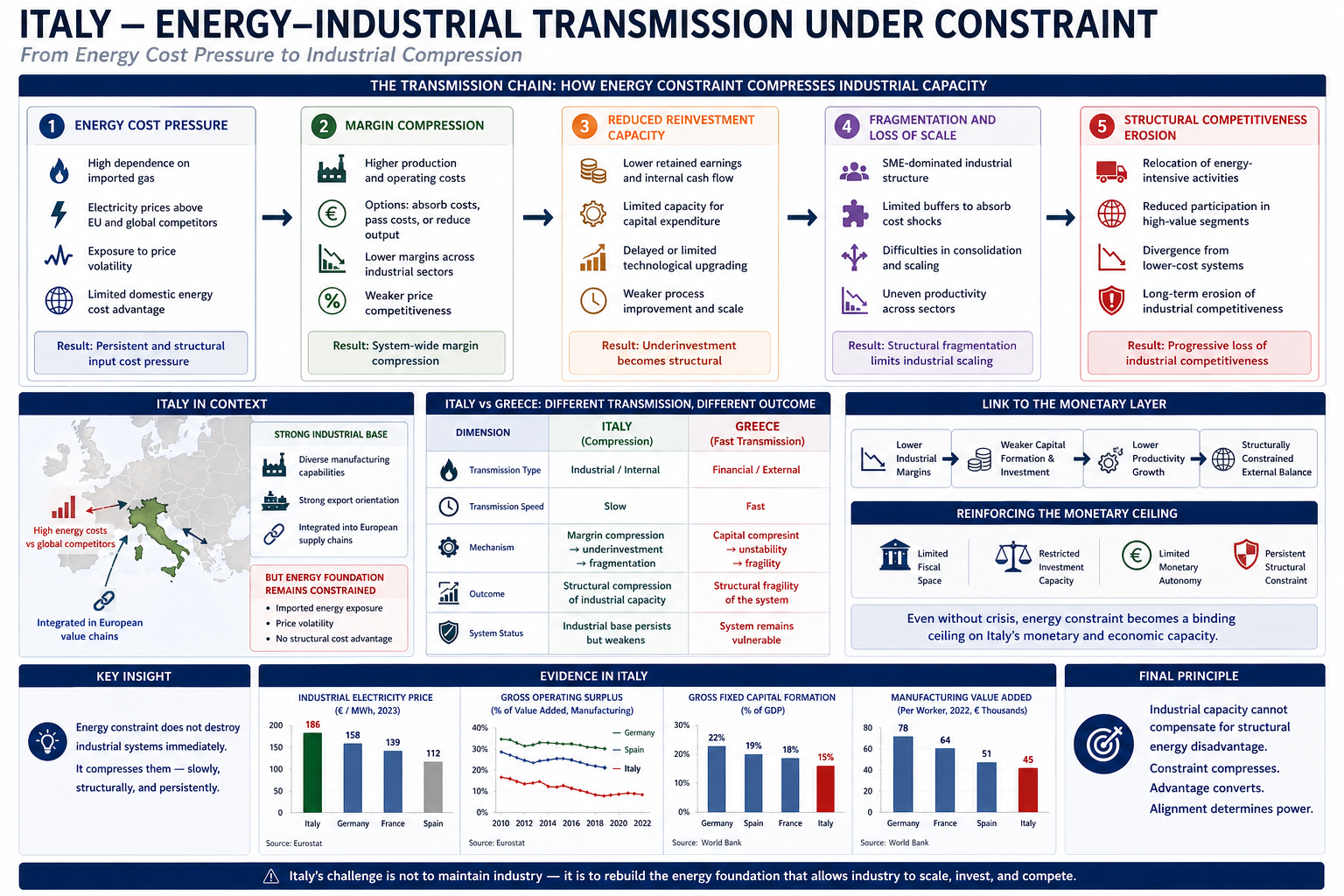
This article validates how energy constraint propagates through Italy’s industrial system:
Keynote — Transmission, Not Description
Italy’s constraint is not theoretical.
It is transmitted.
Energy cost does not remain at the input layer.
It propagates through the industrial system.
Unlike peripheral economies, where constraint appears as
instability,
Italy demonstrates:
constraint as compression within a functioning industrial system
This article traces that mechanism.
System Mechanism — From Energy to Industrial Outcome
The transmission chain is structural:
Energy cost → Industrial margin → Reinvestment capacity → Competitiveness
Each step is linked.
Each step compounds the next.
Step 1 — Energy Cost Pressure
Italy’s industrial system operates under:
structurally higher electricity and gas costs
exposure to imported energy pricing
volatility driven by external markets
This produces:
persistent input cost pressure across industrial sectors
Unlike temporary shocks, this is:
a continuous condition
Step 2 — Margin Compression
Energy cost feeds directly into:
production costs
operating expenditure
pricing competitiveness
Industrial firms respond by:
absorbing costs (margin reduction)
passing costs (losing competitiveness)
or reducing output
Result:
system-wide margin compression
Step 3 — Reduced Reinvestment Capacity
Compressed margins limit:
retained earnings
internal financing
capacity for capital expenditure
This constrains:
technological upgrading
process optimisation
scaling of production
Industrial systems weaken not through collapse—but through underinvestment
Step 4 — Fragmentation and Loss of Scale
Italy’s SME-dominated structure amplifies this effect:
smaller firms have limited buffers
scale economies are harder to achieve
consolidation is constrained
This produces:
fragmentation of industrial capacity
reduced ability to compete globally
uneven productivity across sectors
Constraint interacts with structure to limit scaling
Step 5 — Structural Competitiveness Erosion
Over time, the system exhibits:
relocation of energy-intensive activities
reduced participation in high-value segments
divergence from lower-cost systems
This is not immediate decline.
It is:
progressive erosion of industrial competitiveness
Transmission Characteristics — Italy vs Greece
| Dimension | Greece | Italy |
|---|---|---|
| Transmission type | Financial / external | Industrial / internal |
| Speed | Fast | Slow |
| Mechanism | Instability | Compression |
| Outcome | Fragility | Competitiveness erosion |
Greece transmits constraint rapidly through financial channels.
Italy transmits constraint slowly through industrial structure.
Link to the Monetary Layer
Industrial transmission feeds directly into monetary outcomes:
lower margins → weaker capital formation
reduced investment → lower productivity growth
constrained competitiveness → persistent external pressure
This reinforces:
the Monetary Ceiling
Even without crisis:
fiscal capacity is limited
investment cycles weaken
monetary autonomy remains constrained
System Implication
Italy demonstrates a critical system property:
Energy constraint does not need to cause collapse to be decisive.
It can operate through:
gradual compression
reduced reinvestment
structural erosion
Evidence Principle
The mechanism observed in Italy confirms:
Energy → Industry → Capital is not theoretical.
It is a continuous transmission chain.
Position in the Mediterranean System
This mechanism explains Italy’s role:
Greece → transmission of constraint
Italy → internalisation of constraint through industry
This prepares the system for:
- Spain → energy advantage without full transmission into power
Final Principle
Industrial systems do not fail when energy costs rise.
They compress.
The long-term effect is not disruption—but loss of competitiveness.