Standards, Protocols, and System Control
How Rules of Interaction Become Instruments of Power
System Navigation
Control propagates through shared rules:
Compute → Operating Systems → Standards → Platforms → Capital → Sovereignty
Standards, Protocols, and System Control
Keynote
Standards are often framed as technical agreements.
They are not.
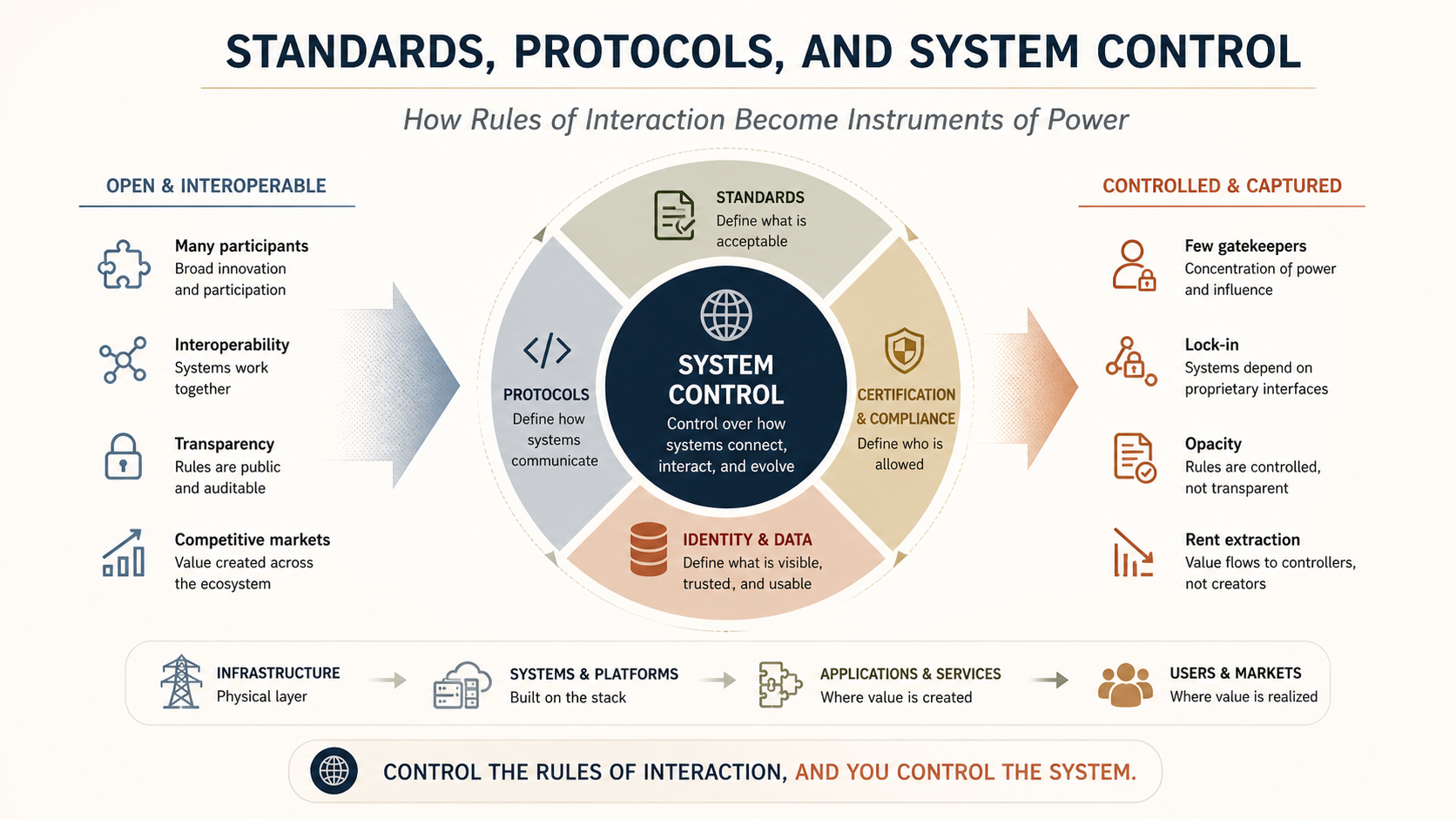
They are systems of coordination and control.
Standards determine:
how systems communicate
how components interoperate
how developers build
how markets scale
and how power consolidates
Protocols operationalise those standards.
They define the rules through which interaction occurs.
In an energy-bound system, where infrastructure, compute, and platforms must align efficiently, these rules become critical.
Standards do not simply enable systems to function.
They determine who can participate—and under what conditions.
Core Thesis
Standards and protocols are the governance layer of interoperability.
They define:
compatibility
access pathways
switching costs
ecosystem boundaries
and scaling dynamics
Control over standards does not always appear as ownership.
It often appears as:
definition
influence
implementation dominance
or ecosystem gravity
This makes standards one of the most subtle but powerful layers in the system stack.
They sit between infrastructure and application—but shape both.
System Position — Between Operating Systems and Platforms
Within the stack, standards and protocols sit directly above the operating system layer:
Energy → Industry → Compute → Operating Systems → Standards → Platforms → Capital → Sovereignty
They perform three critical functions:
1. They enable interoperability
Without standards, systems cannot scale across boundaries.
2. They define system boundaries
Standards determine what is “inside” or “outside” an ecosystem.
3. They shape power distribution
Control over standards determines who captures value as systems expand.
This is why standards are not neutral.
They structure markets before competition even begins.
Why Standards Matter Strategically
Standards shape the system in ways that are often invisible but decisive.
They influence:
which technologies become dominant
which firms scale
which ecosystems interconnect
and which regions retain control
A system that defines standards gains:
early-mover advantage
network effects
developer alignment
and long-term lock-in
A system that adopts external standards often gains speed—but sacrifices control.
Types of Standards Power
Standards operate through different mechanisms of control.
1. Formal Standards (Institutional Control)
These are defined through official bodies and coordination processes.
They include:
telecommunications standards
industrial interoperability frameworks
infrastructure protocols
They often involve:
governments
international organisations
large industrial actors
Control here is exercised through:
negotiation
representation
and agenda-setting
This is slower, but can create durable global influence.
2. De Facto Standards (Market Control)
These emerge through dominance rather than agreement.
They are defined by:
widespread adoption
developer preference
ecosystem lock-in
or platform scale
Examples include:
dominant APIs
widely used software frameworks
cloud service architectures
In this model:
adoption creates standardisation
This is the dominant mechanism in the digital economy.
3. Embedded Standards (Infrastructure Control)
These are built directly into systems.
They are not negotiated or chosen—they are inherited through use.
They exist in:
operating systems
cloud architectures
chip instruction sets
AI frameworks
networking layers
Control here is strongest because it is least visible.
Once embedded, these standards become difficult to replace.
Standards and Ecosystem Formation
Standards determine how ecosystems form and scale.
They influence:
how easily developers can enter
how applications interconnect
how services integrate
how data flows
This creates two broad system outcomes:
Open Interoperable Ecosystems
lower barriers to entry
broader participation
faster diffusion of innovation
But also:
weaker control
more fragmentation
less value capture per node
Controlled Ecosystems
tighter integration
higher performance
stronger monetisation
clearer governance
But also:
restricted access
higher dependency
reduced flexibility
The balance between openness and control is not ideological.
It is strategic.
Standards as Lock-In Mechanisms
One of the most important functions of standards is to create switching costs.
Once systems adopt a standard:
changing becomes expensive
compatibility must be maintained
ecosystems align around it
This creates path dependency.
Over time, standards can:
entrench incumbents
stabilise ecosystems
reinforce dominant architectures
This is why early influence over standards can produce long-term structural advantage.
Standards and Platform Power
Platforms do not simply operate within standards.
They often define them.
This occurs through:
APIs
developer tools
service architectures
data models
integration frameworks
As platforms scale, their internal standards become external dependencies.
This allows them to:
shape developer behaviour
control interoperability
define access conditions
and extract value across ecosystems
Platforms extend power by turning internal architecture into external necessity.
The Cloud and AI Layer
In modern systems, standards increasingly emerge from:
cloud infrastructure
AI frameworks
data architectures
These layers are not governed primarily through formal standard bodies.
They are governed through:
deployment scale
developer ecosystems
and infrastructure dominance
This creates a shift:
from negotiated standards
to embedded, platform-driven standards
This shift concentrates power in actors that control:
infrastructure
tooling
and deployment environments
Europe and the Standards Problem
Europe has historically played a role in formal standard-setting.
But the centre of gravity has shifted.
Digital standards today increasingly emerge from:
platforms
cloud ecosystems
software frameworks
and developer environments
This creates a structural disadvantage.
Europe may:
influence regulation
contribute to formal standards
But still lack influence over:
de facto standards
embedded standards
platform-defined protocols
As a result:
European firms often build on external standards
European ecosystems align with external architectures
value capture shifts outward
This creates a form of dependency that is less visible than platform dominance—but equally structural.
Standards, Sovereignty, and System Power
Control over standards determines whether a system:
shapes global architecture
participates within external rules
or fragments into localised alternatives
A system with strong standards influence can:
extend its reach beyond its borders
shape global interoperability
and anchor ecosystems around its architecture
A system without it must:
adapt to external frameworks
accept external dependencies
or incur high costs to diverge
This makes standards central to sovereignty.
Not in isolation—but as part of the stack.
Control, Leverage, and Fracture
Because standards define interaction, they are also points of leverage.
Control over standards can:
enable exclusion
enforce compatibility
shape competition
and determine system evolution
Misalignment at this layer can produce:
fragmentation
inefficiency
reduced scaling capacity
and strategic vulnerability
This is especially visible in:
competing technological ecosystems
diverging regulatory environments
or geopolitical fragmentation of digital systems
Conclusion
Standards and protocols are not background technical details.
They are architectures of coordination and control.
They determine how systems connect, how ecosystems scale, and how power propagates.
In an energy-bound system, where efficiency, scale, and integration are critical, standards become even more important.
They define the pathways through which capability is translated into power.
And like operating systems, they operate largely out of sight—while shaping outcomes across the entire stack.