Italy — Industrial Compression and Capital Allocation
Investment Positioning in a Constrained Industrial System
Framework → Allocation Layer
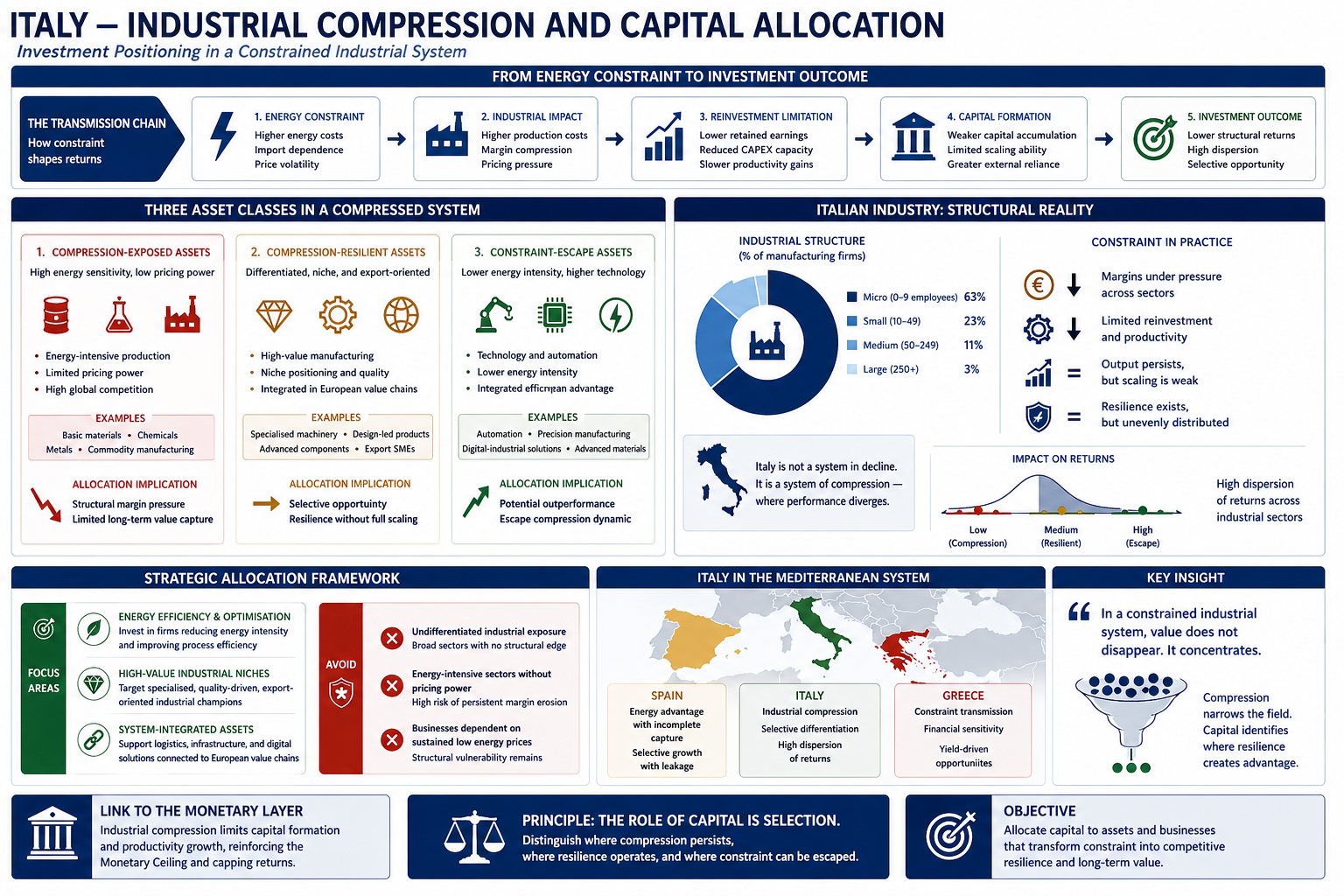
This article translates industrial compression into capital allocation strategy:
System Navigation: Mediterranean System Navigation
Keynote — Compression, Not Collapse
Italy does not present an investment case defined by crisis.
It presents a system defined by:
persistent industrial compression under energy constraint
This distinction matters.
crisis systems produce volatility
compression systems produce selective erosion and mispricing
The opportunity is not in recovery.
It is in structural differentiation within a constrained system.
System Position — Industrial Layer Under Pressure
Within the system chain:
Energy → Industry → Capital → Currency
Italy operates at the industrial layer, but under:
elevated energy costs
constrained reinvestment
limited capital flexibility
This produces:
a system where industrial assets persist—but do not uniformly generate value
Core Allocation Problem
Industrial compression creates divergence within the system, not just between countries.
Capital must distinguish between:
assets that absorb constraint
assets that transmit constraint
and assets that escape constraint
Allocation Segmentation — Three Asset Classes
1. Compression-Exposed Assets
Industrial segments where energy cost is dominant and margins are structurally pressured.
Characteristics:
energy-intensive production
limited pricing power
high exposure to global competition
Examples:
basic materials
chemicals
energy-intensive manufacturing
Allocation Implication:
structural margin pressure → limited long-term value capture
2. Compression-Resilient Assets
Segments able to operate within constraint through:
specialisation
pricing power
niche positioning
Characteristics:
high-value manufacturing
export-oriented SMEs with differentiation
strong integration into value chains
Allocation Implication:
selective opportunity → resilience without full scaling
3. Constraint-Escape Assets (Highest Strategic Value)
Segments that partially bypass energy constraint through:
technological intensity
lower energy sensitivity
system integration advantages
Characteristics:
advanced manufacturing
automation-driven production
energy-efficient processes
digital–industrial integration
Allocation Implication:
potential for outperformance within a constrained system
Core Mechanism — How Compression Shapes Returns
The transmission chain defines investment outcomes:
Energy cost → Margin compression → Reduced reinvestment → Limited scaling → Lower capital returns
This produces:
uneven profitability across sectors
reduced aggregate return potential
high dispersion of outcomes
Italy is not a low-return system.
It is a high-dispersion system.
Capital Allocation Reality
Investors face three structural constraints:
1. Limited System-Wide Growth
industrial expansion is constrained
productivity gains are uneven
scaling is selective
2. Constrained Capital Formation
reinvestment capacity is limited
fiscal support is bounded
external capital plays a larger role
3. Structural Mispricing
compression is often misinterpreted as cyclical weakness
resilience is underpriced
structural erosion is under-recognised
Link to the Monetary Layer
Industrial compression translates into:
lower capital formation
weaker productivity growth
constrained fiscal capacity
This reinforces:
the Monetary Ceiling
Implication:
returns are structurally capped at the system level—even when assets perform
Strategic Allocation Framework
Capital allocation in Italy must shift from:
macro exposure → structural selection
Focus Areas
1. Energy Efficiency and Optimisation
firms reducing energy intensity
process innovation
electrification integration
2. High-Value Industrial Niches
specialised manufacturing
export-driven excellence
technological differentiation
3. System-Integrated Assets
logistics linked to European value chains
infrastructure supporting industrial activity
automation and digital integration
Avoid
undifferentiated industrial exposure
energy-intensive sectors without pricing power
assets dependent on sustained low energy costs
Comparative Position — Italy in the Mediterranean System
| Country | Allocation Profile |
|---|---|
| Greece | Yield / transmission assets |
| Italy | Selective industrial differentiation |
| Spain | Energy-linked growth with incomplete capture |
Italy is not a growth story.
It is a selection story within constraint.
System Insight
Italy demonstrates:
constraint does not eliminate opportunity—
it redistributes it unevenly
Final Principle
In a constrained industrial system, value does not disappear.
It concentrates.
The role of capital is to identify where compression stops—and resilience begins.