Epilogue: Sovereignty as a Built Capability
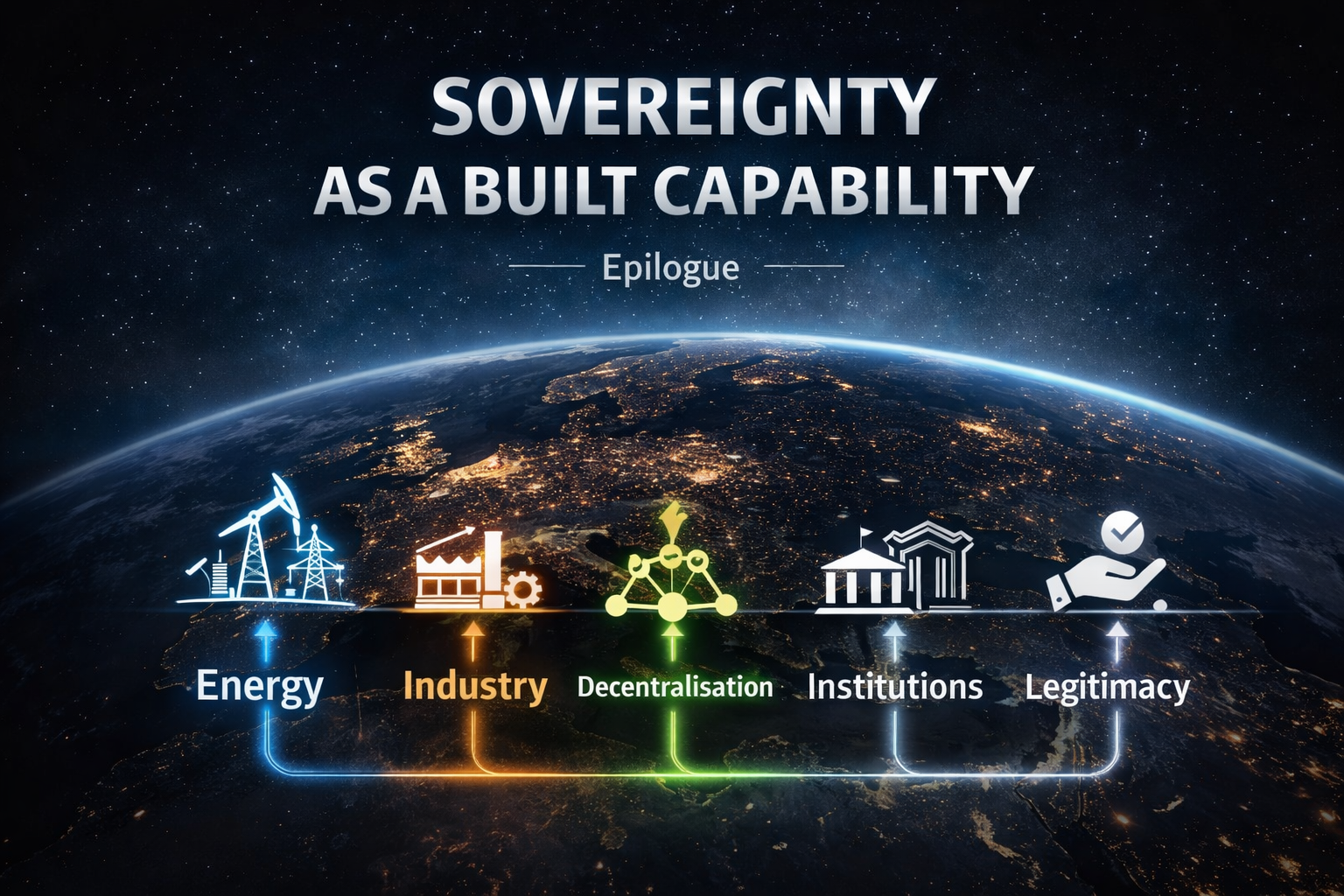
This epilogue does not advance a new argument; it draws together the logic established across the preceding articles.
Sovereignty in the twenty-first century is no longer defined by borders alone. It is built through energy systems, industrial capability, and the capacity to act with autonomy in an electrified, AI-driven world. This series has argued that for Europe, sovereignty begins with energy—and that decarbonised, decentralised systems are not optional, but foundational.
Across these articles, one hierarchy has been established and tested. It is not ideological, and it is not optional.
Energy autonomy—electrified, decarbonised, and increasingly decentralised—is the non-negotiable foundation of modern sovereignty. Everything else follows from it.
The Irreducible Constraint
The Fourth Industrial Revolution is electricity-intensive by design. AI, automation, data centres, edge computing, and digitally integrated industry all increase demand for reliable, affordable power. This is a technological reality, not a policy preference.
For Europe, whose fossil energy base is structurally import-dependent and geopolitically exposed, there is no credible path to meeting this demand while preserving autonomy through conventional energy systems. Electrification without decarbonisation deepens dependence; decarbonisation without electrification stalls competitiveness.
This is why decarbonisation must be understood not as climate policy, but as the only scalable route to energy autonomy under Europe’s geographic and geopolitical constraints.
Competitiveness Is Downstream
Industrial competitiveness, AI capability, and digital sovereignty are not independent ambitions. They are downstream outcomes of energy system design.
Where energy is volatile, externally priced, or insecure, industry hesitates, AI fragments, and investment thins. Where energy is stable, domestic, and digitally optimised, competitiveness compounds. Europe’s persistent difficulty has not been a lack of ideas, talent, or standards, but the absence of a sufficiently aligned energy–industry–technology system capable of scaling these strengths into durable power.
Decentralisation as the Bridge Between Strategy and Society
Perhaps the most consequential conclusion of this series is political rather than technical.
Energy autonomy will not endure if it is experienced only at the continental level. It must be visible and beneficial at the level of firms, regions, and communities.
Decentralised energy systems—local generation, storage, and digitally managed grids—are the hinge. They translate strategic necessity into lived experience:
- for SMEs, through cost predictability and resilience
- for regions, through investment and regeneration
- for citizens, through agency and trust
In this way, decentralisation is not fragmentation. It is the mechanism through which sovereignty becomes both autonomous and legitimate.
Institutions, Nations, and the European Scale
The series has also shown that sovereignty today operates across levels.
Energy systems, industrial scale, and digital infrastructure require European coordination. Democratic legitimacy, consent, and accountability remain anchored in nations and regions. These realities are not in conflict if strategy is designed correctly.
Europe’s task is not to replace national sovereignty, but to multiply it—by pooling scale where scale is required, and returning control and benefit where democracy demands it. When energy autonomy strengthens national resilience and SME viability, cooperation stabilises rather than polarises politics.
In this sense, Europe’s future does not lie in choosing between integration and democracy, but in aligning them.
What Has Been Established
Taken together, the argument of this series can be stated plainly:
- Sovereignty is a material capability before it is a legal concept
- Energy autonomy is the binding constraint of that capability
- Decarbonisation is the strategic route to autonomy, not an ethical add-on
- Industrial and AI competitiveness depend on energy system design
- Decentralisation is essential for legitimacy, resilience, and regeneration
- Institutions matter only insofar as they deliver alignment and scale
- Public consent is sustained through visible benefit, not abstraction
- Remove energy from this chain, and the entire structure weakens.
Closing Reflection
Europe’s strategic future will be decided less by declarations than by execution. Energy autonomy is the starting point; industrial competitiveness, technological capability, and democratic legitimacy follow from it.
Where energy autonomy is built, capability follows; where capability is shared, legitimacy endures; and where legitimacy endures, sovereignty remains a choice rather than a constraint.
In an electrified, AI-driven world, sovereignty must be built collectively, experienced locally, and sustained democratically. This is not a retreat from integration, but its renewal—within Europe, and through the nations that give it meaning.