Sovereignty After Borders
Why Energy and Competitiveness Now Define Power
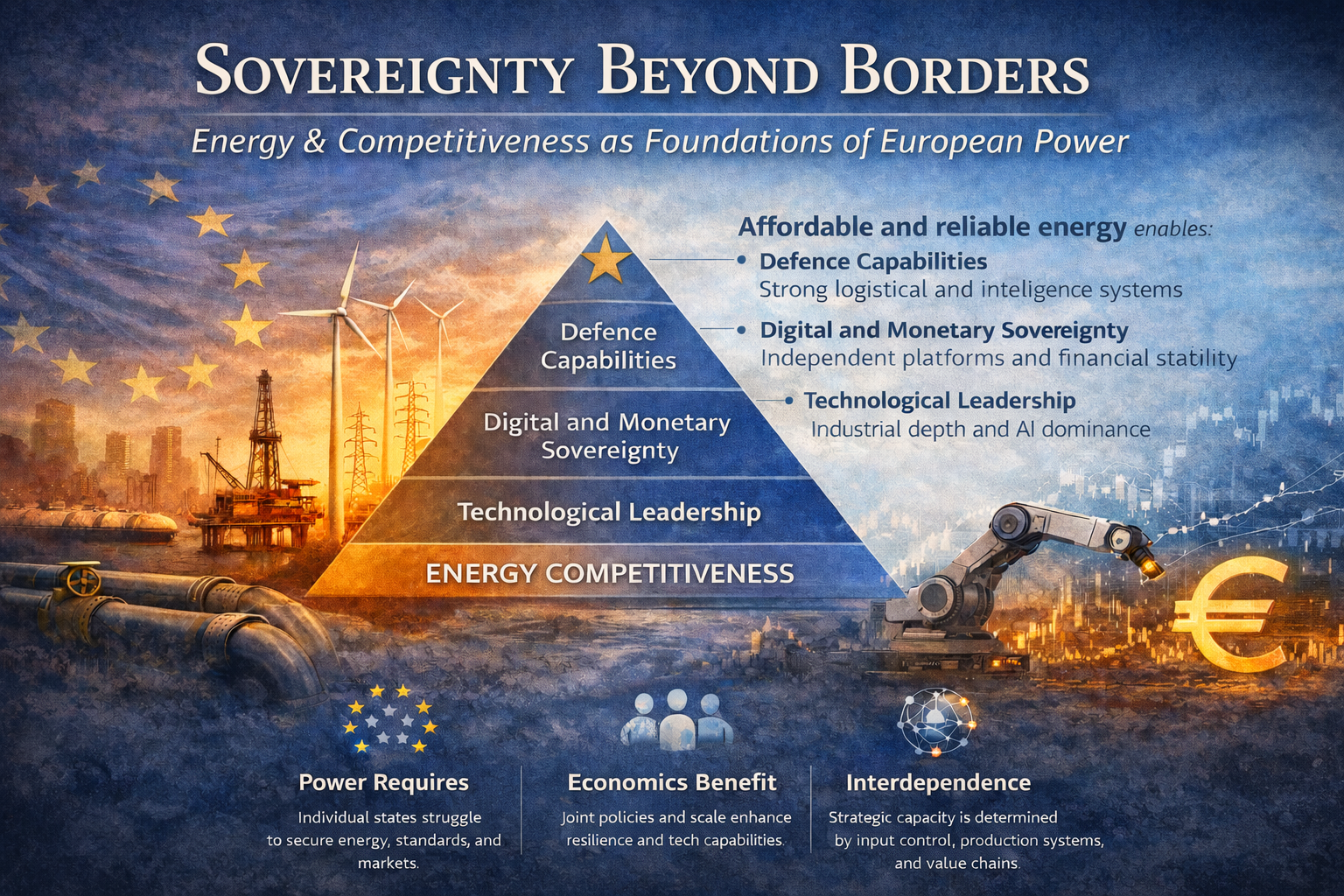
European sovereignty is no longer defined by borders alone. It is defined by systems.
For much of the twentieth century, sovereignty meant territorial control. States secured borders, managed domestic resources, and relied on predictable energy systems and embedded industrial capacity. Even during the Cold War, despite geopolitical rivalry, energy and production were structurally anchored within national systems.
That world has changed.
Financial globalisation, digitalisation, and integrated supply chains gradually shifted power away from territory and toward systemic position — who controls energy inputs, digital infrastructure, industrial capacity, and financial flows. Borders did not disappear, but they ceased to guarantee autonomy.
Today, sovereignty is exercised across interconnected systems rather than defended at geographic lines.
And at the foundation of those systems lies energy.
The Structural Shift Europe Now Faces
Europe’s current debate about strategic autonomy, industrial competitiveness, and defence capability often unfolds in separate silos. Energy policy is treated as climate policy. Competitiveness is treated as growth policy. Defence is treated as security policy.
In reality, these domains are now inseparable.
Artificial intelligence, automation, advanced manufacturing, digital infrastructure, and modern defence logistics are all electricity-intensive. As economies electrify, energy becomes not a background condition but the binding constraint.
This marks a structural shift.
When energy is affordable, stable, and scalable, states retain flexibility. When energy is volatile, structurally expensive, or externally exposed, every downstream ambition weakens — from industrial investment to fiscal resilience.
Europe’s recent experience has demonstrated that energy shocks are not isolated economic disturbances. They are systemic stress tests.
Put simply:
There is no credible defence capability, no digital sovereignty, no AI leadership, and no durable monetary strength without competitive energy.
Europe’s Emerging Strategic Trilemma
Europe now faces a structural tension between three objectives:
Strategic autonomy
Energy security
Industrial competitiveness
Each is necessary.
But pursuing them in parallel, without alignment, creates friction.
High energy prices undermine competitiveness.
Subsidising competitiveness strains fiscal space.
Energy dependence weakens autonomy.
Rapid transition without cost discipline risks deindustrialisation.
Without confronting these trade-offs directly, policy shifts costs rather than resolving constraint.
Energy has emerged as the central variable determining whether the other objectives can coexist.
Why Decarbonisation Is Structural, Not Ideological
For Europe, the energy transition is often framed as a climate preference. In strategic terms, it is a necessity.
Europe lacks large domestic fossil reserves. Fossil dependence exposes it to geopolitical leverage, currency volatility, and supply disruption.
Electrification powered by domestic and near-domestic low-carbon sources — renewables, storage, grid integration, and, where applicable, nuclear — offers predictability and reduced exposure once built.
This does not make the transition painless. But there is no scalable alternative that delivers autonomy, competitiveness, and resilience simultaneously.
Decarbonisation, for Europe, is not primarily moral positioning. It is structural logic.
Competitiveness Now Follows Energy
The Fourth Industrial Revolution does not reduce energy dependency. It intensifies it.
Data centres, semiconductor manufacturing, AI training clusters, electrified logistics, and advanced production systems all require stable electricity.
Regions with abundant, scalable power accumulate compounding advantage. Regions with volatile and expensive energy face structural divergence.
Competitiveness therefore follows energy conditions — not the other way around.
If energy remains structurally uncompetitive, regulatory sophistication cannot compensate.
Sovereignty today is not declared. It is built through capability.
From Energy Policy to System Design
This is why the sovereignty debate must move beyond slogans.
Energy cannot be treated as a standalone sector. It is the enabling layer beneath digital, industrial, monetary, and defence systems.
The question for Europe is no longer whether it supports strategic autonomy in principle.
The question is whether its energy system — pricing, grids, integration, stability — allows the rest of its ambitions to stand.
Sovereignty after borders is sovereignty through systems.
And in an electrified world, sovereignty begins in the grid.
Read the Full Analysis
This article is a bridge within the Europe’s Strategic Renewal series.
The full canonical version — integrated into the EU Sovereignty framework — expands this argument and situates it within Europe’s broader energy-bound constraints, system architecture, and industrial trajectory.
Read the full version: “Sovereignty After Borders: Why Energy and Competitiveness Now Define Power” (EU Sovereignty panel) Link
The longer analysis examines:
The structural redefinition of sovereignty
The energy–competitiveness trilemma in detail
The implications for digital and monetary sovereignty
Why energy system design determines Europe’s strategic horizon
Because in an energy-bound world,
the limits of power are no longer negotiated —
they are engineered.