Halbleiterkontrolle und Rechnerische Souveränität
Warum Rechenleistung zu Infrastrukturmacht geworden ist
Systemnavigation
Dieser Artikel verbindet Halbleitersouveränität, KI-Infrastrukturen, Energiesysteme, industrielle Ökosysteme, digitale Souveränität, Ökosystemkonzentration und die geopolitische Architektur von Systemen unter AI–Energy-Bedingungen.
Er sollte zusammen gelesen werden mit:
I. Das Ende der abstrakten Rechenleistung
Über mehrere Jahrzehnte hinweg schien sich ein großer Teil der digitalen Wirtschaft zunehmend von physischen Systemen zu lösen.
Software skalierte global über vernetzte Infrastrukturen. Finanzmärkte belohnten Plattformexpansion stärker als industrielle Tiefe. Cloud-Architekturen abstrahierten Geographie zunehmend aus der alltäglichen digitalen Erfahrung heraus. Technologisches Wachstum schien sich unabhängig von industrieller Konzentration, Energiesystemen, logistischer Infrastruktur und materieller Rohstoffgewinnung entfalten zu können.
Diese Phase verstärkte die Wahrnehmung, dass Rechenleistung zunehmend immateriell geworden sei.
Digitale Systeme schienen sich immer weiter von den industriellen Fundamenten zu entfernen, die wirtschaftliche Macht historisch begrenzt hatten.
Künstliche Intelligenz schien diese Wahrnehmung zunächst noch weiter zu beschleunigen.
KI wurde häufig als primär softwarebasiertes Phänomen dargestellt, das vor allem durch:
Algorithmen,
Datenakkumulation,
Cloud-Koordination,
und rechnerische Abstraktion
angetrieben werde.
Unter dieser Interpretation schien Intelligenz selbst zunehmend unabhängig von Geographie, Infrastruktur und industrieller Konzentration skalieren zu können.
Die rasche Expansion von KI-Infrastrukturen offenbart jedoch zunehmend die gegenteilige Realität.
Das KI-Zeitalter reduziert die Abhängigkeit von physischen Systemen nicht.
Es rückt physische Systeme wieder in das Zentrum technologischer Macht.
Mit der Skalierung von KI-Systemen wächst die rechnerische Intensität, die für Training, Deployment und Koordination fortgeschrittener Modelle erforderlich ist, gleichzeitig über:
Halbleiterdurchsatz,
Stromnachfrage,
Kühlungsinfrastrukturen,
Netzwerkarchitekturen,
Hyperscale-Deployments,
und industrielle Produktionsökosysteme hinweg.
Diese Transformation verbindet die Expansion digitaler Intelligenz direkt wieder mit den physischen Systemen, die großskalige Rechendichte überhaupt tragen können.
Unter AI–Energy-Bedingungen hängt rechnerische Expansion zunehmend ab von:
Fertigungskapazitäten,
Kontinuität elektrischer Netze,
Infrastrukturentwicklung,
industrieller Koordination,
und Energieverfügbarkeit.
Das Zeitalter abstrakter Rechenleistung beginnt sich daher in ein Zeitalter infrastruktureller Rechenleistung zu verwandeln.
Diese Transformation verändert die geopolitische Bedeutung von Halbleitern grundlegend.
Halbleiter sind nicht länger bloß industrielle Komponenten innerhalb von Lieferketten der Unterhaltungselektronik.
Sie funktionieren zunehmend als fundamentale Infrastrukturinputs der rechnerischen Zivilisation selbst.
II. Rechenleistung ist zu strategischer Infrastruktur geworden
Unter AI–Energy-Bedingungen funktioniert Rechenleistung zunehmend als strategische Infrastruktur.
Dies stellt eine der entscheidenden strukturellen Transformationen des entstehenden technologischen Zeitalters dar.
In früheren Phasen des digitalen Zeitalters erschien rechnerische Kapazität oft zweitrangig gegenüber:
Plattformen,
Anwendungen,
Software-Ökosystemen,
und internetbasierter Koordination.
Heute kehrt sich diese Hierarchie zunehmend um.
Ohne ausreichende Rechenkapazität:
können fortgeschrittene KI-Systeme nicht effektiv skalieren,
wird industrielle Automatisierung geschwächt,
verlangsamt sich wissenschaftliche Beschleunigung,
verschlechtern sich KI-bezogene militärische Fähigkeiten,
verstärkt sich externe Cloud-Konzentration,
und werden heimische digitale Ökosysteme zunehmend abhängig von ausländischer Infrastruktur.
Rechenleistung ähnelt daher immer stärker:
Energieinfrastrukturen,
elektrischen Systemen,
maritimen Korridoren,
Telekommunikationsnetzen,
und monetären Infrastrukturen.
Diese Transformation ist entscheidend, weil Infrastruktursysteme langfristige Asymmetrien erzeugen.
Infrastrukturen unterstützen wirtschaftliche Aktivität nicht bloß.
Sie strukturieren:
Abhängigkeit,
Skalierungsfähigkeit,
Ökosystemkonzentration,
Preisgestaltungsmacht,
industrielle Koordination,
und geopolitische Hierarchie über Zeit hinweg.
Mit der Expansion rechnerischer Infrastrukturen multiplizieren sich diese rekursiv über das gesamte System hinweg.
Die Kontrolle über Rechenleistung beeinflusst gleichzeitig:
KI-Fähigkeiten,
industrielle Produktivität,
finanzielle Konzentration,
Plattformmacht,
militärische Modernisierung,
wissenschaftliche Wettbewerbsfähigkeit,
und Ökosystementwicklung.
Rechenleistung fungiert damit zunehmend als infrastruktureller Multiplikator, der breitere Machtsysteme reorganisieren kann.
Unter diesen Bedingungen werden Halbleitersysteme zunehmend zu Souveränitätssystemen.
Die Kontrolle über Rechenleistung bestimmt zunehmend:
wer skaliert,
wer Vorteile akkumuliert,
wer Ökosysteme koordiniert,
und wer strukturell abhängig innerhalb extern kontrollierter technologischer Architekturen bleibt.
III. Halbleiterfertigung und die Rückkehr der industriellen Geographie
Die Halbleiterindustrie wurde lange Zeit durch die Logik der Globalisierung interpretiert.
Produktion wurde international verteilt. Lieferketten spezialisierten sich geographisch. Industrielle Konzentration wurde primär durch Effizienzoptimierung und komparative Vorteile gerechtfertigt.
Dieses Modell beruhte auf der Annahme, dass technologische Interdependenz geopolitische Fragmentierung stabilisieren würde.
Unter AI–Energy-Bedingungen wird diese Annahme zunehmend geschwächt.
Fortgeschrittene Halbleiterfertigung hängt von hochkonzentrierten industriellen Ökosystemen ab, die gleichzeitige Koordination erfordern zwischen:
fortgeschrittener Lithographie,
ultrareinen Materialien,
Präzisionsausrüstung,
chemischer Verfahrenstechnik,
Reinraumumgebungen,
hochspezialisierter Arbeitskraft,
elektrischer Kontinuität,
Infrastrukturstabilität,
und industrieller Produktionstiefe.
Diese Ökosysteme lassen sich nicht schnell replizieren.
Ihre Komplexität entsteht aus jahrzehntelanger Akkumulation industrieller Koordination, konzentrierter Ingenieurskompetenz, Infrastrukturinvestitionen und Ökosystemskalierung.
Infolgedessen erzeugt die Konzentration der Fertigung zunehmend strukturelle geopolitische Hebelwirkung.
Die Fähigkeit, fortgeschrittene Halbleiter zu produzieren, bestimmt zunehmend:
die Skalierungsfähigkeit von KI,
die Expansion von Cloud-Infrastrukturen,
industrielle Automatisierung,
militärische Modernisierung,
fortgeschrittene Forschungskapazitäten,
und die Kontrolle digitaler Ökosysteme.
Die Halbleiterindustrie funktioniert daher immer weniger als konventioneller Industriesektor und zunehmend als strategische Infrastrukturschicht innerhalb breiterer Souveränitätsarchitekturen.
Diese Transformation rückt industrielle Geographie wieder in das Zentrum geopolitischer Macht.
Die Geographie der Fertigung wird zunehmend untrennbar:
von der Energiegeographie,
von der Infrastrukturgeographie,
von der Geographie industrieller Ökosysteme,
und von der Geographie rechnerischer Souveränität.
Unter AI–Energy-Bedingungen verbindet sich technologische Macht damit zunehmend wieder mit physischer Konzentration.
IV. KI-Skalierung und der Fertigungsengpass
Die Expansion künstlicher Intelligenz offenbart zunehmend, dass rechnerische Skalierung nicht primär durch Softwareambition begrenzt wird, sondern durch den physischen Durchsatz von Infrastruktur.
Dies ist eine der entscheidenden strukturellen Realitäten des KI-Zeitalters.
Frühere Phasen digitaler Expansion erzeugten häufig den Eindruck, dass Software nahezu unabhängig von industriellen Begrenzungen skalieren könne. Cloud-Systeme verstärkten diese Abstraktion zusätzlich, indem sie einen Großteil der zugrunde liegenden Infrastruktur hinter immer nahtloseren digitalen Umgebungen verbargen.
Großskalige KI-Systeme legen jedoch zunehmend die physischen Fundamente offen, auf denen rechnerische Expansion tatsächlich beruht.
Mit der Skalierung von Modellen expandieren die Infrastrukturen, die erforderlich sind für:
Training,
Inferenz,
Koordination,
und Deployment,
gleichzeitig über:
fortgeschrittene Halbleiterfertigung,
Hochbandbreiten-Speichersysteme,
Netzwerkarchitekturen,
Stromproduktion,
Übertragungsinfrastrukturen,
Kühlsysteme,
und Hyperscale-Rechenzentren hinweg.
Diese Transformation verbindet algorithmische Ambition direkt wieder mit industrieller Kapazität.
Unter diesen Bedingungen wird KI-Wettbewerb zunehmend zu einem Wettbewerb um physische Skalierungskapazität.
Der Engpass verschiebt sich damit auf die fundamentalen unteren Schichten des Technologie-Stacks.
Die entscheidende Begrenzung wird zunehmend die Frage, ob ein System über ausreichende:
Fertigungskapazität,
Infrastrukturkontinuität,
elektrische Kapazität,
industrielle Koordination,
und Ökosystemkonzentration
verfügt, um großskalige Rechendichte aufrechterhalten zu können.
Diese Transformation verändert die Bedeutung technologischer Führung grundlegend.
Die entscheidende Frage lautet nicht länger bloß, ob eine Gesellschaft fortgeschrittene Software entwickeln kann.
Die entscheidende Frage wird zunehmend, ob sie die industriellen und infrastrukturellen Systeme aufrechterhalten kann, die erforderlich sind, um Intelligenz dauerhaft zu skalieren.
Deshalb nimmt Halbleiterfertigung inzwischen eine zentrale Stellung im geopolitischen Wettbewerb ein.
KI-Systeme mögen auf Anwendungsebene digital erscheinen.
Unterhalb der Softwareschicht hängt Intelligenz jedoch zunehmend ab von:
Fertigungsökosystemen,
elektrischen Systemen,
industrieller Produktion,
strategischen Mineralienketten,
und Infrastrukturkontinuität.
Der Wettbewerb um KI wird dadurch gleichzeitig:
zu einem Energiewettbewerb,
zu einem Infrastrukturwettbewerb,
zu einem industriellen Wettbewerb,
zu einem Fertigungswettbewerb,
und zu einem Wettbewerb um Ökosystemkoordination.
Diese Dynamik begünstigt zunehmend Systeme, die in der Lage sind:
Energie, Infrastruktur, Industrie, Rechenleistung, Logistik und Kapital
innerhalb kohärenter Skalierungsarchitekturen zu integrieren.
Die Fähigkeit, rechnerische Expansion aufrechtzuerhalten, bestimmt zunehmend die Fähigkeit, technologische Souveränität selbst aufrechtzuerhalten.
V. Halbleiter-Ökosysteme und nicht bloß Halbleiterunternehmen
Halbleiterfähigkeiten werden häufig durch die Perspektive einzelner Unternehmen interpretiert.
Dies verdeckt zunehmend die tatsächliche Struktur technologischer Macht.
Fortgeschrittene Halbleitersysteme entstehen nicht aus isolierten Unternehmen, die unabhängig innerhalb offener Märkte operieren.
Sie entstehen aus tief integrierten Ökosystemen, die fortlaufende Koordination zwischen mehreren voneinander abhängigen Ebenen gleichzeitig erfordern.
Diese Ebenen umfassen zunehmend:
Fertigungsanlagen,
Lithographie-Zulieferer,
Hersteller von Präzisionsausrüstung,
fortgeschrittene chemische Verarbeitungssysteme,
elektrische Infrastrukturen,
Logistiksysteme,
universitäre Forschungsnetzwerke,
Softwareumgebungen,
Entwickler-Ökosysteme,
industriepolitische Strukturen,
und Kapitalallokationssysteme.
Unter AI–Energy-Bedingungen wird die strategische Einheit des Wettbewerbs zunehmend das Ökosystem und nicht das Unternehmen.
Diese Unterscheidung ist grundlegend.
Eine einzelne Fertigungsanlage erzeugt für sich genommen keine Souveränität.
Souveränität hängt zunehmend davon ab, ob ein System verfügt über:
Ökosystemkontinuität,
industrielle Tiefe,
Infrastrukturresilienz,
konzentrierte Ingenieurskompetenz,
Energiestabilität,
und langfristige Skalierungsfähigkeit.
Die Halbleiterindustrie offenbart damit zunehmend ein breiteres Prinzip rechnerischer Zivilisation:
Ökosysteme akkumulieren Macht effektiver als isolierte technologische Vermögenswerte.
Dies erklärt, warum sich technologische Führung zunehmend geographisch konzentriert.
Mit zunehmender Vertiefung von Halbleiter-Ökosystemen verstärken sich diese rekursiv durch:
Infrastrukturkonzentration,
Spezialisierung der Arbeitskräfte,
Kapitalanziehung,
Integration von Lieferketten,
Forschungskoordination,
und Ökosystemgravitation.
Über Zeit hinweg erzeugt dies asymmetrische Skalierungsvorteile.
Systeme mit Ökosystemtiefe ziehen an:
mehr Investitionen,
größere Ingenieurskapazitäten,
umfangreichere Infrastrukturentwicklung,
stärkere industrielle Koordination,
und größere rechnerische Konzentration.
Systeme ohne ausreichende Ökosystemtiefe haben zunehmend Schwierigkeiten, wettbewerbsfähig zu skalieren, selbst wenn sie über:
wissenschaftliche Expertise,
fortgeschrittene Unternehmen,
oder industrielle Fragmente
verfügen.
Unter diesen Bedingungen wird Halbleitersouveränität zunehmend zu Ökosystem-Souveränität.
Die strategische Frage lautet nicht länger bloß:
Wer produziert Chips?
Die tiefere Frage wird zunehmend:
Welche Systeme können die gesamte industrielle Architektur aufrechterhalten, die für rechnerische Zivilisation erforderlich ist?
Diese Transformation ist zentral innerhalb des breiteren AI–Energy-Rahmens, weil KI-Infrastrukturen nicht bloß durch isolierte Innovation skalieren.
Sie skalieren durch die rekursive Integration:
von Energiesystemen,
industriellen Systemen,
rechnerischen Systemen,
Infrastruktursystemen,
Logistiksystemen,
und Kapitalsystemen.
Halbleiter-Ökosysteme funktionieren damit zunehmend als strategische Koordinationsarchitekturen innerhalb breiterer Souveränitätsstrukturen.
VI. Die Konvergenz von Energie und Halbleitern
Die Halbleiterfrage kann nicht länger von der Energiefrage getrennt werden.
Unter AI–Energy-Bedingungen konvergieren diese Systeme zunehmend strukturell innerhalb derselben Infrastrukturarchitektur.
Diese Konvergenz beschleunigt sich, weil rechnerische Expansion zunehmend elektrizitätsintensiver wird.
Mit der Skalierung von KI-Systemen wächst die Energie, die erforderlich ist für:
Training,
Inferenz,
Netzwerke,
Kühlung,
und Hyperscale-Deployments,
gleichzeitig über das gesamte rechnerische Ökosystem hinweg.
Diese Transformation verbindet die Wettbewerbsfähigkeit von Halbleitern zunehmend direkt mit:
Netzstabilität,
Stromkosten,
Übertragungsinfrastruktur,
Kühlungsverfügbarkeit,
industrieller Energiekontinuität,
und Infrastrukturresilienz.
In früheren Phasen des digitalen Zeitalters erschienen Softwareplattformen relativ losgelöst von Energiegeographie.
Unter AI–Energy-Bedingungen schwächt sich diese Abstraktion rasch ab.
Die Geographie der Rechenleistung wird zunehmend zur Geographie der Elektrizität.
Diese Transformation ist grundlegend.
Fortgeschrittene Halbleiter-Ökosysteme benötigen zunehmend:
stabile Grundlastenergie,
großskalige Infrastrukturkontinuität,
resiliente Übertragungssysteme,
industrielle Kühlungskapazitäten,
und langfristige Investitionskoordination.
Mit wachsender Rechendichte integrieren sich elektrische Systeme direkt in technologische Wettbewerbsfähigkeit selbst.
Dies verändert die Logik der Halbleitergeographie.
Regionen, die in der Lage sind:
kostengünstige Energie,
Infrastrukturkontinuität,
industrielle Konzentration,
und rechnerische Kapazitäten
miteinander zu verbinden, gewinnen zunehmend Vorteile bei der KI-Skalierung.
Unter diesen Bedingungen konvergieren Halbleiter-Ökosysteme zunehmend mit:
Energiesystemen,
industriellen Korridoren,
Logistikarchitekturen,
Infrastrukturgeographien,
und Souveränitätssystemen.
Diese Konvergenz erklärt auch, warum künstliche Intelligenz physisch geworden ist.
Die Expansion von Intelligenzinfrastrukturen verbindet rechnerische Systeme zunehmend wieder mit:
elektrischen Netzen,
Mineraliengewinnung,
Übertragungskorridoren,
industrieller Produktion,
Kühlsystemen,
und physischem Infrastrukturaufbau.
Der Technologie-Stack verbindet sich damit zunehmend wieder mit den materiellen Systemen, die ihn tragen.
Halbleitersysteme operieren nicht länger bloß innerhalb der digitalen Wirtschaft.
Sie operieren zunehmend innerhalb einer breiteren energie-industriellen Zivilisationsarchitektur, in der Rechenleistung direkt von den physischen Systemen abhängt, die sie tragen können.
Unter diesen Bedingungen wird Halbleitersouveränität zunehmend untrennbar:
von Energiesouveränität,
von Infrastruktur-Souveränität,
von industrieller Souveränität,
und von Ökosystem-Souveränität zugleich.
VII. Rechnerische Souveränität und die neue Infrastrukturhierarchie

Rechnerische Souveränität entwickelt sich zunehmend zu einer der fundamentalen Ebenen geopolitischer Macht.
Diese Transformation spiegelt eine breitere strukturelle Reorganisation des globalen Systems unter AI–Energy-Bedingungen wider.
Frühere geopolitische Epochen waren primär strukturiert um die Kontrolle über:
maritime Systeme,
industrielle Produktion,
kohlenwasserstoffbasierte Energiesysteme,
Handelskorridore,
und monetäre Infrastrukturen.
Diese Systeme bestimmten:
wirtschaftliche Skalierung,
militärische Reichweite,
industrielle Produktivität,
finanzielle Hebelwirkung,
und geopolitische Hierarchie.
Das KI-Zeitalter ersetzt diese Systeme nicht.
Es integriert rechnerische Infrastrukturen zunehmend in sie hinein.
Dadurch fungiert Rechenleistung zunehmend als Souveränitätsmultiplikator innerhalb der gesamten Machtarchitektur.
Die Kontrolle rechnerischer Infrastruktur beeinflusst zunehmend gleichzeitig:
wissenschaftliche Beschleunigung,
militärische Modernisierung,
industrielle Produktivität,
finanzielle Konzentration,
Ökosystemskalierung,
Plattformdominanz,
Automatisierungsfähigkeit,
und strategische Koordinationsfähigkeit.
Diese Transformation verändert die Hierarchie von Infrastruktur selbst.
Rechenleistung funktioniert nicht länger bloß als unterstützende Ebene wirtschaftlicher Aktivität.
Sie wird zunehmend zu einem der Systeme, durch die wirtschaftliche Macht organisiert, skaliert und gesteuert wird.
Unter diesen Bedingungen bestimmt die Kontrolle über Rechenleistung zunehmend:
wer technologische Renten abschöpft,
wer digitale Ökosysteme kontrolliert,
wer Kapital konzentriert,
wer KI-Fähigkeiten entwickelt,
und wer abhängig von extern kontrollierter Infrastruktur bleibt.
Dies erzeugt eine neue Hierarchie der Abhängigkeit innerhalb der rechnerischen Zivilisation.
Ein Staat oder eine Region kann:
formale politische Souveränität,
industrielle Fähigkeiten,
regulatorische Autorität,
und finanzielle Komplexität
bewahren und dennoch strukturell abhängig bleiben, wenn:
fortgeschrittene Halbleiter,
Cloud-Infrastrukturen,
Betriebssysteme,
KI-Deployment-Umgebungen,
oder Hyperscale-Rechenkapazitäten
extern kontrolliert werden.
Diese Abhängigkeit breitet sich zunehmend in die oberen Ebenen des Technologie-Stacks aus.
Eine Schwäche auf rechnerischer Ebene beeinflusst zunehmend:
Plattformentwicklung,
industrielle Wettbewerbsfähigkeit,
Entwickler-Ökosysteme,
KI-Skalierungsfähigkeit,
Kapitalbindung,
und strategische Autonomie.
Deshalb wird rechnerische Souveränität zunehmend untrennbar:
von industrieller Souveränität,
von Energiesouveränität,
von digitaler Souveränität,
von Plattform-Souveränität,
und von Infrastruktur-Souveränität.
Das KI-Zeitalter reorganisiert Macht zunehmend um Systeme herum, die in der Lage sind, diese verschiedenen Ebenen kohärent zu integrieren.
Unter diesen Bedingungen wird die Kontrolle über Halbleiter zunehmend Teil eines breiteren Kampfes um die Governance-Architektur rechnerischer Zivilisation selbst.
VIII. Europa und strukturelle Abhängigkeit
Die europäische Herausforderung im Bereich der Halbleiter stellt grundlegend kein isoliertes Technologieproblem dar.
Sie stellt ein Problem systemischer Konversion dar.
Der Kontinent verfügt weiterhin über bedeutende:
wissenschaftliche Fähigkeiten,
industrielle Komplexität,
Infrastrukturdichte,
Ingenieurskompetenz,
industrielle Fertigungstiefe,
und regulatorische Einflussmöglichkeiten.
Unter AI–Energy-Bedingungen übersetzen sich diese Fähigkeiten jedoch nicht automatisch in souveräne Rechenleistung.
Die zentrale Frage wird zunehmend, ob Europa in der Lage ist:
industrielle Fähigkeiten, Infrastruktur, Energiesysteme, wissenschaftliche Forschung und Kapital
in kohärente rechnerische Ökosysteme zu konvertieren, die autonom skalieren können.
Genau auf dieser Ebene stößt Europa auf zunehmende strukturelle Schwierigkeiten.
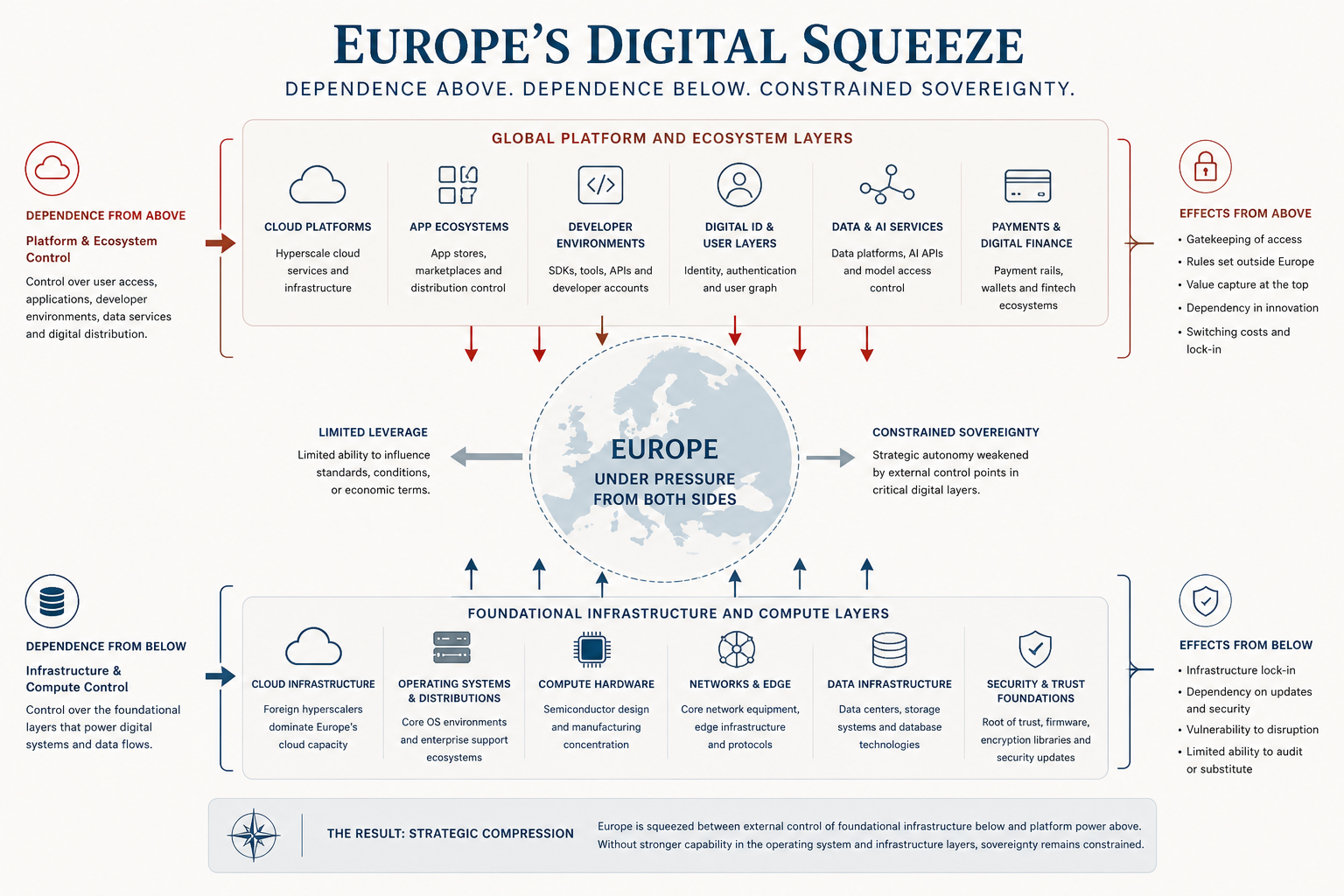
Der Kontinent bleibt gleichzeitig stark abhängig von:
fortgeschrittener Halbleiterfertigung,
Hyperscale-Cloud-Infrastrukturen,
GPU-Konzentration,
Betriebssystemen,
KI-Deployment-Umgebungen,
Entwickler-Ökosystemen,
und Plattform-Governance.
Diese Abhängigkeit wird zusätzlich verstärkt durch:
fragmentierte Kapitalallokation,
ungleiche Infrastrukturintegration,
höhere industrielle Energiekosten,
unvollständige digitale Skalierung,
und schwächere Ökosystemkonzentration als in den Vereinigten Staaten oder Ostasien.
In früheren wirtschaftlichen Phasen konnte Europa diese Schwächen häufig kompensieren durch:
Industrieexporte,
regulatorischen Einfluss,
Fertigungsqualität,
und Integration in globale Handelssysteme.
Unter AI–Energy-Bedingungen werden diese Kompensationsmechanismen zunehmend unzureichend.
Dies liegt daran, dass KI-Infrastrukturen sich nun rekursiv verstärken.
Systeme, die in der Lage sind:
Rechenleistung,
Kapital,
Energie,
Infrastruktur,
und Ökosysteme
zu konzentrieren, gewinnen mit der Zeit zunehmend stärkere Skalierungsvorteile.
Fragmentierte Systeme hingegen haben zunehmende Schwierigkeiten, wettbewerbsfähige rechnerische Expansion aufrechtzuerhalten.
Europa läuft daher Gefahr, an der KI-Wirtschaft primär über extern kontrollierte Infrastrukturarchitekturen teilzunehmen.
Dies erzeugt strukturelle Asymmetrien bei:
Cloud-Abhängigkeit,
Plattform-Abhängigkeit,
Kapitalabfluss,
KI-Deployment,
Ökosystemkonzentration,
und technologischer Governance.
Das Problem besteht daher nicht bloß in Innovation.
Es handelt sich auch nicht allein um industriellen Niedergang.
Das tiefere Problem besteht darin, dass Europa zunehmend eine vollständig integrierte Konversionsarchitektur fehlt, die in der Lage wäre:
industrielle Tiefe,
wissenschaftliche Fähigkeiten,
Energieinfrastrukturen,
und Kapitalressourcen
in souveräne rechnerische Ökosysteme zu transformieren.
Deshalb überschneidet sich die Halbleiterfrage inzwischen direkt mit:
Energiesystemen,
Infrastrukturintegration,
Industriepolitik,
digitaler Souveränität,
und Ökosystemkoordination.
Die Herausforderung besteht nicht länger bloß darin, technologisch aufzuholen.
Sie besteht zunehmend darin, ob Europa ausreichende systemische Integration aufrechterhalten kann, um innerhalb der rechnerischen Zivilisation ein autonomer Akteur zu bleiben.
IX. Der Mittelmeerraum und die Geographie von KI-Infrastrukturen
Unter AI–Energy-Bedingungen entwickelt sich der Mittelmeerraum zunehmend zu einer strategischen Infrastrukturschnittstelle innerhalb der zukünftigen europäischen Geographie rechnerischer Macht.
Diese Transformation ist grundlegend für das Verständnis der breiteren Architektur von Halbleitersouveränität.
Das KI-Zeitalter hängt zunehmend ab von der großskaligen Integration:
elektrischer Systeme,
Unterseekabel-Infrastrukturen,
logistischer Korridore,
verteilter rechnerischer Architekturen,
Kühlungsgeographien,
industrieller Rückverlagerung,
Übertragungsnetze,
und Hyperscale-Infrastrukturdeployments.
Der Mittelmeerraum liegt direkt an der Schnittstelle dieser Systeme.
Diese Geographie verbindet zunehmend:
nordafrikanische Energiesysteme,
südeuropäische Industriekorridore,
LNG-Infrastrukturen,
digitale Unterseekonnektivität,
Ausbau erneuerbarer Energien,
elektrische Interkonnektoren,
maritime Logistik,
und entstehende verteilte Rechennetze.
In früheren geopolitischen Rahmen wurde Südeuropa häufig primär durch die Sprache fragiler Peripherie und struktureller Abhängigkeit interpretiert.
Unter AI–Energy-Bedingungen wird diese Interpretation zunehmend unzureichend.
Mit der Expansion von KI-Infrastrukturen folgt das Deployment künstlicher Intelligenz zunehmend:
elektrischer Stabilität,
Infrastrukturkontinuität,
Kühlungsverfügbarkeit,
Übertragungskapazitäten,
und der physischen Geographie von Infrastrukturdeployment.
Diese Transformation erhöht zunehmend die strategische Bedeutung:
von Energiekorridoren,
Hafensystemen,
Interkonnektoren,
verteilten Infrastrukturnetzen,
und mediterraner Logistikpositionierung.
Der Mittelmeerraum funktioniert dadurch zunehmend nicht als äußere Peripherie europäischer Technologieentwicklung, sondern als:
Konversionsschnittstelle zwischen Energiesystemen und rechnerischen Systemen.
Diese Transformation besitzt grundlegende strategische Bedeutung, weil Europas zukünftige rechnerische Position zunehmend davon abhängen könnte, ob mediterrane Infrastrukturen in eine breitere europäische Konversionsarchitektur integriert werden können.
Der Mittelmeerraum verfügt zunehmend über strukturelle Vorteile bei:
der Skalierung erneuerbarer Energien,
maritimer Positionierung,
Unterseekonnektivität,
verteilten Infrastrukturgeographien,
logistischer Integration,
und elektrischer Interkonnektivität.
Unter AI–Energy-Bedingungen werden diese Systeme direkt relevant für:
rechnerische Lokalisierung,
Edge-AI-Deployment,
Infrastrukturresilienz,
industrielle Dezentralisierung,
und verteilte rechnerische Skalierung.
Diese Transformation verändert die geopolitische Bedeutung Südeuropas.
Der Mittelmeerraum verschiebt sich zunehmend:
von wahrgenommener peripherer Verwundbarkeit
hin zu:
strategischer infrastruktureller Zentralität innerhalb des zukünftigen europäischen rechnerischen Systems.
Halbleitersouveränität kann daher nicht ausschließlich durch Fertigungsanlagen oder Chipdesign verstanden werden.
Sie muss verstanden werden durch die breitere Geographie:
von Energiesystemen,
Infrastrukturkorridoren,
industriellen Ökosystemen,
logistischer Integration,
und rechnerischen Deployment-Architekturen.
Unter diesen Bedingungen wird der Mittelmeerraum zunehmend zu einem der physischen Fundamente, über die sich europäische rechnerische Souveränität entweder konsolidieren oder fragmentieren wird.
X. Halbleitersouveränität als systemische Souveränität
Halbleiter sind nicht länger bloß industrielle Komponenten innerhalb technologischer Konsumsysteme.
Unter AI–Energy-Bedingungen funktionieren sie zunehmend als fundamentale Infrastrukturebenen der rechnerischen Zivilisation selbst.
Diese Transformation verändert die Bedeutung technologischer Macht grundlegend.
Die Expansion künstlicher Intelligenz verbindet rechnerische Fähigkeiten zunehmend wieder mit:
Halbleiterfertigung,
elektrischen Systemen,
industrieller Produktion,
strategischen Mineralien,
Logistikarchitekturen,
Kühlungsinfrastrukturen,
Übertragungsnetzen,
und Ökosystemkonzentration.
Dadurch wird digitale Macht zunehmend untrennbar von physischen Infrastrukturkapazitäten.
Das KI-Zeitalter reduziert daher nicht die Bedeutung industrieller Systeme.
Es rückt industrielle Systeme wieder in das Zentrum geopolitischer Hierarchie.
Diese Transformation ist grundlegend, weil Rechenleistung zunehmend als rekursive Infrastrukturebene innerhalb des gesamten globalen Systems funktioniert.
Die Kontrolle über Halbleiter beeinflusst zunehmend gleichzeitig:
KI-Skalierung,
industrielle Produktivität,
militärische Modernisierung,
wissenschaftliche Beschleunigung,
Plattformkonzentration,
Ökosystementwicklung,
und Kapitalakkumulation.
Unter diesen Bedingungen kann Halbleitersouveränität nicht länger eng als bloße sektorale Industriefrage verstanden werden.
Sie wird gleichzeitig zu:
Infrastrukturpolitik,
Energiepolitik,
Industriepolitik,
Ökosystempolitik,
Digitalpolitik,
und geopolitischer Strategie.
Deshalb überschneidet sich die Halbleiterfrage inzwischen direkt mit:
Energiesouveränität,
rechnerischer Souveränität,
Plattform-Souveränität,
Infrastruktur-Souveränität,
und Ökosystem-Souveränität.
Die strategische Frage lautet nicht länger bloß, ob ein Land fortgeschrittene Chips produzieren kann.
Die tiefere Frage wird zunehmend, ob ein System die gesamte Architektur aufrechterhalten kann, die für souveräne rechnerische Skalierung erforderlich ist.
Diese Architektur umfasst zunehmend:
Energiekontinuität,
Infrastrukturresilienz,
industrielle Konzentration,
Ökosystemkoordination,
logistische Integration,
Softwareumgebungen,
Kapiteltiefe,
und langfristige Skalierungsfähigkeit.
Unter AI–Energy-Bedingungen verstärken sich diese Ebenen zunehmend rekursiv.
Systeme, die in der Lage sind:
Energie, Infrastruktur, Industrie, Rechenleistung, Ökosysteme, Logistik und Kapital
zu integrieren, gewinnen mit der Zeit zunehmend strukturelle Hebelwirkung.
Systeme, die diese Integration nicht aufrechterhalten können, riskieren abhängig von extern kontrollierten rechnerischen Infrastrukturen zu werden.
Diese Transformation reorganisiert die Architektur von Souveränität selbst grundlegend.
Frühere Phasen der Globalisierung hatten die Vorstellung verstärkt, dass Software, Finanzsysteme und digitale Koordination Macht zunehmend von Geographie und industrieller Konzentration lösen könnten.
Das KI-Zeitalter kehrt diese Abstraktion zunehmend um.
Mit der Skalierung von Intelligenzinfrastrukturen kehren physische Systeme zunehmend in das Zentrum wirtschaftlicher und geopolitischer Macht zurück.
Industrielle Geographie tritt erneut hervor.
Infrastrukturdichte gewinnt wieder strategische Bedeutung.
Energiesysteme integrieren sich direkt in rechnerische Wettbewerbsfähigkeit.
Fertigungsökosysteme werden zu Hebelsystemen.
Und die Kontrolle über Halbleiter wird zunehmend zu einer der fundamentalen Determinanten langfristiger technologischer Autonomie.
Die Halbleiterindustrie repräsentiert daher inzwischen weit mehr als bloß einen Technologiesektor.
Sie repräsentiert zunehmend eine der kritischen Infrastrukturgrundlagen, über die rechnerische Zivilisation organisiert, gesteuert und skaliert werden wird.
Unter diesen Bedingungen bestimmt Halbleitersouveränität zunehmend, ob Gesellschaften am KI-Zeitalter teilnehmen:
als souveräne Systemarchitekten, die rechnerische Infrastrukturen gestalten können,
oder:
als abhängige Konsumenten innerhalb extern kontrollierter technologischer Architekturen.
Deshalb wird die Kontrolle über Halbleiter zunehmend untrennbar von der breiteren Frage systemischer Souveränität selbst.