EVIDENCE
Energy Systems, Capital Allocation, and Strategic Returns
System Navigation
Investor Framework — Capital Allocation in an Energy-Bound System
→ Investor Index — Navigation Hub
→ Energy Constraint and the Monetary Ceiling
This section provides the empirical foundation supporting the system analysis developed across the site.
It is designed for investors, capital allocators, and strategic decision-makers seeking to understand how:
- energy cost structures shape industrial competitiveness
- industrial structure shapes capital allocation
- capital allocation shapes technological capacity and returns
The materials assembled here validate a central proposition:
Energy systems increasingly determine the structure of returns.
Evidence does not precede the framework — it validates it.
Data, Strategic Validation, and System Signals
This section provides the empirical grounding for the analytical framework developed across the site.
It should be read in conjunction with:
→ Investor
Framework — Capital Allocation in an Energy-Bound System
→ Investor Index —
Navigation Hub
The objective is clarity rather than volume: a curated body of evidence illustrating how the emerging energy-bound system reshapes industrial competitiveness, capital allocation, and technological capacity.
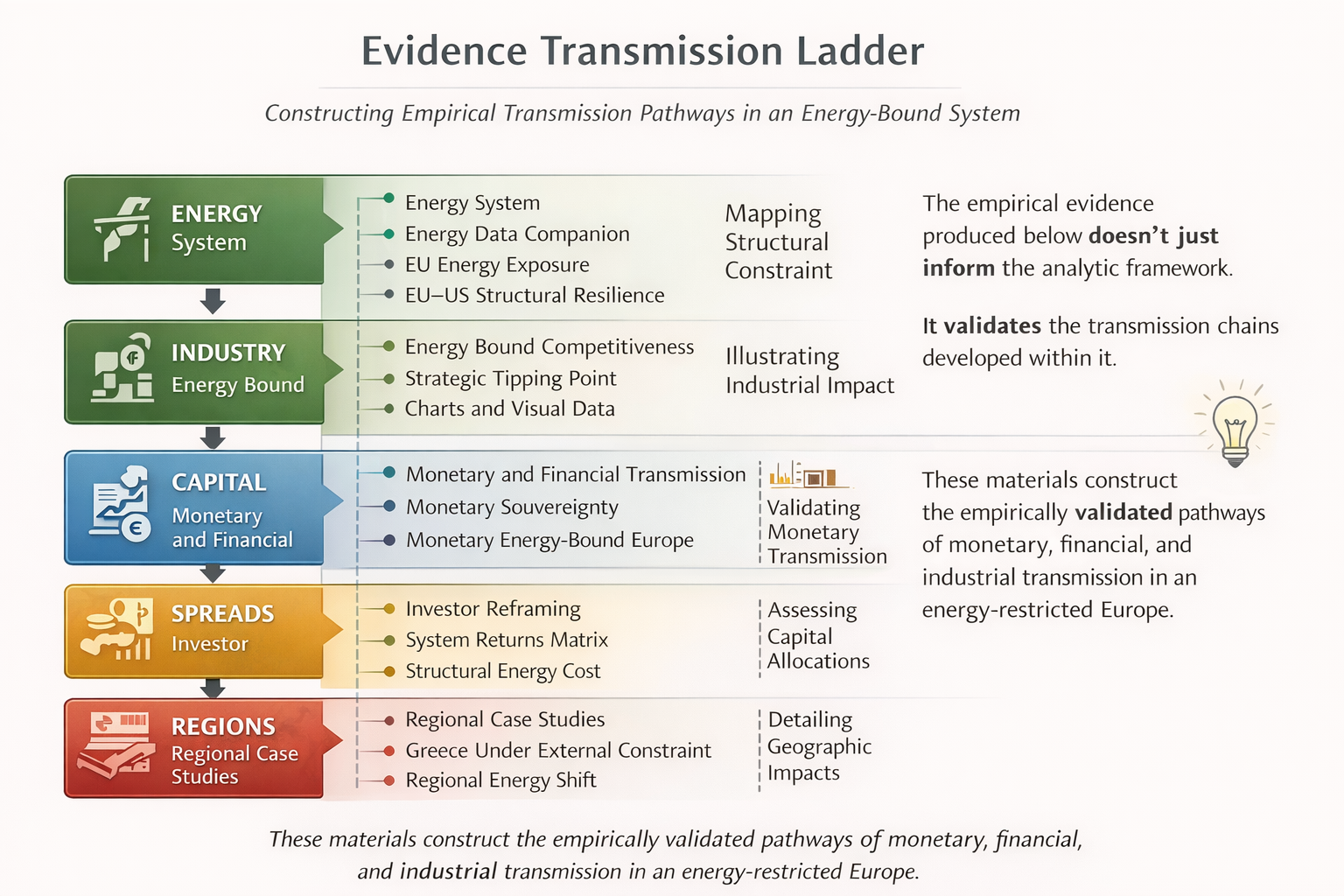
Evidence Transmission Ladder
The materials in this section correspond to successive layers of the energy-bound system:
Energy Systems
↓
Industrial Cost Structure
↓
Capital Allocation
↓
Financial Conditions (Spreads, Liquidity, Risk
Premia)
↓
Regional Transmission
Each layer validates a different stage of the system dynamics analysed across the site.
System Evidence Framework
The analytical framework developed across the site examines how energy systems shape industrial structure, capital allocation, and technological infrastructure.
The materials collected below provide the empirical layer supporting each stage of this transmission chain.
Energy Systems
↓
Industrial Structure
↓
Capital Allocation
↓
Technological Infrastructure

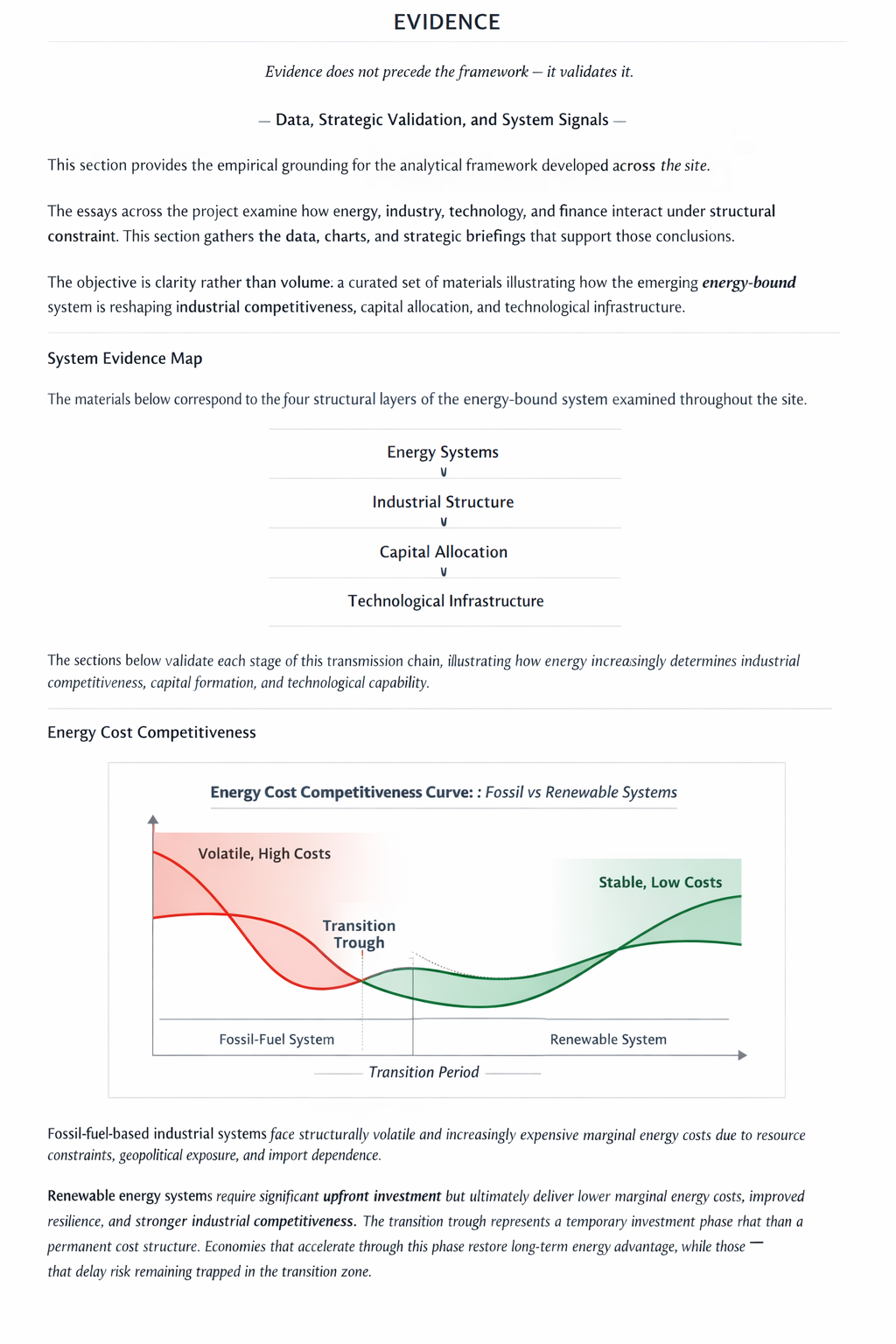
Energy Cost Competitiveness
Energy Cost Competitiveness Curve
Fossil vs Renewable Systems
Industrial systems based on fossil fuels increasingly face volatile and structurally rising marginal energy costs, driven by resource constraints, geopolitical exposure, and import dependence.
Renewable energy systems require substantial upfront investment, but once deployed they provide:
- structurally lower marginal energy costs
- greater energy security
- improved industrial competitiveness
- stronger long-term system resilience
The transition trough represents a temporary investment phase rather than a permanent cost structure.
Economies that accelerate through this phase regain long-term energy
advantage.
Those that delay risk remaining trapped in a high-cost
industrial equilibrium.
For investors, this dynamic increasingly determines:
- industrial margin stability
- capital formation
- long-term return potential
Strategic System Signals
The analyses below highlight the structural shift emerging across Europe’s energy, industrial, and financial systems.
These materials provide a macro-interpretation layer grounded in empirical evidence, bridging data and strategic positioning.
- Europe at a Strategic Tipping Point — Brief
- Europe at a Strategic Tipping Point — Extended Analysis
- INTERNAL Comparative EU–US Structural Resilience
Energy System Evidence
Energy remains the upstream constraint shaping economic and strategic outcomes.
The materials below provide the empirical foundation underlying the energy analysis developed across the site.
- Energy System Data Companion
- EU Energy Exposure — Sovereignty Data Companion
- EU–US Structural Resilience Matrix
- Charts and Visual Data
Together these materials provide the empirical layer supporting the system analysis developed across the site.
Monetary Transmission and Structural Constraint
Energy shocks increasingly propagate through monetary and financial channels.
The materials below examine how energy costs influence:
- inflation dynamics
- sovereign risk
- fiscal capacity
- monetary policy space
- Monetary Sovereignty in an Energy-Bound Europe
- Monetary Energy-Bound Europe — Policy Brief
- Monetary Transmission Annex
- Monetary Ceiling — Greece
These materials illustrate how energy constraint propagates through currency stability, sovereign risk, and monetary policy capacity.
Capital Allocation and System Capacity
Energy constraints increasingly influence industrial investment patterns, infrastructure deployment, and long-term system capacity.
- Investor Reframing](../4_Investor_Reframing/spa.md)
- Investor Structural Note
- Investor Structural Energy Cost — Long Horizon
- [Investor Reframing: System Returns Europe]
These materials translate empirical patterns into:
- allocation framing
- valuation context
- long-term positioning logic
Regional Structural Evidence
Energy constraint produces uneven regional effects across Europe and the Mediterranean.
The following case studies examine how these dynamics interact with regional industrial structure and strategic positioning.
Strategic Orientation
The materials assembled in this section illustrate a consistent structural pattern:
Energy systems increasingly determine:
- industrial competitiveness
- capital formation
- technological capability
- monetary stability
For investors, this implies a structural shift:
- energy is no longer a sectoral variable
- it is a primary driver of industrial margins and capital allocation
→ and increasingly, the foundation of long-term returns
Suggested Strategic Reading
Core Essays on this Site
Strategic Context
- Vaclav Smil — Energy and Civilization
- Daniel Yergin — The New Map
- International Energy Agency — Energy Investment and Transition Reports
- International Monetary Fund — Energy Price Transmission Studies
Annex — Research Foundations & Reference Architecture
Methodological Note
The following institutional reports, datasets, strategic analyses, and industrial research publications informed the development of the analytical frameworks presented throughout this research programme.
These sources do not represent a single interpretive position. Rather, they form part of a broader systems synthesis examining the relationship between energy systems, industrial competitiveness, compute infrastructure, capital formation, technological sovereignty, and geopolitical restructuring in an energy-bound global order.
The references below support the validation and evidence architecture underlying the broader analytical framework developed across the GLOBAL, TECHWAR, and EU SOVEREIGNTY sections of this platform.
Energy Systems, Electrification & Industrial Transformation
International Energy Agency (IEA)
World Energy Outlook (2022–2024 editions)
https://www.iea.org/reports/world-energy-outlook-2023Electricity 2024: Analysis and Forecast to 2026
https://www.iea.org/reports/electricity-2024Data Centres and Data Transmission Networks
https://www.iea.org/reports/data-centres-and-data-transmission-networksDigital Demand-Driven Electricity Systems
https://www.iea.org/reports/digital-demand-driven-electricity-systemsAfrica Energy Outlook (2022–2024 editions)
https://www.iea.org/reports/africa-energy-outlook-2022
International Renewable Energy Agency (IRENA)
World Energy Transitions Outlook 2023
https://www.irena.org/publications/2023/Jun/WETO-2023Innovation Outlook: Smart Grids
https://www.irena.org/publications/2019/Sep/Innovation-Outlook-Smart-GridsChina Renewable Energy Development
https://www.irena.org/china
Energy Data & Market Analysis
BP. Statistical Review of World Energy 2023
https://www.bp.com/en/global/corporate/energy-economics/statistical-review-of-world-energy.htmlEmber Climate. Global Electricity Review (2023–2024)
https://ember-climate.org/insights/research/global-electricity-review-2024/BloombergNEF. Energy & Manufacturing Outlooks
https://about.bnef.com
AI Infrastructure, Compute & Digital Sovereignty
AI Compute, Data Centres & Infrastructure
NVIDIA Research
https://www.nvidia.com/en-us/research/Stanford HAI — Human-Centered Artificial Intelligence
https://hai.stanford.eduMIT Technology Review — AI & Compute Research
https://www.technologyreview.com/topic/artificial-intelligence/McKinsey Global Institute — Generative AI & Economic Impact
https://www.mckinsey.com/capabilities/mckinsey-digital/our-insightsLawrence Berkeley National Laboratory — Data Centre Energy Research
https://eta.lbl.gov/publications
Cloud Infrastructure & Digital Sovereignty
European Commission — Europe’s Digital Decade
https://digital-strategy.ec.europa.eu/en/policies/europes-digital-decadeEuropean Commission — European Data Strategy
https://digital-strategy.ec.europa.eu/en/policies/data-strategyEuropean Union Artificial Intelligence Act (2024)
https://artificialintelligenceact.eu/GAIA-X Initiative
https://gaia-x.eu/Synergy Research Group — Global Cloud Market Share Reports
https://www.srgresearch.com/articles
Digital Governance & AI Regulation
OECD — Digital Governance & Data Sovereignty
https://www.oecd.org/digital/OECD AI Observatory
https://oecd.ai/World Economic Forum — Governing Smart Cities
https://www.weforum.org/reportsUN Habitat — Urban Digital Transformation Reports
https://unhabitat.org
China, Industrial Scale & Strategic Competition
China Energy & Industrial Transformation
CSIS — China’s Path to Carbon Neutrality
https://www.csis.org/analysis/chinas-path-carbon-neutralityIMF — China’s Green Transformation
https://www.imf.org/en/Publications/WP/Issues/2022/04/22/Chinas-Green-Transformation-517077BloombergNEF — China Market Outlooks
https://about.bnef.com
AI, Compute & Technology Competition
Center for Security and Emerging Technology (CSET)
China AI & Compute Ecosystem Reports
https://cset.georgetown.edu/publications/ITIF — Global Tech Leadership Index (2025)
https://itif.orgU.S. Congressional Research Service — Artificial Intelligence & National Security
https://crsreports.congress.govBrookings Institution — U.S.–China AI Competition
https://www.brookings.eduNCUSCR — U.S.–China Smart Cities Dialogue
https://www.ncuscr.org
Fourth Industrial Revolution, Industry & Supply Chains
Industrial Transformation & Manufacturing Systems
World Economic Forum — Fourth Industrial Revolution Reports
https://www.weforum.org/reports/OECD — Industrial Transformation & Automation
https://www.oecd.org/industry/ind/UNIDO — Smart Manufacturing & Industry 4.0
https://www.unido.org/our-focus-cross-cutting-services/advancing-economic-competitiveness/innovation-and-digitalizationMcKinsey — Smart Factories & Industrial AI
https://www.mckinsey.com/capabilities/operations/how-we-help-clients/smart-factory
Global Value Chains & Industrial Competitiveness
World Bank — Global Economic Prospects
https://www.worldbank.orgOECD — Productivity & Competitiveness Research
https://www.oecd.orgEuropean Investment Bank — Innovation & Green Transition Reports
https://www.eib.org/en/publicationsBruegel — European Industrial Policy & Competitiveness
https://www.bruegel.org
Decentralised Energy, Grid Modernisation & Resilience
Distributed Energy Systems & Grid Architecture
Rocky Mountain Institute (RMI) — Microgrids & Energy Resilience
https://rmi.org/insight/microgrids/National Renewable Energy Laboratory (NREL) — Distributed Energy Futures Study
https://www.nrel.gov/dees/distributed-energy-futures-study.htmlEuropean Commission Joint Research Centre (JRC) — Digital–Energy System Integration
https://joint-research-centre.ec.europa.euWorld Economic Forum — Future of Electricity
https://www.weforum.org
Development, Electrification & Inclusive Growth
World Bank — Energy for Development Reports
https://www.worldbank.org/en/topic/energy/publicationUNDP — Decentralised Renewable Energy & Inclusive Growth
https://www.undp.org/publications
Monetary Systems, Digital Currencies & Financial Infrastructure
Central Bank Digital Currencies & Monetary Architecture
Bank for International Settlements (BIS) — CBDC Research Hub
https://www.bis.org/cbdc/BIS — Project mBridge
https://www.bis.org/publ/othp44.htmEuropean Central Bank — Digital Euro Documentation
https://www.ecb.europa.eu/paym/digital_euro/html/index.en.htmlU.S. Federal Reserve — Digital Assets & Financial Stability
https://www.federalreserve.gov/supervisionreg/fintech.htmIMF — Fintech, Crypto & Capital Flows
https://www.imf.org/en/Topics/fintechOECD — Blockchain Policy & Governance
https://www.oecd.org/digital/blockchain/Atlantic Council — CBDC Tracker
https://www.atlanticcouncil.org/cbdctracker/
Geopolitics, Fragmentation & Strategic Autonomy
Global Fragmentation & Systemic Transition
IMF — Geopolitics & Global Economic Fragmentation
https://www.imf.org/en/Topics/geopoliticsEuropean External Action Service (EEAS) — Strategic Foresight Reports
https://www.eeas.europa.euEuropean Commission — Strategic Foresight Reports
https://commission.europa.eu/strategy-and-policy/strategic-planning/strategic-foresight/strategic-foresight-reports_enChatham House — Future of Multilateralism
https://www.chathamhouse.orgUN DESA — Population & Urbanisation Trends
https://www.un.org/development/desa
Europe, Competitiveness & Sovereignty
European Industrial Capacity & Strategic Autonomy
European Court of Auditors — EU Industrial Strategy Assessment
https://www.eca.europa.euCEPS — Europe in a Multipolar System
https://www.ceps.euEurostat — SME Contribution to GDP & Employment
https://ec.europa.eu/eurostatJRC — Europe’s Innovation & Skills Landscape
https://joint-research-centre.ec.europa.euMcKinsey — The Future of Europe’s Industrial Base
https://www.mckinsey.comEuropean Parliament Research Service — Strategic Autonomy
https://epthinktank.eu
Internal Analytical Frameworks
The following internally developed frameworks structure the broader analytical synthesis presented throughout this platform:
Energy-Bound System
Energy Transition J-Curve
Infrastructure Currency Doctrine
System Stack Architecture
Energy–Industry–Compute Hierarchy
Energy–Compute–Capital–Sovereignty Framework
AI–Energy–Cost Chasm
Systems Sovereignty Framework
Mediterranean Conversion Framework
Industrial Ecosystem Density Framework
Compute Locality Doctrine
Security Architecture as System Enforcement
Research Architecture
This research programme is organised across interconnected analytical layers:
Doctrine
Structural frameworks defining the operating logic of the system.Foundational Analysis
Long-form strategic essays explaining systemic transformation.Evidence & Validation
Data companions, transmission chains, industrial mappings, and structural comparisons.Investor & Allocation Layer
Infrastructure, industrial, and sovereignty-oriented investment implications.
Together, these layers form an integrated framework for analysing power, infrastructure, sovereignty, and strategic transformation in an energy-bound global order.