Europe’s Energy Paradigm Shift and the Politics of Regeneration
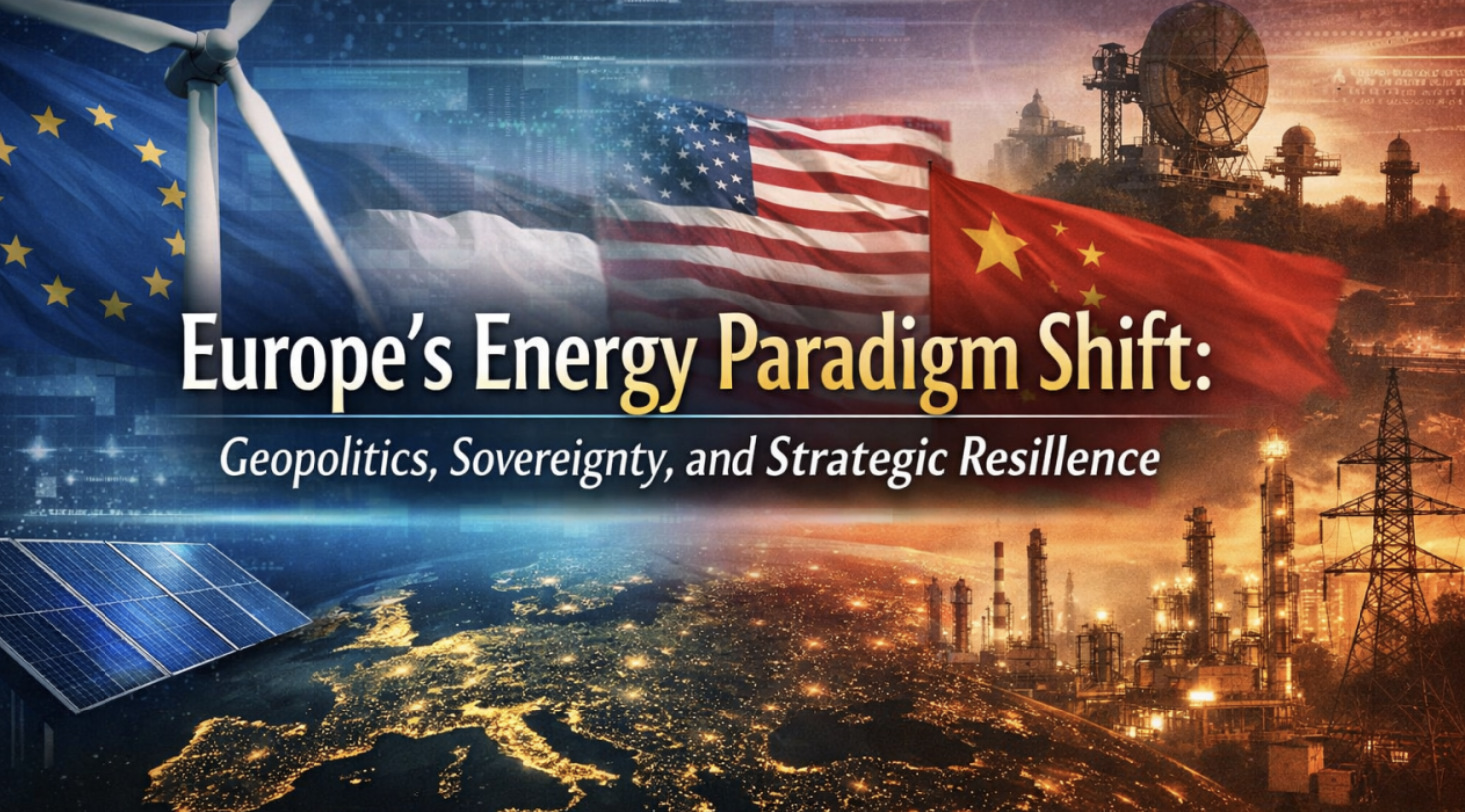
This article extends the European Sovereignty series by examining how structural energy constraint translates into political economy design. It shifts the focus from diagnosis to regeneration.
Europe’s energy debate is often reduced to a set of immediate pressures: price volatility, climate targets, dependence on external suppliers. These are real constraints, but they are not the whole story. Beneath them lies a deeper question about how economic power is organised, where value is created, and who exercises control over critical systems.
Seen in this light, the shift toward decentralised, digitally enabled energy systems is not simply an energy transition. It is a structural transformation comparable to the rise of the Internet, with implications for Europe’s economic model, democratic legitimacy, and long-term sovereignty.
From centralisation to coordination: a political economy shift
For much of the post-war period, Europe’s energy systems evolved toward centralisation. Large-scale generation, long transmission networks, and cross-border financing delivered efficiency under stable conditions. But they also produced distance—between production and consumption, between decision-makers and citizens, and between economic activity and local economies.
That distance is now politically and economically costly. It exposes Europe to external price shocks, supply disruptions, and geopolitical leverage. It also reinforces a sense of powerlessness, as essential infrastructures appear remote, opaque, and beyond democratic influence.
Decentralised energy challenges this model. Enabled by digital coordination, it allows energy to be produced closer to demand and managed as a system rather than traded purely as a commodity. This is not a return to small-scale autarky, but a shift toward coordination over centralisation—a model better suited to complexity, volatility, and constraint.
The sovereignty debate beyond slogans
Energy sovereignty is often framed as a question of self-sufficiency. That framing is misleading. Sovereignty in an interdependent world is not about doing everything domestically, but about retaining control over critical functions.
This is where the common argument that China “monopolises renewables” obscures more than it reveals. China dominates the manufacturing of solar panels, wind turbines, and batteries. But decentralised energy systems increasingly derive value from system integration, software-defined control, grid orchestration, aggregation, and data—layers that are shaped by regulation, standards, and institutional design.
China itself understands this. Its investments in smart grids and digital energy platforms reflect an awareness that hardware dominance alone does not guarantee system control. Europe’s strategic opportunity lies not in replicating China’s manufacturing scale, but in anchoring value in coordination, services, and governance close to demand.
Democracy and the economy of proximity
Europe’s democratic strain cannot be separated from its economic geography. Over time, economic activity has become more abstract and distant, while infrastructures that shape daily life have grown less visible and less accountable.
Decentralised energy reintroduces proximity into the political economy. Investment flows toward regions rather than bypassing them. Jobs emerge in installation, maintenance, system operation, and digital services. Citizens encounter energy not only as a bill, but as a system that is locally present and intelligible.
This does not automatically democratise energy. But it alters the conditions under which democratic accountability can operate. Economies organised around visible, place-based services are easier to contest, regulate, and govern than those organised around distant assets and opaque financial structures.
Regeneration through regional ecosystems
One of Europe’s persistent challenges is not a lack of innovation, but a failure to embed innovation in regional ecosystems. In contrast, East Asia’s rise was built on dense clusters of specialised firms, skills, and institutions that evolved together over time.
Decentralised energy is inherently compatible with this logic. Its value chain—installation, operations, storage management, software integration, grid services—is local by nature. These activities cluster, specialise, and deepen capabilities at regional level.
Importantly, this model privileges domestic and regional demand before export orientation. Stable internal markets allow firms to learn, reduce costs, and mature. For Europe, this represents a path toward regeneration that is not dependent on external demand or foreign-currency-denominated inputs.
SMEs, aggregation, and the reality of investment
Critics often argue that decentralised energy is unrealistic because it relies on small and medium-sized enterprises that lack capital and scale. This critique identifies a real constraint but misunderstands the model.
Decentralised energy does not scale through isolated SMEs acting alone. It scales through aggregation—the pooling of assets, demand, data, and finance into coordinated systems. SMEs provide local services; platforms and intermediaries provide scale and risk management.
This is how mature networked sectors operate, from telecommunications to cloud computing. The economic opportunity lies not in owning individual assets, but in operating and coordinating systems.
For investors, the shift is equally significant. Value increasingly accrues through services—reliability, flexibility, balancing, optimisation—rather than through energy sales alone. These revenues may be less spectacular, but they are more stable in a volatile world.
The US–China–EU triangle: three energy logics, one contested system
The emerging energy order is best understood through a US–China–EU triangle, in which each pole approaches energy through a distinct strategic logic. The United States treats energy primarily as a tool of market power and geopolitical leverage, combining large-scale domestic production with financial dominance, sanctions capacity, and control over key technologies and platforms. China, by contrast, has pursued energy as an industrial and infrastructural project, embedding renewables, grids, and digital control systems within a state-coordinated strategy aimed at long-term system control and technological upgrading.
The European Union occupies a more constrained position. It lacks the United States’ financial and security instruments and China’s scale-driven industrial coordination, yet it operates the world’s most complex regulatory and market architecture. Decentralised energy offers the EU a way to convert this apparent weakness into a strategic asset: by shaping standards, aggregation models, and system governance, Europe can exercise influence through architecture rather than dominance, reducing dependence on both US financial power and Chinese industrial scale without attempting to replicate either.
Energy as the connective tissue of defence, finance, and technology
In an era of systemic rivalry, energy can no longer be treated as a standalone sector. It is increasingly the connective tissue linking defence, finance, and technology. Energy systems determine military readiness and logistical resilience; they shape exposure to sanctions, currency volatility, and external financing; and they define the platforms on which digital control, data, and automation operate.
Decentralised energy, when properly governed, reduces single points of failure across all three domains. It limits the strategic leverage created by concentrated infrastructure, lowers reliance on foreign-currency energy imports and external capital markets, and embeds digital capabilities within domestically governed systems rather than proprietary black boxes. In this sense, energy policy becomes defence policy by other means, financial policy by other instruments, and technology policy through system design rather than industrial fiat.
For Europe, the choice is not between markets and security, or openness and sovereignty. It is between remaining structurally exposed across energy, finance, and technology—or deliberately reshaping the architecture that links them. Decentralised energy is not a guarantee of strategic autonomy, but without it, autonomy in any of these domains becomes increasingly difficult to sustain.
Energy resilience and NATO’s defence readiness
For NATO, energy resilience is no longer a logistical afterthought but a core component of defence readiness. Modern military operations, deterrence, and crisis response depend on uninterrupted power for bases, communications, transport, and civilian infrastructure that supports mobilisation. Highly centralised energy systems create strategic chokepoints that can be disrupted through cyber operations, sabotage, or political pressure well below the threshold of armed conflict. Decentralised, digitally coordinated energy systems—microgrids, distributed generation, and local storage—reduce these vulnerabilities by ensuring continuity of power even under stress. In this sense, decentralised energy strengthens collective defence not by militarising infrastructure, but by making societies and supply systems harder to coerce, disrupt, or destabilise in the grey zone between peace and war.
A question of political choice
Europe’s energy transition is often treated as a technical or regulatory exercise. In reality, it is a choice about economic structure, democratic resilience, and strategic autonomy.
Decentralised energy will not deliver its benefits automatically. It requires governance frameworks that enable aggregation, prioritise interoperability, and focus on system performance rather than symbolic targets. But if Europe succeeds, it gains more than cleaner energy. It gains a pathway to regeneration rooted in regions, a democracy reinforced by proximity, and a form of sovereignty suited to an interdependent age.
As with the Internet, the question is not whether this paradigm shift will occur, but who shapes it—and in whose interests.
Further Reading
Energy as Europe’s Strategic Constraint (EU_SOV)
On why electrification tightens the structural ceiling.Energy and the Base Layer of Constraint (GLOBAL)
On the structural energy-power equation shaping global systems.Energy Sovereignty as System Control (EU_SOV — Doctrine) On why integration, not ownership, determines power.
Industrial Power in the Age of AI (EU_SOV)
On why competitiveness now depends on stable electricity.