Industrial Power in the Age of AI: Why Energy Determines Europe’s Competitiveness
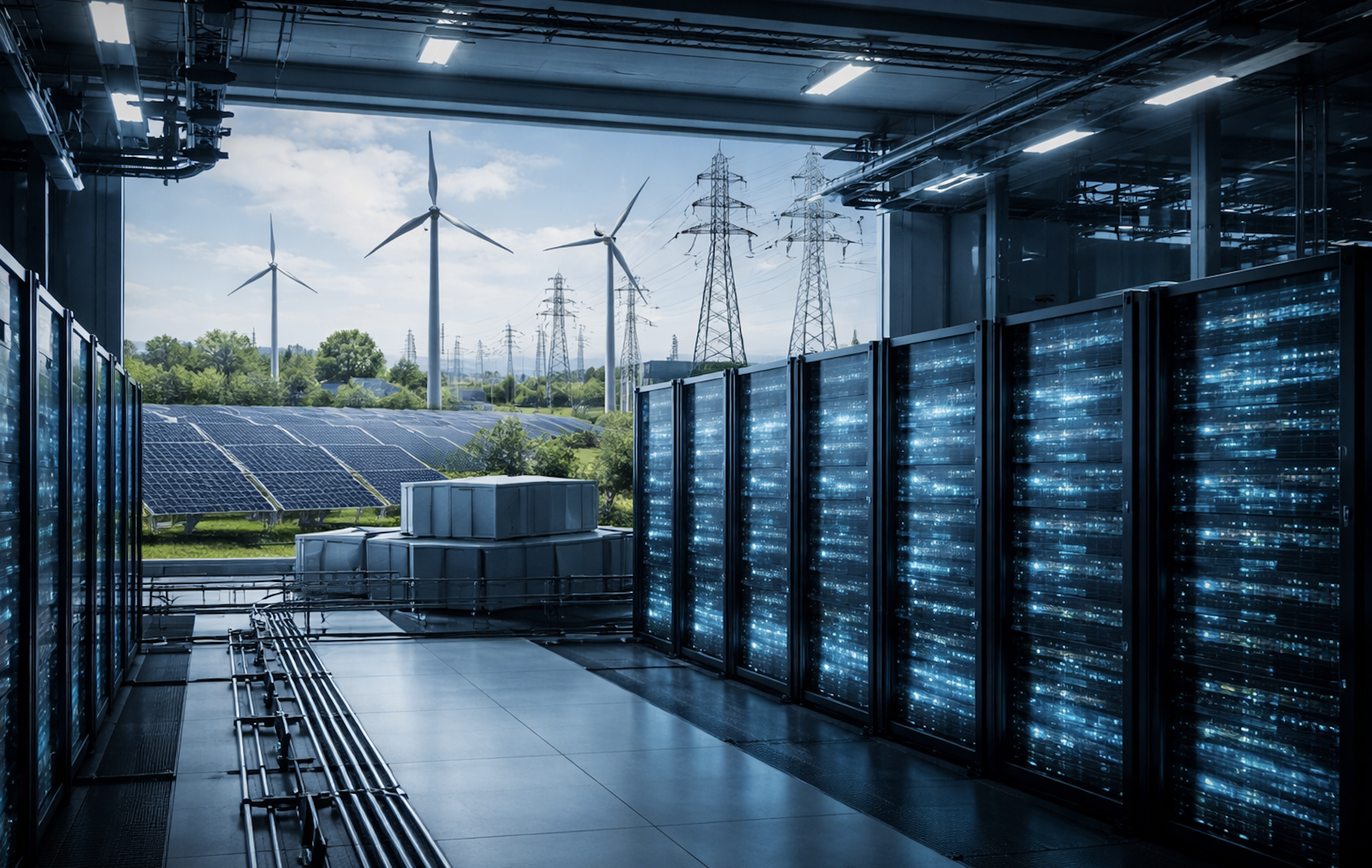
Having established energy autonomy as the core constraint on sovereignty, this article examines how industrial power and AI translate that constraint into competitiveness.
Artificial intelligence is often described as a digital revolution. In reality, it is a material one. AI does not exist in the abstract: it is embedded in factories, logistics systems, data centres, and physical infrastructure that all depend on reliable and affordable energy.
For Europe, this has a clear implication. Industrial competitiveness in the age of AI is no longer a question of innovation alone, but of whether the underlying energy system can sustain electrified, automated production at scale. In this sense, industrial competitiveness in the age of AI is not an economic objective alone, but a condition of sovereignty as defined at the outset of this series.
AI Is an Industrial System, Not a Digital Abstraction
AI systems consume electricity at scale. Training large models, operating data centres, running edge-compute networks, and integrating AI into industrial processes all require continuous, reliable power. Automation, robotics, and advanced manufacturing amplify this demand further.
The Fourth Industrial Revolution is therefore not only digital—it is electric.
Unlike previous waves of innovation, AI does not dematerialise production. It intensifies it. Compute replaces labour in some areas, but it adds new layers of infrastructure, hardware, cooling, networks, and redundancy. Every gain in intelligence carries an energy cost.
For regions with abundant, affordable, and stable electricity, this creates a competitive advantage. For those without it, AI remains theoretical rather than transformative.
Energy as the Binding Constraint on Industrial Competitiveness
Europe’s industrial challenge in the AI era is not primarily a lack of talent, ideas, or regulation. It is a question of system compatibility.
AI-driven industry requires:
- predictable electricity prices
- high grid reliability
- local capacity for peak demand
- resilience against external shocks
Where energy is volatile, expensive, or geopolitically exposed, industrial deployment slows. Investment decisions are delayed. Scale is constrained. Over time, competitiveness erodes.
This is why energy must be treated as a binding constraint, not a background variable. Industrial strategy that ignores energy realities risks becoming aspirational rather than operational.
Decarbonised Energy as the Enabler of AI-Driven Industry
For Europe, the link between AI and decarbonisation is structural.
Electrified industry built on imported fossil fuels inherits their volatility and dependence. Prices are externally set. Supply chains are exposed. Long-term cost predictability is weak. Under these conditions, AI-intensive industrial systems struggle to scale sustainably.
Decarbonised energy systems—renewables, storage, electrification, and where applicable nuclear—change this equation. Once deployed, they provide:
- greater price stability
- reduced exposure to geopolitical disruption
- compatibility with digital optimisation
This is why decarbonisation should not be framed as a trade-off against competitiveness. In the European context, it is the enabler of AI-driven industrial power.
Decarbonisation aligns energy supply with the demands of an electrified, automated economy. It is the system design that allows AI to move from pilot projects to industrial backbone.
Decentralisation, Edge Computing, and Industrial Resilience
The architecture of AI-driven industry is increasingly decentralised. Edge computing brings intelligence closer to machines, factories, and logistics nodes. This reduces latency, increases resilience, and allows real-time optimisation.
Energy systems must mirror this structure.
Decentralised energy—local generation, storage, and digitally managed grids—supports:
- resilient production
- reduced downtime
- flexibility under stress
- faster adaptation to demand shifts
The same technologies that enable industrial AI also enable sophisticated energy management. AI does not merely consume electricity; it optimises energy systems, balancing supply and demand, managing loads, and improving efficiency.
This convergence creates a powerful feedback loop:
- decentralised energy supports industrial AI
- industrial AI improves energy system performance
Together, they form a resilient industrial ecosystem rather than a brittle, centralised one. AI only becomes a general-purpose technology when energy and compute are accessible beyond large incumbents; without decentralised systems, the Fourth Industrial Revolution concentrates rather than transforms.
SMEs, Automation, and the New Industrial Base
Europe’s industrial fabric is dominated by small and medium-sized enterprises. For these firms, AI adoption is not about frontier models or hyperscale data centres. It is about automation, predictive maintenance, quality control, logistics, and efficiency.
Energy stability is critical here.
Decentralised, decarbonised energy systems can provide SMEs with:
- cost predictability
- partial control over supply
- reduced exposure to price shocks
- new service ecosystems
When combined with accessible AI tools and automation, this allows SMEs to modernise without becoming dependent on external platforms or volatile energy markets.
In this sense, decentralised energy is not only a technical choice, but a competitiveness and resilience strategy for Europe’s SME-based economy.
Industrial Power as a Condition of Sovereignty
AI capability without industrial capacity does not produce sovereignty. It produces dependence.
Industrial power determines:
- the ability to scale technologies
- resilience under crisis
- control over supply chains
- credibility in alliances
For Europe, rebuilding industrial power in the AI era depends on aligning three systems:
- Electrified, decarbonised energy
- AI-enabled industrial processes
- Decentralised, resilient infrastructure
If these systems are misaligned, competitiveness declines regardless of regulatory ambition or research excellence.
Conclusion: Energy First, Industry Follows
In the age of AI, industrial power flows from energy systems that are stable, predictable, and under domestic control. For Europe, competitiveness cannot be separated from the design of its energy transition. Electrified, decarbonised, and decentralised energy is not an environmental add-on to industrial strategy—it is the condition that makes industrial renewal possible. Without it, AI leadership remains fragile and sovereignty incomplete.
References
OECD
Industrial Policy for the Digital Age
https://www.oecd.org/industry/industrial-policy/
European Commission
A New Industrial Strategy for Europe
McKinsey Global Institute
The Economic Potential of Generative AI
https://www.mckinsey.com/mgi/our-research/the-economic-potential-of-generative-ai
International Monetary Fund
AI and the Future of Work
https://www.imf.org/en/Blogs/Articles/2024/01/14/ai-and-the-future-of-work
Bruegel
Europe’s Competitiveness and Scale Problem
https://www.bruegel.org/analysis/european-competitiveness
[DIV]100
#EnergySecurity #IndustrialPolicy #ArtificialIntelligence #Competitiveness #EuropeanEconomy